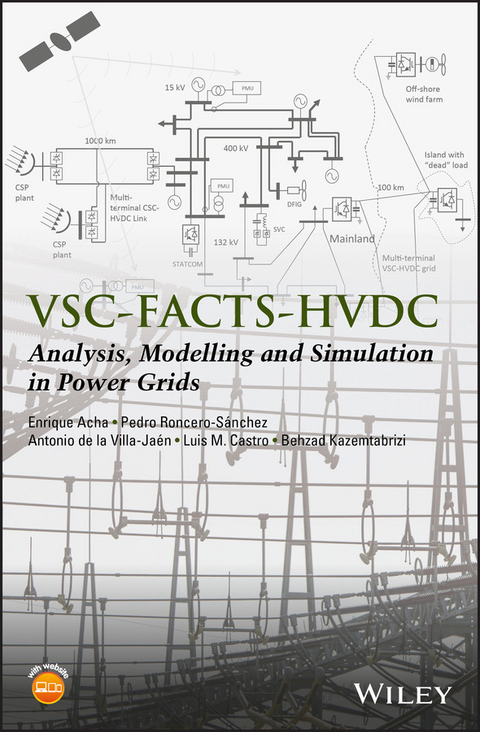
VSC-FACTS-HVDC (eBook)
John Wiley & Sons (Verlag)
978-1-118-96584-9 (ISBN)
An authoritative reference on the new generation of VSC-FACTS and VSC-HVDC systems and their applicability within current and future power systems
VSC-FACTS-HVDC and PMU: Analysis, Modelling and Simulation in Power Grids provides comprehensive coverage of VSC-FACTS and VSC-HVDC systems within the context of high-voltage Smart Grids modelling and simulation. Readers are presented with an examination of the advanced computer modelling of the VSC-FACTS and VSC-HVDC systems for steady-state, optimal solutions, state estimation and transient stability analyses, including numerous case studies for the reader to gain hands-on experience in the use of models and concepts.
Key features:
An essential guide for utility engineers, academics, and research students as well as industry managers, engineers in equipment design and manufacturing, and consultants. |
Professor Enrique Acha, Department of Electronics and Electrical Engineering, University of Glasgow, UK Professor Acha has worked for twenty five years in the area of electrical power systems. He has authored/co-authored over 150 research papers and three books. In 2004 he joined the Planning Department of the Mexican national utility, educating over sixty planning utility engineers on power electronics (FACTS) applications to high-voltage transmission and distributed, renewable generation. He worked on a proof-of-concept for a 600 km-long HVDC transmission line.
Dr Pedro Roncero-Sánchez, Department of Electronics, Electrical Engineering and Control Systems, University of Castilla-La Mancha, Spain Dr Roncero-Sánchezis presently carrying out collaborative research with the Institute of Photovoltaic Systems: 'Study and Development of Control and Power-Quality-Improvement Techniques in Concentrated Photovoltaic Systems', supported by the Council of Castilla-La Mancha, and 'Sigmasoles'. He is an active contributor of the research project for the integration of electrical vehicles in smart grids ENERGOSHe carried out post-doctoral research at the University of Glasgow, Scotland from June 2006 to December 2007.
Dr Antonio de la Villa Jaén, Department of Electrical Engineering, University of Seville, Spain Dr de la Villa Jaén became an Assistant Professor at the University of Seville after acting as a visiting researcher at the Department of Electronics and Electrical Engineering at the University of Glasgow in 2007. He has authored over 20 research papers.
Luis M. Castro, Tampere University of Technology, Finland
Mr Behzad Kazemtabrizi, Research Fellow, University of Glasgow, UK Mr Kazemtabrizi's research interests are in the general area of power system modelling, analysis and simulation, where he has developed advanced models of HVDC-VSC systems and FACTS-VSC controllers aimed at optimal power flow solutions.
An authoritative reference on the new generation of VSC-FACTS and VSC-HVDC systems and their applicability within current and future power systems VSC-FACTS-HVDC and PMU: Analysis, Modelling and Simulation in Power Grids provides comprehensive coverage of VSC-FACTS and VSC-HVDC systems within the context of high-voltage Smart Grids modelling and simulation. Readers are presented with an examination of the advanced computer modelling of the VSC-FACTS and VSC-HVDC systems for steady-state, optimal solutions, state estimation and transient stability analyses, including numerous case studies for the reader to gain hands-on experience in the use of models and concepts. Key features: Wide-ranging treatment of the VSC achieved by assessing basic operating principles, topology structures, control algorithms and utility-level applications. Detailed advanced models of VSC-FACTS and VSC-HVDC equipment, suitable for a wide range of power network-wide studies, such as power flows, optimal power flows, state estimation and dynamic simulations. Contains numerous case studies and practical examples, including cases of multi-terminal VSC-HVDC systems. Includes a companion website featuring MATLAB software and Power System Computer Aided Design (PSCAD) scripts which are provided to enable the reader to gain hands-on experience. Detailed coverage of electromagnetic transient studies of VSC-FACTS and VSC-HVDC systems using the de-facto industry standard PSCAD/EMTDC simulation package. An essential guide for utility engineers, academics, and research students as well as industry managers, engineers in equipment design and manufacturing, and consultants.
Professor Enrique Acha, Laboratory of Electrical Energy Engineering, Tampere University of Technology, Finland Dr Pedro Roncero-ánchez, Department of Electronics, Electrical Engineering and Control Systems, University of Castilla-La Mancha, Spain Dr Antonio de la Villa-Jaén, Department of Electrical Engineering, University of Seville, Spain Dr Luis M. Castro, Faculty of Engineering, National University of Mexico (UNAM), Mexico City, Mexico Dr Behzad Kazemtabrizi, School of Engineering, Durham University, UK
Preface
Electrical power transmission using high voltage direct current () is a well‐established practice. There is common agreement that the world's first commercial HVDC link was the Gotland link, built in 1954, designed to carry undersea power from the east coast of Sweden to the Island of Gotland, some 90 km away. The original design was rated at 20 MW, 100 kV and used mercury‐arc valve converters. Its power and voltage ratings were increased in 1970 to 30 MW and 150 kV, respectively. Solid‐state electronic valves were used for the first time in the upgrade, with the new type of valve, termed silicon‐controlled rectifier () or thyristor, being connected in series with the mercury‐arc valves. This kind of HVDC link, and ancillary technology, has been magnificently described in earlier treatises by Adamson and Hingorani, Kimbark, Uhlmann and Arrillaga.
By the turn of the second millennium, there had been 56 HVDC links of various topologies and capacities built around the world: 22 in North and South America, 14 in Europe, 2 in Africa and 18 in Australasia. They ranged from the small, 25 MW, Corsica tapping of the Sardinia–Italy HVDC link to the large, 6300 MW HVDC link, a part of the awesome Itaipu hydro‐electric development on the Brazil–Paraguay border. At the time, three other large capacity HVDC links were at the planning/construction stage in China, to transport hydro‐electric power from the Three Gorges to the east and southeast of the country, each spanning distances of around 1000 km, rated at 3000 MW – the Three Gorges is a gigantic hydro resource in central China, with an estimated power capacity of 22 MW. Heretofore all the HVDC links in the world had employed either mercury‐arc rectifier or thyristor bridges and phase control to enable the rectification/inversion process. These converters are said to be line commutated and when applied to HVDC transmission are termed LCC‐HVDC converters. The LCC‐HVDC technology has continued its upward trend and five other high‐power, high‐voltage, long‐distance DC links have been built in China since 2010. The most recent LCC‐HVDC in operation was commissioned in 2012; it is the Jinping‐Sunan link in East China, rated at 7200 MW and ±800 kV, spanning a distance of 2100 km.
In LCC‐HVDC systems the current is unidirectional, flowing from the rectifier to the inverter stations. Such a fundamental physical constraint in thyristor‐based converters limits applicability to the following HVDC system topologies: point‐to‐point, back‐to‐back and radial, multi‐terminal links. In this context, the conventional, or classical, HVDC transmission technology is not a meshed grid maker; rather, its role has been to interconnect AC systems where an AC interconnection is deemed too expensive or technically infeasible.
However, one has to bear in mind that nowadays, in many situations, robust AC interconnections may be achieved more economically using one or more of the options afforded by the Flexible Alternating Current Transmission Systems () technology, an array of power electronics‐based equipment and control methods which became commercially available in around 1990. It is widely acknowledged that N.G. Hingorani and L. Gyugyi stand out prominently as the intellectual driving force behind the development of the FACTS technology.
The main aim of the FACTS technology is to enable almost instantaneous control of the nodal voltages and power flows in the vicinity of where the FACTS equipment has been installed. We should not forget that power flows over an AC line can be manipulated very effectively by controlling the line impedance, or the phase angles, or the voltages, or a combination of these parameters up to the thermal rating of the equipment. A key element of the FACTS technology is the so‐called static compensator (), which, in the parlance of a power electronics engineer, is a voltage source converter () and serves the purpose of injecting/absorbing reactive power to enable tight voltage magnitude regulation at its point of connection with the AC power grid. The advent of the STATCOM in the mid‐1990s was made possible by the development of power semiconductor valves with forced turn‐off capabilities, like the gate turn‐off () first and the insulated gate bi‐polar transistor () soon afterwards. GTOs are like thyristors, which can be turned on by a positive gate pulse when the anode–cathode voltage is positive, and, unlike thyristors, can be turned off by a negative gate pulse. This turn‐off feature led to new circuit concepts and methods such as self‐commutated, pulse‐width‐modulated, soft‐switching, voltage‐driven and multi‐level converters. These circuits may be made to operate at higher internal switching frequencies than the fundamental level, at several hundreds of hertz, which, in turn, reduces low‐order harmonics and allows operation at unity and leading power factors. This contrasts sharply with what can be achieved with the normal thyristors.
Advances in the design of the power GTO and its applications in Japan and the USA continued apace by virtue of strategic collaborative R&D projects funded by utilities, manufacturers and governments. In Japan there was a target to develop 300 MW GTO converters for back‐to‐back HVDC interconnections, while in the USA a 100 MVAR GTO‐STATCOM was commissioned in 1996 for the Tennessee Valley Authority. Meanwhile, similar efforts were conducted in Europe in the design of the power IGBT. It is reported that on 10 March 1997, power was first transmitted between Hellsjön and Grängesberg in central Sweden using an HVDC link employing IGBT converters driven by pulse‐width‐modulation () control. The link is 10 km long, rated at 3 MW, 10 kV and is used to test new components for HVDC.
In spite of the great many technical advantages and operational flexibility of the VSC compared with the thyristor bridge, the GTO‐based converters did not make inroads into HVDC applications because of the much higher power losses and cost of GTOs compared with thyristors. A further reason is that the ratings of GTOs are low compared with those of thyristors. All this conspired to make VSC‐HVDC installations expensive. The impasse was broken with the use of IGBT valves, which exhibit lower switching losses than GTO valves, and decreasing manufacturing costs. Three years after the commissioning of the Hellsjön‐Grängesberg, four other VSC‐HVDC links had been commissioned in very distant parts of the world: a 50 MVA DC link in the emblematic Island of Gotland to evacuate wind power, an 8 MVA DC link in West Denmark to link an offshore wind farm, the 180 MVA Directlink or Terranora project in Australia for power export from New South Wales into Southern Queensland, and a 36 MVA DC link for system interconnection on the Mexican–Texan border. The undersea Estlink 1, linking the Estonian and Finnish power grids, was commissioned in 2006, rated at 350 MW and using VSC stations. Intriguingly, the Estlink 2, rated at 650 MW and commissioned in 2014, uses the classical thyristor‐converter technology.
It should be noted that all the VSC stations used in HVDC projects until 2010 had been of the so‐called two‐ and three‐level power converters. In around 2008, a new breed of VSCs was introduced into the market, the modular multilevel converters (s), which switch at low frequencies, yield minimum harmonic production and have power losses just above those of the classical thyristor‐based HVDC converters. Equally important is the fact that it has been possible to increase the capacity of VSC‐HVDC links using MMC, by a very considerable margin, say 1000 MW per circuit, such as in the INELFE DC link between Baixas, France, and Santa Llogaia, Spain. Two identical circuits make up for a transmission capacity of 2000 MW. The link was commissioned at the end of 2013. Note that this application comes into the realm of bulk power transmission and is already eating into the niche area of classical thyristor‐based HVDC technology, namely asynchronous bulk power transmission, an area until recently thought to be unassailable. The Trans Bay Cable link was the first MMC VSC‐HVDC, commissioned in 2010, transmitting up to 400 MW of power from Pittsburg in the East Bay to Potrero Hill in the centre of San Francisco, California.
Furthermore, there are new application areas in which VSC‐HVDC transmission does not seem to have a competitor in sight – the connection of wind sites lying more than 70 km away from the shore is one of the most obvious applications, but there are a few others. For instance, the connection of microgrids with insufficient local generation and little or no inertia (inertia‐less power grids), the electricity supply of oil and gas rigs in deep waters, the infeed of densely populated urban centres with power grids already experiencing high short‐circuit ratios. Moreover, the unassailable characteristic of the HVDC transmission using the VSC technology is that it is a natural enabler of meshed DC power grids, with such a high level of operational...
| Erscheint lt. Verlag | 4.4.2019 |
|---|---|
| Sprache | englisch |
| Themenwelt | Technik ► Elektrotechnik / Energietechnik |
| Schlagworte | Computer Science • Electrical & Electronics Engineering • Elektrotechnik u. Elektronik • Energie • Energietechnik • Energy • FACTS • Grid & Cloud Computing • Grid- u. Cloud-Computing • Informatik • Leistungselektronik • <p>VSC-HVDC • OPF • PMU • Power Electronics • Power flows • Power system dynamics</p> • Power Technology & Power Engineering • PSCAD • Smart Grids • State Estimation |
| ISBN-10 | 1-118-96584-1 / 1118965841 |
| ISBN-13 | 978-1-118-96584-9 / 9781118965849 |
| Informationen gemäß Produktsicherheitsverordnung (GPSR) | |
| Haben Sie eine Frage zum Produkt? |
 EPUB (Adobe DRM)
Kopierschutz: Adobe-DRM
Adobe-DRM ist ein Kopierschutz, der das eBook vor Mißbrauch schützen soll. Dabei wird das eBook bereits beim Download auf Ihre persönliche Adobe-ID autorisiert. Lesen können Sie das eBook dann nur auf den Geräten, welche ebenfalls auf Ihre Adobe-ID registriert sind.
Details zum Adobe-DRM
Dateiformat: EPUB (Electronic Publication)
EPUB ist ein offener Standard für eBooks und eignet sich besonders zur Darstellung von Belletristik und Sachbüchern. Der Fließtext wird dynamisch an die Display- und Schriftgröße angepasst. Auch für mobile Lesegeräte ist EPUB daher gut geeignet.
Systemvoraussetzungen:
PC/Mac: Mit einem PC oder Mac können Sie dieses eBook lesen. Sie benötigen eine
eReader: Dieses eBook kann mit (fast) allen eBook-Readern gelesen werden. Mit dem amazon-Kindle ist es aber nicht kompatibel.
Smartphone/Tablet: Egal ob Apple oder Android, dieses eBook können Sie lesen. Sie benötigen eine
Geräteliste und zusätzliche Hinweise
Buying eBooks from abroad
For tax law reasons we can sell eBooks just within Germany and Switzerland. Regrettably we cannot fulfill eBook-orders from other countries.
aus dem Bereich