


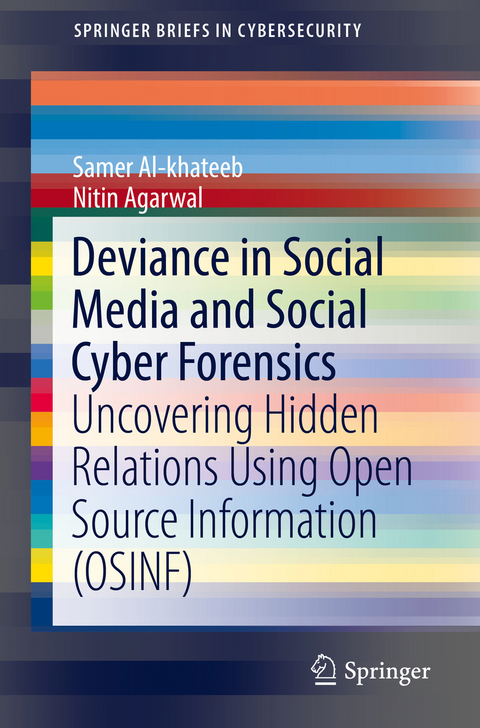
Deviance in Social Media and Social Cyber Forensics (eBook)
101 Seiten
Springer International Publishing (Verlag)
978-3-030-13690-1 (ISBN)
This book describes the methodologies and tools used to conduct social cyber forensic analysis. By applying these methodologies and tools on various events observed in the case studies contained within, their effectiveness is highlighted. They blend computational social network analysis and cyber forensic concepts and tools in order to identify and study information competitors.
Through cyber forensic analysis, metadata associated with propaganda-riddled websites are extracted. This metadata assists in extracting social network information such as friends and followers along with communication network information such as networks depicting flows of information among the actors such as tweets, replies, retweets, mentions, and hyperlinks. Through computational social network analysis, the authors identify influential actors and powerful groups coordinating the disinformation campaign. A blended social cyber forensic approach allows them to study cross-media affiliations of the information competitors. For instance, narratives are framed on blogs and YouTube videos, and then Twitter and Reddit, for instance, will be used to disseminate the message. Social cyber forensic methodologies enable researchers to study the role of modern information and communication technologies (ICTs) in the evolution of information campaign and coordination.
In addition to the concepts and methodologies pertaining to social cyber forensics, this book also offers a collection of resources for readers including several datasets that were collected during case studies, up-to-date reference and literature surveys in the domain, and a suite of tools that students, researchers, and practitioners alike can utilize. Most importantly, the book demands a dialogue between information science researchers, public affairs officers, and policy makers to prepare our society to deal with the lawless 'wild west' of modern social information systems triggering debates and studies on cyber diplomacy.
Samer Al-khateeb is an Assistant Professor at the Department of Journalism, Media and Computing, College of Arts and Sciences, at Creighton University and a former Postdoctorate Research Fellow at the Collaboratorium for Social Media and Online Behavioral Studies (COSMOS) at the University of Arkansas at Little Rock (UA-Little Rock). He obtained his Ph.D. in Computer and Information Sciences, a master's degree in Applied Science, and a bachelor's degree in Computer Science form UA-Little Rock. He studies deviant acts (e.g., deviant cyber flash mobs and cyber propaganda campaigns) on social media that are conducted by deviant groups (e.g., Daesh, Black-hat hackers, and Propagandist) which aim to influence individual's behaviors and provoke hysteria among citizens. He also studies the type of actors these deviant groups use to perform their acts, i.e., are they human (e.g., Internet trolls) or automated actors (e.g., social bots) by leveraging social science theories (e.g., the theory of collective action), social network analysis (e.g., centralities and community detection algorithms), and social cyber forensics (e.g., metadata collection to uncover the hidden relations among these actors across platforms). He has many publications including book chapters, journal papers (e.g., Journal of Defence Strategic Communications; Journal of Digital Forensics, Security, and Law; Journal of Baltic Security; and the IARIA International Journal on Advances in Internet Technology), conferences proceedings, and conferences presentations. He won various awards such as the Staff Achievement Award for Educational Achievements, Excellence in Research Award, Outstanding Graduating Student Award (Master's Level), Who's Who Among Students in American Universities and Colleges, the Best Paper Award, 2nd Place Most Innovative Award, and 2nd Place Societal Impact Award, among others.
Dr. Nitin Agarwal is the Jerry L. Maulden-Entergy Endowed Chair and Distinguished Professor of Information Science at University of Arkansas at Little Rock. He is the founding director of the Collaboratorium for Social Media and Online Behavioral Studies (COSMOS) at UA Little Rock. His research aims to push the boundaries of our understanding of cyber social behaviors that emerge and evolve constantly in the modern information and communication platforms with applications in defense and security, health, business and marketing, finance, and education. At COSMOS, he is leading projects funded by over $10 million from an array of federal agencies including U.S. National Science Foundation, Office of Naval Research, Army Research Office, Air Force Research Lab, Defense Advanced Research Projects Agency, Department of State, and plays a significant role in the long-term partnership between UA Little Rock and the Department of Homeland Security. He developed publicly available social media mining tools, viz., Blogtrackers, YouTubeTracker, and Focal Structure Analysis used by NATO Strategic Communications and public affairs, among others. Dr. Agarwal participates in the national Tech Innovation Hub launched by the U.S. Department of State to defeat foreign based propaganda.
Dr. Agarwal's research contributions lie at the intersection of social computing, behavior-cultural modeling, collective action, social-cyber forensics, AI, data mining, and machine learning. From Saudi Arabian women's right to drive cyber campaigns to Autism awareness campaigns to ISIS' and anti-West/anti-NATO disinformation campaigns, at COSMOS, he is directing several projects that have made foundational and applicational contributions to social and computational sciences. He has published 8 books and over 150 articles in top-tier peer-reviewed forums with several best paper awards and nominations. Dr. Agarwal obtained Ph.D. from Arizona State University with outstanding dissertation recognition in 2009. He was recognized as one of 'The New Influentials: 20 In Their 20s' by Arkansas Business in 2012. He was recognized with the University-wide Faculty Excellence Award in Research and Creative Endeavors by UALR in 2015. Dr. Agarwal received the Social Media Educator of the Year Award at the 21st International Education and Technology Conference in 2015. In 2017 the Arkansas Times featured Dr. Agarwal in their special issue on 'Visionary Arkansans: A Celebration of Arkansans with ideas and achievements of transformative power.' Dr. Agarwal was nominated as International Academy, Research and Industry Association (IARIA) Fellow in 2017, Arkansas Academy of Computing (AAoC) Fellow in 2018, and Arkansas Research Alliance (ARA) Fellow in 2018.Samer Al-khateeb is an Assistant Professor at the Department of Journalism, Media and Computing, College of Arts and Sciences, at Creighton University and a former Postdoctorate Research Fellow at the Collaboratorium for Social Media and Online Behavioral Studies (COSMOS) at the University of Arkansas at Little Rock (UA-Little Rock). He obtained his Ph.D. in Computer and Information Sciences, a master’s degree in Applied Science, and a bachelor’s degree in Computer Science form UA-Little Rock. He studies deviant acts (e.g., deviant cyber flash mobs and cyber propaganda campaigns) on social media that are conducted by deviant groups (e.g., Daesh, Black-hat hackers, and Propagandist) which aim to influence individual’s behaviors and provoke hysteria among citizens. He also studies the type of actors these deviant groups use to perform their acts, i.e., are they human (e.g., Internet trolls) or automated actors (e.g., social bots) by leveraging social science theories (e.g., the theory of collective action), social network analysis (e.g., centralities and community detection algorithms), and social cyber forensics (e.g., metadata collection to uncover the hidden relations among these actors across platforms). He has many publications including book chapters, journal papers (e.g., Journal of Defence Strategic Communications; Journal of Digital Forensics, Security, and Law; Journal of Baltic Security; and the IARIA International Journal on Advances in Internet Technology), conferences proceedings, and conferences presentations. He won various awards such as the Staff Achievement Award for Educational Achievements, Excellence in Research Award, Outstanding Graduating Student Award (Master's Level), Who’s Who Among Students in American Universities and Colleges, the Best Paper Award, 2nd Place Most Innovative Award, and 2nd Place Societal Impact Award, among others. Dr. Nitin Agarwal is the Jerry L. Maulden-Entergy Endowed Chair and Distinguished Professor of Information Science at University of Arkansas at Little Rock. He is the founding director of the Collaboratorium for Social Media and Online Behavioral Studies (COSMOS) at UA Little Rock. His research aims to push the boundaries of our understanding of cyber social behaviors that emerge and evolve constantly in the modern information and communication platforms with applications in defense and security, health, business and marketing, finance, and education. At COSMOS, he is leading projects funded by over $10 million from an array of federal agencies including U.S. National Science Foundation, Office of Naval Research, Army Research Office, Air Force Research Lab, Defense Advanced Research Projects Agency, Department of State, and plays a significant role in the long-term partnership between UA Little Rock and the Department of Homeland Security. He developed publicly available social media mining tools, viz., Blogtrackers, YouTubeTracker, and Focal Structure Analysis used by NATO Strategic Communications and public affairs, among others. Dr. Agarwal participates in the national Tech Innovation Hub launched by the U.S. Department of State to defeat foreign based propaganda. Dr. Agarwal’s research contributions lie at the intersection of social computing, behavior-cultural modeling, collective action, social-cyber forensics, AI, data mining, and machine learning. From Saudi Arabian women's right to drive cyber campaigns to Autism awareness campaigns to ISIS' and anti-West/anti-NATO disinformation campaigns, at COSMOS, he is directing several projects that have made foundational and applicational contributions to social and computational sciences. He has published 8 books and over 150 articles in top-tier peer-reviewed forums with several best paper awards and nominations. Dr. Agarwal obtained Ph.D. from Arizona State University with outstanding dissertation recognition in 2009. He was recognized as one of 'The New Influentials: 20 In Their 20s' by Arkansas Business in 2012. He was recognized with the University-wide Faculty Excellence Award in Research and Creative Endeavors by UALR in 2015. Dr. Agarwal received the Social Media Educator of the Year Award at the 21st International Education and Technology Conference in 2015. In 2017 the Arkansas Times featured Dr. Agarwal in their special issue on "Visionary Arkansans: A Celebration of Arkansans with ideas and achievements of transformative power." Dr. Agarwal was nominated as International Academy, Research and Industry Association (IARIA) Fellow in 2017, Arkansas Academy of Computing (AAoC) Fellow in 2018, and Arkansas Research Alliance (ARA) Fellow in 2018.
Foreword 7
Preface 8
Acknowledgments 9
Contents 10
About the Authors 12
Acronyms 14
List of Figures 16
1 Deviance in Social Media 19
1.1 Introduction 19
1.2 Literature on Online Deviant Behaviors 21
1.2.1 Online Deviant Groups 22
1.2.1.1 Islamic State of Iraq and the Levant/Syria (ISIL) (ISIS) (Daesh) 22
1.2.1.2 Anti-NATO Propagandist 24
1.2.1.3 Deviant Hackers Networks (DHNs) 24
1.2.1.4 Internet Trolls 26
1.2.2 Online Deviant Events 26
1.2.3 Online Deviant Tactics 29
1.3 Leveraging the Theory of Collective Action to Study DCFMs 31
1.3.1 The Case of DCFM-Success 34
1.3.2 The Case of DCFM-Failure 35
1.3.3 Conceptual Framework 35
1.3.4 A CFM Scenario 37
References 40
2 Social Network Measures and Analysis 45
2.1 Basics of Graph Theory 45
2.1.1 Graph Data Structures 49
2.1.1.1 List Structure 49
2.1.1.2 Matrix Structure 49
2.2 Fundamentals of Social Network Analysis (SNA) 50
2.2.1 Centrality Measures 52
2.2.2 Triadic Closure and Clustering Coefficient 54
2.2.3 Modularity 56
2.2.4 Influential Blogs and Influential Bloggers 57
2.2.5 Focal Structures Analysis (FSA) 59
References 61
3 Tools and Methodologies for Data Collection, Analysis, and Visualization 63
3.1 TouchGraph SEO Browser 63
3.2 Twitter Archiving Google Sheet (TAGS) and TAGSExplorer 65
3.3 Network Overview, Discovery, and Exploration for Excel(NodeXL) 66
3.4 Gephi 66
3.5 CytoScape 69
3.6 Linguistic Inquiry and Word Count (LIWC) 69
3.7 Organizational Risk Analyzer (ORA) NetScenes 71
3.8 IBM Watson Analytics 73
3.9 Web Content Extractor (WCE) 75
3.10 Blogtrackers 76
3.11 YouTubeTracker 78
3.12 Botometer 79
3.13 Reaper: Social Media Scraping Tool 80
References 82
4 Social Cyber Forensics (SCF): Uncovering Hidden Relationships 84
4.1 Social Cyber Forensics Analysis (SCF) Using Maltego 84
4.2 Methodologies to Extract Open Source Information 88
4.2.1 Finding Related Websites From Web TrackerCode (WTC) 88
4.2.2 Finding Blog Sites From Twitter Handles 89
4.2.3 Inferring the Ownership or Hidden Connections Among Different Websites 90
4.3 Hands-On Exercises 90
4.3.1 Exercise A 90
4.3.2 Exercise B 92
4.3.3 Exercise C 92
References 93
5 Case Studies of Deviance in Social Media 95
5.1 Introduction 95
5.2 Case Study 1: Propaganda During the 2014 Crimean WaterCrisis 98
5.3 Case Study 2: Anti-NATO Propaganda During the 2015 Trident Juncture Exercise 100
5.4 Case Study 3: Anti-NATO Propaganda During the 2015 Dragoon Ride Exercise 103
5.5 Case Study 4: ISIS Beheading Propaganda in 2015 105
References 108
Glossary 111
Index 112
| Erscheint lt. Verlag | 1.4.2019 |
|---|---|
| Reihe/Serie | SpringerBriefs in Cybersecurity | SpringerBriefs in Cybersecurity |
| Zusatzinfo | XXI, 101 p. 39 illus. |
| Verlagsort | Cham |
| Sprache | englisch |
| Themenwelt | Mathematik / Informatik ► Informatik ► Datenbanken |
| Sozialwissenschaften ► Politik / Verwaltung | |
| Technik | |
| Schlagworte | Computational Social Sciences • cyber forensics (Maltego) • cyber propaganda campaigns • Daesh online presence • deviant groups or behaviors • Information Warfare • online misinformation campaign • strategic communications |
| ISBN-10 | 3-030-13690-6 / 3030136906 |
| ISBN-13 | 978-3-030-13690-1 / 9783030136901 |
| Informationen gemäß Produktsicherheitsverordnung (GPSR) | |
| Haben Sie eine Frage zum Produkt? |
 PDF (Wasserzeichen)
DRM: Digitales Wasserzeichen
Dieses eBook enthält ein digitales Wasserzeichen und ist damit für Sie personalisiert. Bei einer missbräuchlichen Weitergabe des eBooks an Dritte ist eine Rückverfolgung an die Quelle möglich.
Dateiformat: PDF (Portable Document Format)
Mit einem festen Seitenlayout eignet sich die PDF besonders für Fachbücher mit Spalten, Tabellen und Abbildungen. Eine PDF kann auf fast allen Geräten angezeigt werden, ist aber für kleine Displays (Smartphone, eReader) nur eingeschränkt geeignet.
Systemvoraussetzungen:
PC/Mac: Mit einem PC oder Mac können Sie dieses eBook lesen. Sie benötigen dafür einen PDF-Viewer - z.B. den Adobe Reader oder Adobe Digital Editions.
eReader: Dieses eBook kann mit (fast) allen eBook-Readern gelesen werden. Mit dem amazon-Kindle ist es aber nicht kompatibel.
Smartphone/Tablet: Egal ob Apple oder Android, dieses eBook können Sie lesen. Sie benötigen dafür einen PDF-Viewer - z.B. die kostenlose Adobe Digital Editions-App.
Buying eBooks from abroad
For tax law reasons we can sell eBooks just within Germany and Switzerland. Regrettably we cannot fulfill eBook-orders from other countries.
aus dem Bereich


