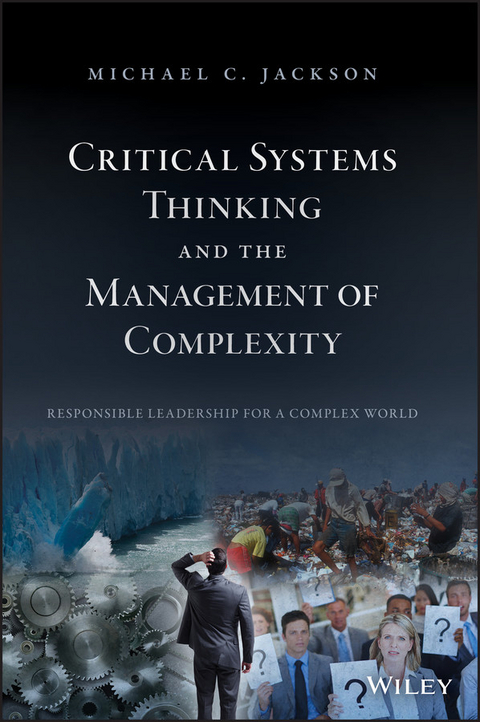
Critical Systems Thinking and the Management of Complexity (eBook)
John Wiley & Sons (Verlag)
978-1-119-11839-8 (ISBN)
The world has become increasingly networked and unpredictable. Decision makers at all levels are required to manage the consequences of complexity every day. They must deal with problems that arise unexpectedly, generate uncertainty, are characterised by interconnectivity, and spread across traditional boundaries. Simple solutions to complex problems are usually inadequate and risk exacerbating the original issues.
Leaders of international bodies such as the UN, OECD, UNESCO and WHO - and of major business, public sector, charitable, and professional organizations - have all declared that systems thinking is an essential leadership skill for managing the complexity of the economic, social and environmental issues that confront decision makers. Systems thinking must be implemented more generally, and on a wider scale, to address these issues.
An evaluation of different systems methodologies suggests that they concentrate on different aspects of complexity. To be in the best position to deal with complexity, decision makers must understand the strengths and weaknesses of the various approaches and learn how to employ them in combination. This is called critical systems thinking. Making use of over 25 case studies, the book offers an account of the development of systems thinking and of major efforts to apply the approach in real-world interventions. Further, it encourages the widespread use of critical systems practice as a means of ensuring responsible leadership in a complex world.
Comments on a previous version of the book:
Russ Ackoff: 'the book is the best overview of the field I have seen'
JP van Gigch: 'Jackson does a masterful job. The book is lucid ...well written and eminently readable'
Professional Manager (Journal of the Chartered Management Institute): 'Provides an excellent guide and introduction to systems thinking for students of management'
MICHAEL C. JACKSON is Emeritus Professor at the University of Hull, editor- in-chief of Systems Research and Behavioral Science, and MD of Systems Research Ltd. He graduated from Oxford University, gained an MA from Lancaster University and a PhD from Hull, and has worked in the civil service, in academia and as a consultant. Between 1999 and 2011, Mike was Dean of Hull University Business School, leading it to triple-crown accreditation. Mike has been President of the International Federation for Systems Research and the International Society for the Systems Sciences. He is a Companion of the Association of Business Schools, a Chartered IT Professional, and a Fellow of the British Computer Society, the Cybernetics Society, the Chartered Management Institute, the Operational Research Society and the International Academy for Systems and Cybernetic Sciences. Mike has received many awards, two honorary degrees, and has been a visiting professor at numerous international universities. In 2011 he was awarded an OBE for services to higher education and business. In 2017 he received the Beale Medal of the UK Operational Research Society for 'a sustained contribution over many years to the theory, practice, or philosophy of Operational Research.' The previous version of this book Systems Thinking: Creative Holism for Managers was translated into four languages.
From the winner of the INCOSE Pioneer Award 2022The world has become increasingly networked and unpredictable. Decision makers at all levels are required to manage the consequences of complexity every day. They must deal with problems that arise unexpectedly, generate uncertainty, are characterised by interconnectivity, and spread across traditional boundaries. Simple solutions to complex problems are usually inadequate and risk exacerbating the original issues. Leaders of international bodies such as the UN, OECD, UNESCO and WHO and of major business, public sector, charitable, and professional organizations have all declared that systems thinking is an essential leadership skill for managing the complexity of the economic, social and environmental issues that confront decision makers. Systems thinking must be implemented more generally, and on a wider scale, to address these issues. An evaluation of different systems methodologies suggests that they concentrate on different aspects of complexity. To be in the best position to deal with complexity, decision makers must understand the strengths and weaknesses of the various approaches and learn how to employ them in combination. This is called critical systems thinking. Making use of over 25 case studies, the book offers an account of the development of systems thinking and of major efforts to apply the approach in real-world interventions. Further, it encourages the widespread use of critical systems practice as a means of ensuring responsible leadership in a complex world.The INCOSE Pioneer Award is presented to someone who, by their achievements in the engineering of systems, has contributed uniquely to major products or outcomes enhancing society or meeting its needs. The criteria may apply to a single outstanding outcome or a lifetime of significant achievements in effecting successful systems. Comments on a previous version of the book: Russ Ackoff: the book is the best overview of the field I have seen JP van Gigch: Jackson does a masterful job. The book is lucid ...well written and eminently readable Professional Manager (Journal of the Chartered Management Institute): Provides an excellent guide and introduction to systems thinking for students of management
MICHAEL C. JACKSON is Emeritus Professor at the University of Hull, editor- in-chief of Systems Research and Behavioral Science, and MD of Systems Research Ltd. He graduated from Oxford University, gained an MA from Lancaster University and a PhD from Hull, and has worked in the civil service, in academia and as a consultant. Between 1999 and 2011, Mike was Dean of Hull University Business School, leading it to triple-crown accreditation. Mike has been President of the International Federation for Systems Research and the International Society for the Systems Sciences. He is a Companion of the Association of Business Schools, a Chartered IT Professional, and a Fellow of the British Computer Society, the Cybernetics Society, the Chartered Management Institute, the Operational Research Society and the International Academy for Systems and Cybernetic Sciences. Mike has received many awards, two honorary degrees, and has been a visiting professor at numerous international universities. In 2011 he was awarded an OBE for services to higher education and business. In 2017 he received the Beale Medal of the UK Operational Research Society for 'a sustained contribution over many years to the theory, practice, or philosophy of Operational Research.' The previous version of this book Systems Thinking: Creative Holism for Managers was translated into four languages.
Preface
There is a considerable debate about how to describe the modern world. Alternatives include the following: a global village, postindustrial society, consumer society, media society, network society, risk society, late capitalism, high modernity, postmodernity, liquid modernity, and the information age. To some, the new names just signal the rapid acceleration of changes in society that started to emerge between the sixteenth and eighteenth centuries. To others, we have crossed a threshold and entered a completely new era. What no one doubts is that things have become much more complex. We are entangled in complexity.
An IBM survey of more than 1500 Chief Executive Officers worldwide states:
The world's private and public sector leaders believe that a rapid escalation of ‘complexity’ is the biggest challenge confronting them. They expect it to continue – indeed, to accelerate – in the coming years.(2010)
An OECD report begins:
Complexity is a core feature of most policy issues today; their components are interrelated in multiple, hard‐to‐define ways. Yet governments are ill‐equipped to deal with complex problems.(2017)
At the global level, economic, social, technological, and ecological systems have become interconnected in unprecedented ways, and the consequences are immense. We face a growing set of apparently intractable problems, including the nuclear threat; continual warfare; terrorism; climate change; difficulties in securing energy, food, and water supplies; pollution; environmental degradation; species extinction; automation; inequality; poverty; and exclusion. Attempts to provide solutions to these ills only seem to make matters worse. Unpredictable “black swan” events (Taleb 2007), like the fall of the Soviet Union, 9/11, and the financial crisis, have become frequent and have widespread impact. On top of this, there are fewer shared values that help tame complexity by guaranteeing consensus. At the more local level, leaders and managers, whether operating in the private, public, or voluntary sectors, are plagued by interconnectivity and volatility and are uncertain about how to act. They have to ensure that objectives are met and that processes are efficient. They also have to struggle with complex new technologies and constantly innovate to keep ahead of the competition and/or do more with less. They have to deal with increased risk. Talented employees have to be attracted, retained, and inspired, and the enterprise's stock of knowledge captured and distributed so that it can learn faster than its rivals. This requires transformational leadership and the putting in place of flexible, networked structures. Changes in the law and in social expectations require managers to respond positively to different stakeholder demands and to monitor the impact of their organization's activities. They have to manage diversity and act with integrity.
Various authors have sought to summarize what they see as the key features of the complex world in which we live. Boulton et al. (2015, p. 36) provide some valuable generalizations, seeing it as:
- Systemic and synergistic: interconnected and resulting from many causes that interact together in complex ways
- Multiscalar: with interactions across many levels
- Having variety, diversity, variation, and fluctuations that can give rise to both resilience and adaptability
- Path‐dependent: contingent on the local context, and on the sequence of what happens
- Changing episodically: sometimes demonstrating resilience, at other times “tipping” into new regimes
- Possessing more than one future: the future is unknowable
- Capable of self‐organizing and self‐regulating and, in some circumstances, giving rise to novel, emergent features
Warfield (2002) sets out 20 “laws of complexity,” emphasizing that 70% of these result from the nature of human beings. For him, it is our cognitive limitations, dysfunctional group and organizational behavior, differences of perception (“spreadthink”), and the conflict we engage in that have to be overcome if we are to get to grips with complexity.
Whether complexity arises from systems or from people, decision‐makers are finding that the problems they face rarely present themselves individually as, for example, production, marketing, human resource, or finance problems. They come intertwined as sets of problems that are better described as “messes” (Ackoff 1999a). Once they are examined, they expand to involve more and more issues and stakeholders. Rittel and Webber (1981) call them “wicked problems” and argue that they possess these characteristics:
- Difficult to formulate
- It is never clear when a solution has been reached
- They don't have true or false solutions, only good or bad according to the perspective taken
- A solution will have long drawn out consequences that need to be taken into account in evaluating it
- An attempted solution will change a wicked problem so it is difficult to learn from trial and error
- There will always be untried solutions that might have been better
- All wicked problems are essentially unique; there are no classes of wicked problems to which similar solutions can be applied
- They have multiple, interdependent causes
- There are lots of explanations for any wicked problem depending on point of view
- Solutions have consequences for which the decision‐makers have responsibility
Summarizing, they describe the difficulties “wicked problems” cause decision‐makers as follows:
The planner who works with open systems is caught up in the ambiguity of their causal webs. Moreover, his would‐be solutions are confounded by a still further set of dilemmas posed by the growing pluralism of the contemporary publics, whose valuations of his proposals are judged against an array of different and contradicting scales.(Rittel and Webber 1981, p. 99)
What help can decision‐makers expect when tackling the “messes” and “wicked problems” that proliferate in this age of complexity? They are usually brought up on classical management theory that emphasizes the need to forecast, plan, organize, lead, and control. This approach relies on there being a predictable future environment in which it is possible to set goals that remain relevant into the foreseeable future; on enough stability to ensure that tasks arranged in a fixed hierarchy continue to deliver efficiency and effectiveness; on a passive and unified workforce; and on a capacity to take control action on the basis of clear measures of success. These assumptions do not hold in the modern world, and classical management theory provides the wrong prescriptions. This is widely recognized and has led to numerous alternative solutions being offered to business managers and other leaders, for example, lean, six sigma, business analytics, value chain analysis, total quality management, learning organizations, process reengineering, knowledge management, balanced scorecard, outsourcing, and enterprise architecture. Occasionally, they hit the mark or at least shake things up. It is sometimes better to do anything rather than nothing. Usually, however, they fail to bring the promised benefits and can even make things worse. They are simple, “quick‐fix” solutions that flounder in the face of interconnectedness, volatility, and uncertainty. They pander to the notion that there is one best solution in all circumstances and seek to reduce complex problems to the particular issues they can deal with. They concentrate on parts of the problem situation rather than on the whole, missing the crucial interactions between the parts. They fail to recognize that optimizing the performance of one part may have consequences elsewhere that are damaging for the whole. They often fail to consider an organization's interactions with its rapidly changing environment. Finally, they don't acknowledge the importance of multiple viewpoints and internal politics. Fundamentally, and in the terms used in this book, they are not systemic enough. In the absence of more thoroughly researched ways forward, however, managers are left to persevere with their favorite panacea in the face of ever diminishing returns or to turn to whatever new fad has hit the market.
This book proposes systems thinking as the only appropriate response to complexity. In systems thinking, the study of wholes, and their emergent properties, is put on an equal footing with the study of parts. The approach also insists that a wide variety of stakeholder perspectives is considered when engaging with problem situations. It has a long history, but it is only recently that it has become possible to recommend systems thinking to leaders and managers as the cornerstone of their practice. This is because the philosophy and theory have now been translated into useful and usable guidelines for action. It possesses a range of methodologies that can be used to confront different aspects of complexity according to the circumstances. In its most advanced form, the systems approach encourages the employment of a variety of methodologies in combination to manage “messes” and “wicked problems.” Critical systems practice informs this way of working and demonstrates how decision‐makers can achieve successful outcomes by becoming “multimethodological.”
...| Erscheint lt. Verlag | 15.3.2019 |
|---|---|
| Sprache | englisch |
| Themenwelt | Technik ► Elektrotechnik / Energietechnik |
| Wirtschaft ► Betriebswirtschaft / Management ► Unternehmensführung / Management | |
| Schlagworte | behavioral science management concepts • Betriebswirtschaft u. Operationsforschung • Business & Management • Business Systems • Critical Systems Thinking • cybernetic sciences • decision-making systems • Decision Sciences • holistic management • Management • Management Science/Operational Research • management systems thinking • operational research systems • Systems Research • Systems Sciences • Theorie der Entscheidungsfindung • Wirtschaft u. Management |
| ISBN-10 | 1-119-11839-5 / 1119118395 |
| ISBN-13 | 978-1-119-11839-8 / 9781119118398 |
| Informationen gemäß Produktsicherheitsverordnung (GPSR) | |
| Haben Sie eine Frage zum Produkt? |
 EPUB (Adobe DRM)
Kopierschutz: Adobe-DRM
Adobe-DRM ist ein Kopierschutz, der das eBook vor Mißbrauch schützen soll. Dabei wird das eBook bereits beim Download auf Ihre persönliche Adobe-ID autorisiert. Lesen können Sie das eBook dann nur auf den Geräten, welche ebenfalls auf Ihre Adobe-ID registriert sind.
Details zum Adobe-DRM
Dateiformat: EPUB (Electronic Publication)
EPUB ist ein offener Standard für eBooks und eignet sich besonders zur Darstellung von Belletristik und Sachbüchern. Der Fließtext wird dynamisch an die Display- und Schriftgröße angepasst. Auch für mobile Lesegeräte ist EPUB daher gut geeignet.
Systemvoraussetzungen:
PC/Mac: Mit einem PC oder Mac können Sie dieses eBook lesen. Sie benötigen eine
eReader: Dieses eBook kann mit (fast) allen eBook-Readern gelesen werden. Mit dem amazon-Kindle ist es aber nicht kompatibel.
Smartphone/Tablet: Egal ob Apple oder Android, dieses eBook können Sie lesen. Sie benötigen eine
Geräteliste und zusätzliche Hinweise
Buying eBooks from abroad
For tax law reasons we can sell eBooks just within Germany and Switzerland. Regrettably we cannot fulfill eBook-orders from other countries.
aus dem Bereich