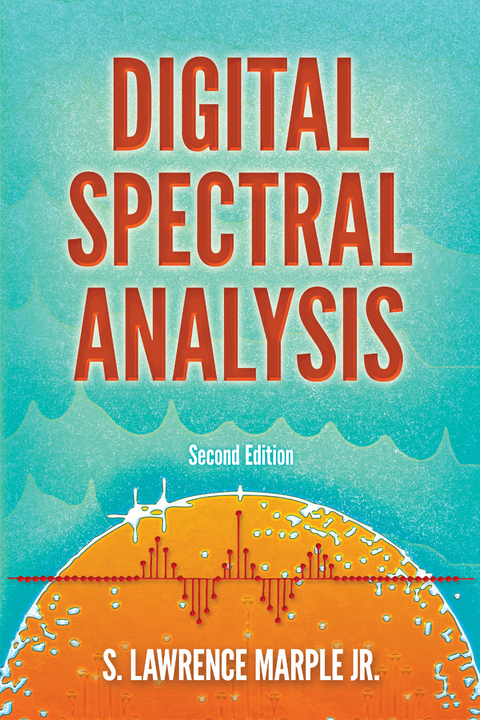
Digital Spectral Analysis (eBook)
432 Seiten
Dover Publications (Verlag)
978-0-486-83886-1 (ISBN)
Digital Spectral Analysis offers a broad perspective of spectral estimation techniques and their implementation. Coverage includes spectral estimation of discrete-time or discrete-space sequences derived by sampling continuous-time or continuous-space signals. The treatment emphasizes the behavior of each spectral estimator for short data records and provides over 40 techniques described and available as implemented MATLAB functions. In addition to summarizing classical spectral estimation, this text provides theoretical background and review material in linear systems, Fourier transforms, matrix algebra, random processes, and statistics. Topics include Prony's method, parametric methods, the minimum variance method, eigenanalysis-based estimators, multichannel methods, and two-dimensional methods. Suitable for advanced undergraduates and graduate students of electrical engineering — and for scientific use in the signal processing application community outside of universities — the treatment's prerequisites include some knowledge of discrete-time linear system and transform theory, introductory probability and statistics, and linear algebra. 1987 edition.
S. Lawrence Marple, Jr., is a Professor in the School of Electrical Engineering and Computer Science at Oregon State University.
CONTENTS NOTATIONAL CONVENTIONS GLOSSARY OF KEY SYMBOLS PREFACE 1 INTRODUCTION 1.1 Historical Perspective 1.2 Sunspot Numbers 1.3 A Test Case 1.4 Issues in Spectral Estimation 1.5 How to Use This Text References 2 REVIEW OF LINEAR SYSTEMS AND TRANSFORM THEORY 2.1 Introduction 2.2 Signal Notation 2.3 Continuous Linear Systems 2.4 Discrete Linear Systems 2.5 Continuous-Time Fourier Transform 2.6 Sampling and Windowing Operations 2.7 Relating the Continuous and Discrete Transforms 2.8 The Issue of Scaling for Power Determination 2.9 The Issue of Zero Padding 2.10 The Fast Fourier Transform 2.11 Resolution and the Time-Bandwidth Product 2.12 Extra: Source of Complex-Valued Signals 2.13 Extra: Wavenumber Processing with Linear Spatial Arrays References 3 REVIEW OF MATRIX ALGEBRA 3.1 Introduction 3.2 Matrix Algebra Basics 3.3 Special Vector and Matrix Structures 3.4 Matrix Inverse 3.5 Solution of Linear Equations 3.6 Overdetermined and Underdetermined Linear Equations 3.7 Solution of Overdetermined and Underdetermined Linear Equations 3.8 The Toeplitz Matrix 3.9 The Vandermonde Matrix References 4 REVIEW OF RANDOM PROCESS THEORY 4.1 Introduction 4.2 Probability and Random Variables 4.3 Random Processes 4.4 Substituting Time Averages for Ensemble Averages 4.5 Entropy Concepts 4.6 Limit Spectrum of Test Data 4.7 Extra: Bias and Variance of the Sample Spectrum References 5 CLASSICAL SPECTRAL ESTIMATION 5.1 Introduction 5.2 Summary 5.3 Windows 5.4 Resolution and the Stability-Time-Bandwidth Product 5.5 Autocorrelation and Cross Correlation Estimation 5.6 Correlogram Power Spectral Density (PSD) Estimators 5.7 Periodogram PSD Estimators 5.8 Combined Periodogram/Correlogram Estimators 5.9 Application to Sunspot Numbers 5.10 Conclusion References 6 PARAMETRIC MODELS OF RANDOM PROCESSES 6.1 Introduction 6.2 Summary 6.3 Autoregressive (AR), Moving Average (MA), and Autoregressive-Moving Average (ARMA) Random Process Models 6.4 Relationships Among AR, MA, and ARMA Process Parameters 6.5 Relationship of AR, MA, and ARMA Parameters to ACS 6.6 Spectral Factorization References 7 AUTOREGRESSIVE PROCESS AND SPECTRUM PROPERTIES 7.1 Introduction 7.2 Summary 7.3 Autoregressive Process Properties 7.4 Autoregressive Power Spectral Density Properties References 8 AR SPECTRAL ESTIMATION: BLOCK DATA ALGORITHMS 8.1 Introduction 8.2 Summary 8.3 Correlation Function Estimation Method 8.4 Reection Coecient Estimation Methods 8.5 Least Squares Linear Prediction Estimation Methods 8.6 Estimator Characteristics 8.7 Model Order Selection 8.8 Autoregressive Processes with Observation Noise 8.9 Application to Sunspot Numbers 8.10 Extra: Covariance Linear Prediction Fast Algorithm 8.11 Extra: Modi_ed Covariance Linear Prediction Fast Algorithm References 9 AR SPECTRAL ESTIMATION: SEQUENTIAL DATA ALGORITHMS 9.1 Introduction 9.2 Summary 9.3 Gradient Adaptive Autoregressive Methods 9.4 Recursive Least Squares (RLS) Autoregressive Methods 9.5 Fast Lattice Autoregressive Methods 9.6 Application to Sunspot Numbers 9.7 Extra: Fast RLS Algorithm for Recursive Linear Prediction References 10 ARMA AVERAGE SPECTRAL ESTIMATION 10.1 Introduction 10.2 Summary 10.3 Moving Average Parameter Estimation 10.4 Separate Autoregressive and Moving Average Parameter Estimation 10.5 Simultaneous Autoregressive and Moving Average Parameter Estimation 10.6 Sequential Approach to ARMA Estimation 10.7 A Special ARMA Process for Sinusoids in White Noise 10.8 Application to Sunspot Numbers References 11 PRONY'S METHOD 11.1 Introduction 11.2 Summary 11.3 Simultaneous Exponential Parameter Estimation 11.4 Original Prony Concept 11.5 Least Squares Prony Method 11.6 Modi_ed Least Squares Prony Method 11.7 Prony Spectrum 11.8 Accounting for Known Exponential Components 11.9 Identi_cation of Exponentials in Noise 11.10 Application to Sunspot Numbers 11.11 Extra: Fast Algorithm to Solve Symmetric Covariance Linear Equations References 12 MINIMUM VARIANCE SPECTRAL ESTIMATION 12.1 Introduction 12.2 Summary 12.3 Derivation of the Minimum Variance Spectral Estimator 12.4 Relationship of Minimum Variance and Autoregressive Spectral Estimators 12.5 Implementation of the Minimum Variance Spectral Estimator 12.6 Application to Sunspot Numbers References 13 EIGENANALYSIS-BASED FREQUENCY ESTIMATION 13.1 Introduction 13.2 Summary 13.3 Eigenanalysis of Autocorrelation Matrix for Sinusoids in White Noise 13.4 Eigenanalysis of Data Matrix for Exponentials in Noise 13.5 Signal Subspace Frequency Estimators 13.6 Noise Subspace Frequency Estimators 13.7 Order Selection References 14 SUMMARY OF SPECTRAL ESTIMATORS Synopsis Table References 15 MULTICHANNEL SPECTRAL ESTIMATION 15.1 Introduction 15.2 Summary 15.3 Multichannel Linear Systems Theory 15.4 Multichannel Random Process Theory 15.5 Multichannel Classical Spectral Estimators 15.6 Multichannel ARMA, AR, and MA Processes 15.7 Multichannel Yule-Walker Equations 15.8 Multichannel Levinson Algorithm 15.9 Multichannel Block Toeplitz Matrix Inverse 15.10 Multichannel Autoregressive Spectral Estimation 15.11 Autoregressive Order Selection 15.12 Experimental Comparison of Multichannel AR PSD Estimators 15.13 Multichannel Minimum Variance Spectral Estimation 15.14 Two Channel Spectral Analysis: Sunspot Numbers and Air Temperature References 16 TWO-DIMENSIONAL SPECTRAL ESTIMATION 16.1 Introduction 16.2 Summary 16.3 Two-Dimensional Linear Systems and Transform Theory 16.4 Two-Dimensional Random Process Theory 16.5 Classical 2-D Spectral Estimation 16.6 Modi_ed Classical 2-D Spectral Estimation 16.7 Two-Dimensional Autoregressive Spectral Estimation 16.8 Two-Dimensional Maximum Entropy Spectral Estimation 16.9 Two-Dimensional Minimum Variance Spectral Estimation Estimator References INDEX
| Erscheint lt. Verlag | 20.3.2019 |
|---|---|
| Reihe/Serie | Dover Books on Electrical Engineering |
| Sprache | englisch |
| Gewicht | 27 g |
| Themenwelt | Technik |
| Schlagworte | adaptive filtering • Autoregressive Techniques • Digital Spectral Analysis • digital techniques • fast algorithms • Fourier Transforms • Frequency Domain, 2 Dimensional Signal Processing • Frequency Domain Analysis, Two-Dimensional Signal Processing • High Resolution Spectrum • linear prediction • Linear Prediction Analysis • Multichannel • Multichannel Signal Analysis • signal analysis • Signal Processing • Signal Processing-Digital Techniques • Spectral Estimation • Spectral Estimation, High Resolution Spectrum • spectral theory |
| ISBN-10 | 0-486-83886-2 / 0486838862 |
| ISBN-13 | 978-0-486-83886-1 / 9780486838861 |
| Informationen gemäß Produktsicherheitsverordnung (GPSR) | |
| Haben Sie eine Frage zum Produkt? |
 EPUB (Adobe DRM)
Kopierschutz: Adobe-DRM
Adobe-DRM ist ein Kopierschutz, der das eBook vor Mißbrauch schützen soll. Dabei wird das eBook bereits beim Download auf Ihre persönliche Adobe-ID autorisiert. Lesen können Sie das eBook dann nur auf den Geräten, welche ebenfalls auf Ihre Adobe-ID registriert sind.
Details zum Adobe-DRM
Dateiformat: EPUB (Electronic Publication)
EPUB ist ein offener Standard für eBooks und eignet sich besonders zur Darstellung von Belletristik und Sachbüchern. Der Fließtext wird dynamisch an die Display- und Schriftgröße angepasst. Auch für mobile Lesegeräte ist EPUB daher gut geeignet.
Systemvoraussetzungen:
PC/Mac: Mit einem PC oder Mac können Sie dieses eBook lesen. Sie benötigen eine
eReader: Dieses eBook kann mit (fast) allen eBook-Readern gelesen werden. Mit dem amazon-Kindle ist es aber nicht kompatibel.
Smartphone/Tablet: Egal ob Apple oder Android, dieses eBook können Sie lesen. Sie benötigen eine
Geräteliste und zusätzliche Hinweise
Buying eBooks from abroad
For tax law reasons we can sell eBooks just within Germany and Switzerland. Regrettably we cannot fulfill eBook-orders from other countries.
aus dem Bereich