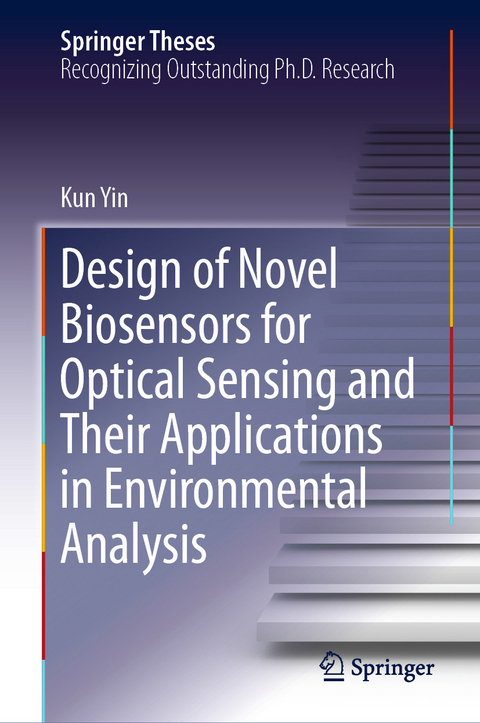
Design of Novel Biosensors for Optical Sensing and Their Applications in Environmental Analysis (eBook)
XV, 94 Seiten
Springer Singapore (Verlag)
978-981-13-6488-4 (ISBN)
This book introduces readers to the development of novel optical biosensors for environmental analysis. Environmental pollution has now become a serious problem, which threatens the health of human beings. Traditional analytical methods have a number of drawbacks, such as the need for professional operators and complicated instruments. After millions of years of evolution, biomolecules can perform various functions with good accuracy and efficiency due to their unique structures, offering a viable alternative to traditional methods.
This work focuses on using new biological sensing strategies, e.g. those based on special biomaterials, bio-reactions or living cells, to establish novel biosensors. As these biosensors offer satisfactory optical response performance, they can be used to transform the recognition behavior of specific targets into optical signals and effectively detect target objects.
Dr. Kun Yin obtained his Ph.D. at the University of Chinese Academy of Sciences (UCAS) in 2016 under the supervision of Prof. Lingxin Chen. During his Ph.D study, he obtained National Scholarship (5%), Outstanding Dissertation Award (1%) and Special Prize of President Scholarship (1%) from UCAS for his outstanding academic research. After that, he did his first postdoctoral training at the Ohio State University and worked alongside Prof. Mingjun Zhang to develop optical cyclic peptide nanoparticles for Alzheimer's disease diagnosis. Then, he joined Prof. Changchun Liu's Lab as a Postdoc Researcher at the University of Pennsylvania in 2017 and the University of Connecticut from 2018, where his research has focused on developing smartphone-based molecular detection platform for disease diagnostics.
This book introduces readers to the development of novel optical biosensors for environmental analysis. Environmental pollution has now become a serious problem, which threatens the health of human beings. Traditional analytical methods have a number of drawbacks, such as the need for professional operators and complicated instruments. After millions of years of evolution, biomolecules can perform various functions with good accuracy and efficiency due to their unique structures, offering a viable alternative to traditional methods. This work focuses on using new biological sensing strategies, e.g. those based on special biomaterials, bio-reactions or living cells, to establish novel biosensors. As these biosensors offer satisfactory optical response performance, they can be used to transform the recognition behavior of specific targets into optical signals and effectively detect target objects.
Dr. Kun Yin obtained his Ph.D. at the University of Chinese Academy of Sciences (UCAS) in 2016 under the supervision of Prof. Lingxin Chen. During his Ph.D study, he obtained National Scholarship (5%), Outstanding Dissertation Award (1%) and Special Prize of President Scholarship (1%) from UCAS for his outstanding academic research. After that, he did his first postdoctoral training at the Ohio State University and worked alongside Prof. Mingjun Zhang to develop optical cyclic peptide nanoparticles for Alzheimer’s disease diagnosis. Then, he joined Prof. Changchun Liu’s Lab as a Postdoc Researcher at the University of Pennsylvania in 2017 and the University of Connecticut from 2018, where his research has focused on developing smartphone-based molecular detection platform for disease diagnostics.
Introduction.- A fluorescent biosensor for copper ion detection.- Pyoverdine as a bio-recognition element to develop biosensor for the detection of furazolidone.- 27An ultrasensitive colorimetric biosensor for copper ion detection.- A carboxylesterase E2 based biosensor to simultaneously remediate and detect mercury ions.- A near-infrared ratiometric fluorescent probe to selectively detect cysteine in mitochondria for indicating oxidative stress in vivo.- Conclusions.
| Erscheint lt. Verlag | 6.3.2019 |
|---|---|
| Reihe/Serie | Springer Theses | Springer Theses |
| Zusatzinfo | XV, 94 p. |
| Verlagsort | Singapore |
| Sprache | englisch |
| Themenwelt | Naturwissenschaften ► Biologie ► Ökologie / Naturschutz |
| Naturwissenschaften ► Chemie | |
| Naturwissenschaften ► Geowissenschaften | |
| Technik ► Umwelttechnik / Biotechnologie | |
| Schlagworte | Biomaterial • colorimetric detection • Environmental Analysis • Fluorescence Detection • Optical Sensing |
| ISBN-10 | 981-13-6488-5 / 9811364885 |
| ISBN-13 | 978-981-13-6488-4 / 9789811364884 |
| Informationen gemäß Produktsicherheitsverordnung (GPSR) | |
| Haben Sie eine Frage zum Produkt? |
 PDF (Wasserzeichen)
DRM: Digitales Wasserzeichen
Dieses eBook enthält ein digitales Wasserzeichen und ist damit für Sie personalisiert. Bei einer missbräuchlichen Weitergabe des eBooks an Dritte ist eine Rückverfolgung an die Quelle möglich.
Dateiformat: PDF (Portable Document Format)
Mit einem festen Seitenlayout eignet sich die PDF besonders für Fachbücher mit Spalten, Tabellen und Abbildungen. Eine PDF kann auf fast allen Geräten angezeigt werden, ist aber für kleine Displays (Smartphone, eReader) nur eingeschränkt geeignet.
Systemvoraussetzungen:
PC/Mac: Mit einem PC oder Mac können Sie dieses eBook lesen. Sie benötigen dafür einen PDF-Viewer - z.B. den Adobe Reader oder Adobe Digital Editions.
eReader: Dieses eBook kann mit (fast) allen eBook-Readern gelesen werden. Mit dem amazon-Kindle ist es aber nicht kompatibel.
Smartphone/Tablet: Egal ob Apple oder Android, dieses eBook können Sie lesen. Sie benötigen dafür einen PDF-Viewer - z.B. die kostenlose Adobe Digital Editions-App.
Buying eBooks from abroad
For tax law reasons we can sell eBooks just within Germany and Switzerland. Regrettably we cannot fulfill eBook-orders from other countries.
aus dem Bereich