


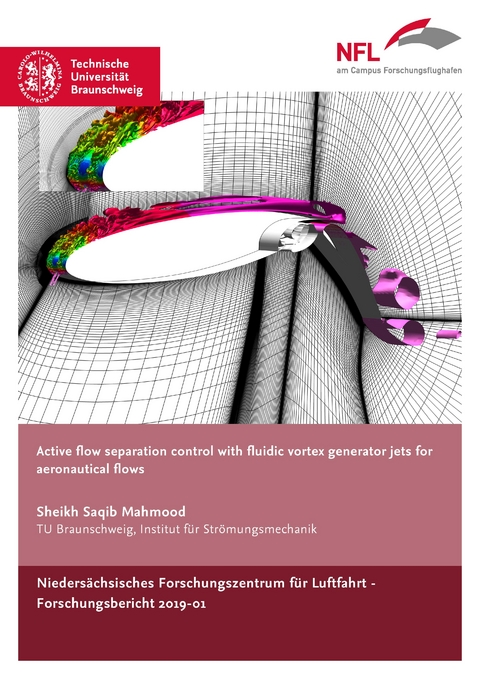
Active flow seperation control with fluidic vortex generator jets for aeronautical flows
Seiten
2019
Technische Uni Braunschweig NFL (Verlag)
978-3-947623-14-3 (ISBN)
Technische Uni Braunschweig NFL (Verlag)
978-3-947623-14-3 (ISBN)
- Titel nicht im Sortiment
- Artikel merken
Abstract:
The dissertation aims at a numerical concept for simulating fluidic active flow control devices, such as vortex generator jets (VGJs), in aeronautical flows.
The validation phase covering the numerical approach simulates the effect of VGJs via Chimera grids using Reynolds-averaged Navier-Stokes (RANS) equations and zonal detached eddy simulation (DES). The numerical results with active flow control over the flat plate and two-element DLR-F15 high-lift airfoil are validated against the experiments at chord-based Reynolds numbers up to Rex=7.67x10⁶ & Rex=2.0x10⁶ for flat plate and airfoil, respectively. The flat plate results showed that the use of a DES model predicts the peak vorticity, turbulent transport and flow dynamics of the vortex quite well at the expense of computational effort compared to the RANS approach. Numerical unsteady RANS (URANS) simulations showed a positive effect of the VGJs on the lift curve that led to an abrupt leading edge (L/E) stall, whereas wind tunnel data that included tunnel side-wall effects indicate a more gentle stalling process. The zonal DES computations confirmed the stalling behavior observed with URANS. At the highest angle of attack (AoA), both approaches show growing cross-flow separations that result from the common-flow-up behavior between the longitudinal vortices.
The application phase discusses the numerical design of a L/E flow control methodology over a swept two-element high-lift airfoil using steady state blowing through VGJs. A turbulent L/E type of stall has been observed in baseline cases without flow control, therefore, the VGJs are applied at the L/E of the airfoil to prevent separations and, thus, increase maximum lift and maximum AoA, respectively. The design of the flow control setup involves the variation of several geometrical and operational key parameters of the VGJs, such as the pitch angle, skew angle, blowing ratio, sense of rotation and spanwise spacing of two adjacent jets. The results show that the numerical design of L/E flow control is feasible for such a wing arrangement. They show a significant degree of stall suppression over the swept high-lift airfoil.
The dissertation aims at a numerical concept for simulating fluidic active flow control devices, such as vortex generator jets (VGJs), in aeronautical flows.
The validation phase covering the numerical approach simulates the effect of VGJs via Chimera grids using Reynolds-averaged Navier-Stokes (RANS) equations and zonal detached eddy simulation (DES). The numerical results with active flow control over the flat plate and two-element DLR-F15 high-lift airfoil are validated against the experiments at chord-based Reynolds numbers up to Rex=7.67x10⁶ & Rex=2.0x10⁶ for flat plate and airfoil, respectively. The flat plate results showed that the use of a DES model predicts the peak vorticity, turbulent transport and flow dynamics of the vortex quite well at the expense of computational effort compared to the RANS approach. Numerical unsteady RANS (URANS) simulations showed a positive effect of the VGJs on the lift curve that led to an abrupt leading edge (L/E) stall, whereas wind tunnel data that included tunnel side-wall effects indicate a more gentle stalling process. The zonal DES computations confirmed the stalling behavior observed with URANS. At the highest angle of attack (AoA), both approaches show growing cross-flow separations that result from the common-flow-up behavior between the longitudinal vortices.
The application phase discusses the numerical design of a L/E flow control methodology over a swept two-element high-lift airfoil using steady state blowing through VGJs. A turbulent L/E type of stall has been observed in baseline cases without flow control, therefore, the VGJs are applied at the L/E of the airfoil to prevent separations and, thus, increase maximum lift and maximum AoA, respectively. The design of the flow control setup involves the variation of several geometrical and operational key parameters of the VGJs, such as the pitch angle, skew angle, blowing ratio, sense of rotation and spanwise spacing of two adjacent jets. The results show that the numerical design of L/E flow control is feasible for such a wing arrangement. They show a significant degree of stall suppression over the swept high-lift airfoil.
| Erscheinungsdatum | 08.03.2019 |
|---|---|
| Reihe/Serie | NFL-Forschungsberichte ; 2019-01 |
| Verlagsort | Braunschweig |
| Sprache | englisch |
| Maße | 148 x 209 mm |
| Themenwelt | Technik ► Luft- / Raumfahrttechnik |
| Schlagworte | Chimera grids • Detached Eddy Simulation • L/E flow control • Reynolds-averaged Navier-Stokes • Vortex generator jets |
| ISBN-10 | 3-947623-14-3 / 3947623143 |
| ISBN-13 | 978-3-947623-14-3 / 9783947623143 |
| Zustand | Neuware |
| Informationen gemäß Produktsicherheitsverordnung (GPSR) | |
| Haben Sie eine Frage zum Produkt? |
Mehr entdecken
aus dem Bereich


aus dem Bereich
Prozessautomatisierung, Bioverfahrenstechnik, Advanced Process …
Buch | Softcover (2025)
De Gruyter Oldenbourg (Verlag)
CHF 76,90
Grundlagen, Mathematik, Kartenkunde, leistungsbasierte Navigation
Buch | Softcover (2022)
De Gruyter Oldenbourg (Verlag)
CHF 102,10
Learning-Based BI-Level Models and Algorithms
Buch | Softcover (2025)
De Gruyter (Verlag)
CHF 125,90


