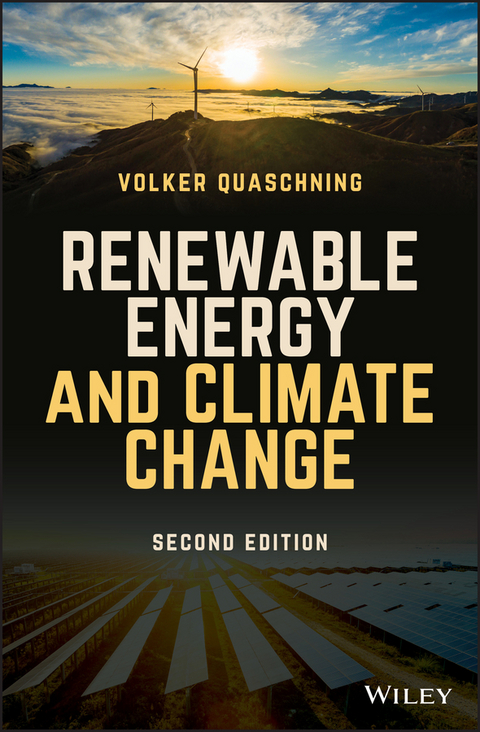
Renewable Energy and Climate Change, 2nd Edition (eBook)
John Wiley & Sons (Verlag)
978-1-119-51488-6 (ISBN)
Provides clear analysis on the development potentials and practical realization of solar, wind, wave, and geothermal renewable energy technologies
Presented as a clear introduction to the topics of climate protection and renewable energy, this book demonstrates the correlations between use of energy, energy prices, and climate change. It evaluates and analyzes the current world situation (drawing on examples given from countries across the globe), whilst also giving essential and practical guidance on 'personal' climate protection. Each major type of renewable energy system is covered in detail and with an easy-to-read approach, making it an ideal manual for planning and realizing climate protection and renewable energy systems, while also being an informative textbook for those studying renewable energy and environment and sustainability courses.
Renewable Energy and Climate Change, 2nd Edition starts by examining our hunger for energy-how much we need, how much we use, and how much it is costing us. It then looks at the state of climate change today and the causes. Following that, the book focuses on how we waste and save energy. The remaining chapters look at the many alternative sources of energy generation, like photovoltaics, solar thermal systems and power plants, wind power systems, hydropower plants, and geothermal power. The book also delves into current state of biomass energy and the hydrogen and fuel cell industry. It finishes with a look at the future of the subject, shining a light on some positive examples of sustainable energy.
- Clear overview on each state-of-the-art technology in alternative energy production
- Presents correlations between use of energy and energy prices, and climate change
- Provides guidance on what the reader can do to reduce their own energy waste
- Full-color figures and photographs throughout, data diagrams and simple calculations and results, and text boxes that highlight important information
- International examples of renewable energy in action
Renewable Energy and Climate Change, 2nd Edition is an excellent text for students and professionals studying or working on renewable energy, or environmental and sustainability alternatives. It will also benefit planners, operators, financers, and consultants in those fields.
Volker Quaschning, PhD, is a Professor for renewable energy systems at the Berlin University of Applied Sciences HTW Berlin and spokesman for the renewable energy program. He has produced hundreds of journal papers, conference papers, lectures, talks, and interviews on radio and television, and has also published 5 books.
Translated by Herbert Eppel at HE Translations, Leicester, UK (https://HETranslations.uk) DISCLAIMER: By including the link to this site, this does not mean the site is endorsed by Wiley
Provides clear analysis on the development potentials and practical realization of solar, wind, wave, and geothermal renewable energy technologies Presented as a clear introduction to the topics of climate protection and renewable energy, this book demonstrates the correlations between use of energy, energy prices, and climate change. It evaluates and analyzes the current world situation (drawing on examples given from countries across the globe), whilst also giving essential and practical guidance on personal climate protection. Each major type of renewable energy system is covered in detail and with an easy-to-read approach, making it an ideal manual for planning and realizing climate protection and renewable energy systems, while also being an informative textbook for those studying renewable energy and environment and sustainability courses. Renewable Energy and Climate Change, 2nd Edition starts by examining our hunger for energy how much we need, how much we use, and how much it is costing us. It then looks at the state of climate change today and the causes. Following that, the book focuses on how we waste and save energy. The remaining chapters look at the many alternative sources of energy generation, like photovoltaics, solar thermal systems and power plants, wind power systems, hydropower plants, and geothermal power. The book also delves into current state of biomass energy and the hydrogen and fuel cell industry. It finishes with a look at the future of the subject, shining a light on some positive examples of sustainable energy. Clear overview on each state-of-the-art technology in alternative energy production Presents correlations between use of energy and energy prices, and climate change Provides guidance on what the reader can do to reduce their own energy waste Full-color figures and photographs throughout, data diagrams and simple calculations and results, and text boxes that highlight important information International examples of renewable energy in action Renewable Energy and Climate Change, 2nd Edition is an excellent text for students and professionals studying or working on renewable energy, or environmental and sustainability alternatives. It will also benefit planners, operators, financers, and consultants in those fields.
Volker Quaschning, PhD, is a Professor for renewable energy systems at the Berlin University of Applied Sciences HTW Berlin and spokesman for the renewable energy program. He has produced hundreds of journal papers, conference papers, lectures, talks, and interviews on radio and television, and has also published 5 books. Translated by Herbert Eppel at HE Translations, Leicester, UK (https://HETranslations.uk) DISCLAIMER: By including the link to this site, this does not mean the site is endorsed by Wiley
Renewable Energy and Climate Change 3
Contents 7
Preface to First Edition 13
Preface to the Second Edition 15
1 Our Hunger for Energy 17
1.1 Energy Supply–Yesterday and Today 18
1.1.1 From the French Revolution to the Early Twentieth Century 18
1.1.2 The Era of Black Gold 20
1.1.3 Natural Gas–The Newest Fossil Energy Source 23
1.1.4 Nuclear Power–Split Energy 24
1.1.5 The Century of Fossil Energy 28
1.1.6 The Renewables Century 29
1.2 Energy Needs–Who Needs What, Where, and How Much? 30
1.3 ‘Anyway’ Energy 33
1.4 Energy Reserves–Wealth for a Time 36
1.4.1 Non-Conventional Reserves–Prolongation of the Oil Age 37
1.4.2 An End in Sight 38
1.4.3 The End of Fission 40
1.5 High Energy Prices–the Key to Climate Protection 40
2 The Climate Before the Collapse 43
2.1 It Is Getting Warm – Climate Changes Today 43
2.1.1 Accelerated Ice Melt 43
2.1.2 More Frequent Natural Catastrophes 46
2.2 The Guilty Parties – Causes of Climate Change 49
2.2.1 The Greenhouse Effect 49
2.2.2 The Prime Suspect: Carbon Dioxide 50
2.2.3 Other Culprits 54
2.3 Outlook and Recommendations –What Lies Ahead? 56
2.3.1 Will it Be Bitterly Cold in Europe? 59
2.3.2 Recommendations for Effective Climate Protection 61
2.4 A Difficult Birth – Politics and Climate Change 64
2.4.1 German Climate Policy 64
2.4.2 International Climate Policy 65
2.5 Self-Help Climate Protection 67
3 From Wasting Energy to Saving Energy and Reducing Carbon Dioxide 69
3.1 Inefficiency 69
3.2 Personal Energy Needs–Savings at Home 72
3.2.1 Domestic Electricity–Money Wasted 72
3.2.2 Heat–Surviving the Winter with Almost No Heating 76
3.2.3 Transport–Getting Somewhere Using Less Energy 80
3.3 Industry and Commerce–Everyone Else is to Blame 82
3.4 Your Personal Carbon Dioxide Balance 83
3.4.1 Emissions Caused Directly by Ones Own Activities 83
3.4.2 Indirect Emissions 84
3.4.3 Total Emissions 87
3.5 The Sale of Ecological Indulgences 87
4 ‘Energiewende’ (Energy Transition)–The Way to a Better Future? 91
4.1 Coal and Nuclear Power Plants–Crutch Instead of Bridge 91
4.1.1 Energy and Automotive Companies Have Bet on the Wrong Horse 92
4.1.2 Lignite–A Climate Killer Made in Germany 94
4.1.3 Carbon Dioxide Sequestration–Out of Sight, Out of Mind 97
4.1.4 Nuclear Power Comeback Was Not a Radiant Success 99
4.2 Efficiency and CHP–A Good Double for Starters 100
4.2.1 Combined Heat and Power–Using Fuel Twice 100
4.2.2 Saving Energy–Achieving More with Less 101
4.3 Renewables–Energy Without End 103
4.4 Germany Is Becoming Renewable 104
4.4.1 All Sectors Are Important 105
4.4.2 Energy Transition in the Heat Sector 106
4.4.3 Energy Transition in the Transport Sector 109
4.4.4 Energy Transition in the Electricity Sector 110
4.4.5 Reliable Supply Using Renewables 113
4.4.6 Decentralized Instead of Centralized–Fewer Power Lines 116
4.5 Not So Expensive–The Myth of Unaffordability 117
4.6 Energy Revolution Instead of Half-Hearted Energy Transition 119
4.6.1 German Energy Policy–In the Shadow of Corporations 119
4.6.2 Energy Transition in the Hands of the Citizens–A Revolution Is Imminent 120
5 Photovoltaics–Energy from Sand 123
5.1 Structure and Function 123
5.1.1 Electrons, Holes, and Space-Charge Regions 123
5.1.2 Efficiency, Characteristics, and MPP 125
5.2 Production of Solar Cells–From Sand to Cell 127
5.2.1 Silicon Solar Cells–Power from Sand 127
5.2.2 From Cell to Module 129
5.2.3 Thin-Film Solar Cells 130
5.3 PV Systems–Grids and Islands 131
5.3.1 Sun Islands 131
5.3.2 Sun in the Grid 134
5.3.3 More Solar Independence 137
5.4 Planning and Design 140
5.4.1 Designing Stand-Alone Systems 140
5.4.2 Designing Grid-Connected Systems 142
5.4.3 Planned Autonomy 146
5.5 Economics 147
5.5.1 What Does It Cost? 147
5.5.2 Funding Programmes 148
5.5.3 Avoiding VAT 150
5.6 Ecology 151
5.7 PV Markets 152
5.8 Outlook and Development Potential 153
6 Solar Thermal Systems–Year-Round Heating from the Sun 157
6.1 Structure and Functionality 158
6.2 Solar Collectors–Collecting the Sun 161
6.2.1 Swimming Pool Absorbers 161
6.2.2 Flat-Plate Collectors 161
6.2.3 Air-Based Collectors 162
6.2.4 Vacuum-Tube Collectors 163
6.3 Solar Thermal Systems 165
6.3.1 Hot Water from the Sun 165
6.3.2 Heating with the Sun 168
6.3.3 Solar Communities 170
6.3.4 Cooling with the Sun 171
6.3.5 Swimming with the Sun 172
6.3.6 Cooking with the Sun 173
6.4 Planning and Design 174
6.4.1 Solar Thermal Heating of Domestic Hot Water 174
6.4.2 Solar Thermal Auxiliary Heating 177
6.5 Economics 179
6.5.1 When Does It Pay off? 179
6.5.2 Funding Programmes 179
6.6 Ecology 180
6.7 Solar Thermal Markets 181
6.8 Outlook and Development Potential 183
7 Solar Power Plants–Even More Power from the Sun 185
7.1 Focusing on the Sun 185
7.2 Solar Power Plants 187
7.2.1 Parabolic Trough Power Plants 187
7.2.2 Solar Tower Power Plants 191
7.2.3 Dish-Stirling Power Plants 193
7.2.4 Solar Chimney Power Plants 194
7.2.5 Concentrating Photovoltaic Power Plants 195
7.2.6 Solar Chemistry 195
7.3 Planning and Design 196
7.3.1 Concentrating Solar Thermal Power Plants 197
7.3.2 Solar Chimney Power Plants 198
7.3.3 Concentrating Photovoltaic Power Plants 198
7.4 Economics 198
7.5 Ecology 199
7.6 Solar Power Plant Markets 200
7.7 Outlook and Development Potential 201
8 Wind Power Systems–Electricity from Thin Air 205
8.1 Gone with the Wind–Where the Wind Comes From 206
8.2 Utilizing Wind 208
8.3 Wind Turbines and Windfarms 212
8.3.1 Wind Chargers 212
8.3.2 Large, Grid-Connected Wind Turbines 213
8.3.3 Small Wind Turbines 217
8.3.4 Windfarms 218
8.3.5 Offshore Windfarms 219
8.4 Planning and Design 222
8.5 Economics 224
8.6 Ecology 226
8.7 Wind Power Markets 228
8.8 Outlook and Development Potential 229
9 Hydropower Plants–Wet Electricity 231
9.1 Tapping into the Water Cycle 231
9.2 Water Turbines 233
9.3 Hydropower Plants 236
9.3.1 Run-of-River Hydropower Plants 236
9.3.2 Storage Power Plants 238
9.3.3 Pumped-storage Hydropower Plants 238
9.3.4 Tidal Power Plants 240
9.3.5 Wave Power Plants 241
9.3.6 Ocean Current Power Plants 242
9.4 Planning and Design 243
9.5 Economics 244
9.6 Ecology 244
9.7 Hydropower Markets 246
9.8 Outlook and Development Potential 247
10 Geothermal Energy–Power from the Deep 249
10.1 Tapping into the Earths Heat 249
10.2 Geothermal Heat and Power Plants 253
10.2.1 Geothermal Heat Plants 253
10.2.2 Geothermal Power Plants 254
10.2.3 Geothermal HDR Power Plants 256
10.3 Planning and Design 257
10.4 Economics 258
10.5 Ecology 258
10.6 Geothermal Markets 259
10.7 Outlook and Development Potential 260
11 Heat Pumps–From Cold to Hot 261
11.1 Heat Sources for Low-Temperature Heat 261
11.2 Operating Principle of Heat Pumps 263
11.2.1 Compression Heat Pumps 264
11.2.2 Absorption Heat Pumps and Adsorption Heat Pumps 265
11.3 Planning and Design 266
11.4 Economics 269
11.5 Ecology 270
11.6 Heat Pump Markets 273
11.7 Outlook and Development Potential 273
12 Biomass–Energy from Nature 275
12.1 Origins and Use of Biomass 276
12.2 Biomass Heating 279
12.2.1 Wood as a Fuel 279
12.2.2 Open Fires and Woodburning Stoves 282
12.2.3 Log Boilers 282
12.2.4 Wood Pellet Heating 284
12.3 Biomass Heat and Power Plants 285
12.4 Biofuels 287
12.4.1 Bio-oil 287
12.4.2 Biodiesel 288
12.4.3 Bioethanol 289
12.4.4 BtL Fuels 290
12.4.5 Biogas 291
12.5 Planning and Design 292
12.5.1 Log Boilers 292
12.5.2 Wood Pellet Heating 293
12.6 Economics 295
12.7 Ecology 296
12.7.1 Solid Fuels 297
12.7.2 Biofuels 298
12.8 Biomass Markets 298
12.9 Outlook and Development Potential 300
13 Renewable Gas and Fuel Cells 301
13.1 Hydrogen as an Energy Source 303
13.2 Methanation 305
13.3 Transport and Storage of Renewable Gas 306
13.3.1 Transport and Storage of Hydrogen 306
13.3.2 Transport and Storage of Renewable Methane 307
13.4 Fuel Cells: Bearers of Hope 309
13.5 Economics 312
13.6 Ecology 313
13.7 Markets, Outlook, and Development Potential 314
14 Sunny Prospects–Examples of Sustainable Energy Supply 317
14.1 Climate-Compatible Living 317
14.1.1 Carbon-Neutral Standard Prefabricated Houses 317
14.1.2 Plus-Energy Solar House 318
14.1.3 Plus-Energy Housing Estate 319
14.1.4 Heating Only with the Sun 320
14.1.5 Zero Heating Costs After Redevelopment 321
14.2 Working and Producing in a Climate-friendly Manner 322
14.2.1 Offices and Shops in the ‘Sonnenschiff’ 322
14.2.2 Zero-Emissions Factory 322
14.2.3 Carbon-free Heavy Equipment Factory 323
14.2.4 Plus-Energy Head Office 323
14.3 Climate-Compatible Driving 325
14.3.1 Travelling Around the World in a Solar Car 325
14.3.2 Across Australia in 33 hours 326
14.3.3 Emission-free Deliveries 327
14.3.4 Electric Cars for All 328
14.4 Climate-Compatible Travel by Water or Air 329
14.4.1 Advanced Sailing 329
14.4.2 Solar Ferry on Lake Constance 330
14.4.3 World Altitude Record with a Solar Aeroplane 330
14.4.4 Flying Around the World in a Solar Plane 331
14.4.5 Flying for Solar Kitchens 332
14.5 Everything Becomes Renewable 333
14.5.1 A Village Becomes Independent 333
14.5.2 Hybrid Power Plant for Secure Renewable Supply 334
14.6 Everything will Turn Out Fine 335
A Appendix 337
A.1 Energy Units and Prefixes 337
A.2 Geographic Coordinates of Power Plants 338
A.3 Further Reading 341
References 343
Index 347
EULA 355
| Erscheint lt. Verlag | 12.2.2019 |
|---|---|
| Sprache | englisch |
| Themenwelt | Technik ► Elektrotechnik / Energietechnik |
| Schlagworte | Biomass energy • climate change • climate change activism • Climate Change Mitigation • earth activism • electricity • Elektrizitätslehre • Energie • Energietechnik • Energy • Energy Security • environmental protection • Erneuerbare Energie • Erneuerbare Energien • Future of renewable energy • Geothermal Power • guide to alternative sources of energy generation • guide to renewable energy • Hydropower plants • Klimawandel • lower greenhouse gases • lowering your carbon footprint • off-grid energy services • Photovoltaics • Photovoltaic Systems • Physics • Physik • Power Plants • Power Technology & Power Engineering • reduce energy waste • renewable energy • Renewable energy sources • Renewable energy systems • Renewable energy technologies • Renewable energy technology • renewable resources • save Earth • saving the environment • saving the world • Solar Thermal Systems • sustainability • Sustainable energy • Sustainable Energy Systems • Wind Power Systems |
| ISBN-10 | 1-119-51488-6 / 1119514886 |
| ISBN-13 | 978-1-119-51488-6 / 9781119514886 |
| Informationen gemäß Produktsicherheitsverordnung (GPSR) | |
| Haben Sie eine Frage zum Produkt? |
 PDF (Adobe DRM)
Kopierschutz: Adobe-DRM
Adobe-DRM ist ein Kopierschutz, der das eBook vor Mißbrauch schützen soll. Dabei wird das eBook bereits beim Download auf Ihre persönliche Adobe-ID autorisiert. Lesen können Sie das eBook dann nur auf den Geräten, welche ebenfalls auf Ihre Adobe-ID registriert sind.
Details zum Adobe-DRM
Dateiformat: PDF (Portable Document Format)
Mit einem festen Seitenlayout eignet sich die PDF besonders für Fachbücher mit Spalten, Tabellen und Abbildungen. Eine PDF kann auf fast allen Geräten angezeigt werden, ist aber für kleine Displays (Smartphone, eReader) nur eingeschränkt geeignet.
Systemvoraussetzungen:
PC/Mac: Mit einem PC oder Mac können Sie dieses eBook lesen. Sie benötigen eine
eReader: Dieses eBook kann mit (fast) allen eBook-Readern gelesen werden. Mit dem amazon-Kindle ist es aber nicht kompatibel.
Smartphone/Tablet: Egal ob Apple oder Android, dieses eBook können Sie lesen. Sie benötigen eine
Geräteliste und zusätzliche Hinweise
Buying eBooks from abroad
For tax law reasons we can sell eBooks just within Germany and Switzerland. Regrettably we cannot fulfill eBook-orders from other countries.
aus dem Bereich