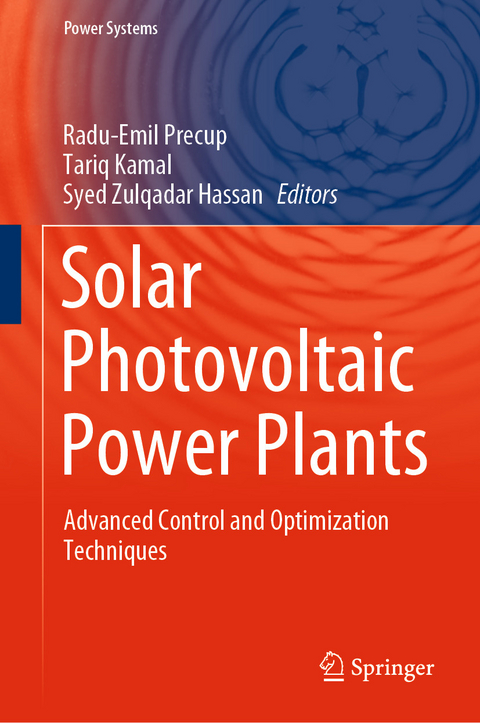
Solar Photovoltaic Power Plants (eBook)
XVII, 250 Seiten
Springer Singapore (Verlag)
978-981-13-6151-7 (ISBN)
This book discusses control and optimization techniques in the broadest sense, covering new theoretical results and the applications of newly developed methods for PV systems. Going beyond classical control techniques, it promotes the use of more efficient control and optimization strategies based on linearized models and purely continuous (or discrete) models. These new strategies not only enhance the performance of the PV systems, but also decrease the cost per kilowatt-hour generated.
This book discusses control and optimization techniques in the broadest sense, covering new theoretical results and the applications of newly developed methods for PV systems. Going beyond classical control techniques, it promotes the use of more efficient control and optimization strategies based on linearized models and purely continuous (or discrete) models. These new strategies not only enhance the performance of the PV systems, but also decrease the cost per kilowatt-hour generated.
Radu-Emil Precup received his Dipl.Ing. degree in Automation and Computers from the Traian Vuia Polytechnic Institute of Timisoara, Romania, in 1987, his diploma in Mathematics from the West University of Timisoara in 1993, and his Ph.D. degree in Automated Systems from the Politehnica University of Timisoara in 1996, where he is currently working. He has been an Editor-in-Chief of the International Journal of Artificial Intelligence since 2008 and also serves on the editorial boards of several other prestigious journals including Applied Soft Computing (Elsevier), Evolving Systems (Springer) and Cogent Engineering (Taylor & Francis). He is the author/coauthor of more than 300 papers published in various scientific journals, conference proceedings, and book chapters. His research interests mainly include the development and analysis of new control structures and algorithms, theory and applications of soft computing, computer-aided design of control systems, and applications to mechatronic systems (including automotive systems and mobile robots). Among other achievements, he was listed as one of the top 10 researchers in Artificial Intelligence and Automation (IIoT World July 2017).Tariq Kamal holds doctorates in Energy and Sustainability Engineering from the University of Cadiz, Spain; and in Electrical Power and Control Engineering from Sakarya University, Turkey. His research interests include advanced intelligent control techniques for power systems; hybrid renewable energy systems; plug-in hybrid electric vehicles and their integration in power systems; distributed generation; smart grid applications; and the application of signal processing in power systems. Currently, he is working with the research group on Electrical Technologies for Sustainable and Renewable Energy, University of Cadiz, Spain. He is the author/co-author of more than 50 papers published in various international scientific journals and conference proceedings. He has been involved in major joint projects around the globe, including Spain, Turkey, Australia, China, the UK, Pakistan and Estonia, and has been a regular reviewer for many leading international journals, including IEEE Transactions on Industrial Electronics, IEEE access, and Applied Energy.Syed Zulqadar Hassan received his Ph.D. degree in Electrical Engineering from Chongqing University, China. His research interests include fuzzy logic, neural networks, optimal control, adaptive control, integration of renewable energies, smart grids and the application of signal processing (wavelets) in power systems. He has contributed more than 45 publications in the field of Electrical Engineering, and frequently serves as a reviewer for IEEE journals and international conferences.
Adaptive Control Techniques for Three-Phase Grid-Connected Photovoltaic Inverters.- Application of sliding-mode control for maximum power point tracking of PV systems.- Predictive Control of Four-Leg Converters for Photovoltaic Energy Systems.- A Novel Maximum Power Point Tracking Method for Photovoltaic Application Using Secant Incremental Gradient Based on Newton Raphson.- Study on control of hybrid photovoltaic-wind power system using Xilinx System Generator.- Artificial Intelligence for Photovoltaic Systems.- Applications of Improved Versions of Fuzzy Logic Based Maximum Power Point Tracking for Controlling Photovoltaic Systems.- A New Method For Generating Short-Term Power Forecasting Based On Artificial Neural Networks And Optimization Methods For Solar Photovoltaic Power Plants.- Evaluation on Training Algorithms of Back Propagation Neural Network for a Solar Photovoltaic based DSTATCOM System.- Power Extraction from PV Module using Hybrid ANFIS Controller.- An Online Self Recurrent Direct Adaptive Nero-fuzzy Wavelet based Control of Photovoltaic Systems.
| Erscheint lt. Verlag | 7.2.2019 |
|---|---|
| Reihe/Serie | Power Systems | Power Systems |
| Zusatzinfo | XVII, 250 p. 174 illus., 95 illus. in color. |
| Verlagsort | Singapore |
| Sprache | englisch |
| Themenwelt | Technik ► Elektrotechnik / Energietechnik |
| Schlagworte | Adaptive fuzzy sliding control • Adaptive Neuro-fuzzy Control • Double-integral sliding-mode control • Fuzzy coupled hopfield neural network • Fuzzy sliding control • Model predictive neuro-fuzzy control • Optimizing PV plants • Second-order sliding-mode control • Type-I and Type-II fuzzy control |
| ISBN-10 | 981-13-6151-7 / 9811361517 |
| ISBN-13 | 978-981-13-6151-7 / 9789811361517 |
| Informationen gemäß Produktsicherheitsverordnung (GPSR) | |
| Haben Sie eine Frage zum Produkt? |
 PDF (Wasserzeichen)
DRM: Digitales Wasserzeichen
Dieses eBook enthält ein digitales Wasserzeichen und ist damit für Sie personalisiert. Bei einer missbräuchlichen Weitergabe des eBooks an Dritte ist eine Rückverfolgung an die Quelle möglich.
Dateiformat: PDF (Portable Document Format)
Mit einem festen Seitenlayout eignet sich die PDF besonders für Fachbücher mit Spalten, Tabellen und Abbildungen. Eine PDF kann auf fast allen Geräten angezeigt werden, ist aber für kleine Displays (Smartphone, eReader) nur eingeschränkt geeignet.
Systemvoraussetzungen:
PC/Mac: Mit einem PC oder Mac können Sie dieses eBook lesen. Sie benötigen dafür einen PDF-Viewer - z.B. den Adobe Reader oder Adobe Digital Editions.
eReader: Dieses eBook kann mit (fast) allen eBook-Readern gelesen werden. Mit dem amazon-Kindle ist es aber nicht kompatibel.
Smartphone/Tablet: Egal ob Apple oder Android, dieses eBook können Sie lesen. Sie benötigen dafür einen PDF-Viewer - z.B. die kostenlose Adobe Digital Editions-App.
Buying eBooks from abroad
For tax law reasons we can sell eBooks just within Germany and Switzerland. Regrettably we cannot fulfill eBook-orders from other countries.
aus dem Bereich