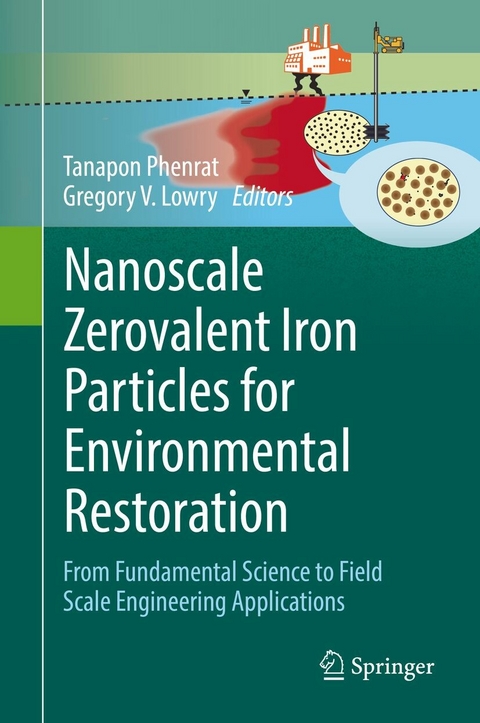
Nanoscale Zerovalent Iron Particles for Environmental Restoration (eBook)
XXIV, 597 Seiten
Springer International Publishing (Verlag)
978-3-319-95340-3 (ISBN)
Dr. Tanapon Phenrat is an assistant professor and a principal investigator of Research Unit for Integrated Natural Resources Remediation and Reclamation (IN3R), Department of Civil Engineering, Faculty of Engineering, Naresuan University, Phitsanulok. Also, he serves as the Deputy Director of Center of Excellent for Sustainability of Health, Environment, and Industry (SHEI), Faculty of Engineering, Naresuan University. He has 13-year experience in conducting research and professional work in the field of remediation of contaminated sites. He has published 36 peer-reviewed research articles in international journals including several highly-cited research articles in nanoscale zerovalent iron applications. He is also a pioneer in remedial engineering in Thailand and has worked collaboratively as a consultant for affected communities, government agencies, and potentially responsible contaminated site owners. He investigated more than 40 contaminated sites and successfully remediated 6 contaminated sites using soil vapor extraction, in-well treatment with chemical oxidation, colloidal carbon injection, colloidal iron oxide injection, magnetic-assisted soil washing with zerovalent iron, and phytoremediation. Dr. Phenrat was awarded with 15 research awards (6 international awards) in the field of environmental remediation.
Dr. Gregory V. Lowry is the Walter J. Blenko, Sr. Professor of Civil and Environmental Engineering at Carnegie Mellon University. He is the Deputy Director of the NSF/EPA Center for Environmental Implications of Nanotechnology (CEINT). He is on the editorial board for Environmental Science: Nano and Nature: Scientific Data. He served as the founding Associate Editor of Environmental Science: Nano for five years (2013-2018). Dr. Lowry earned his B.S. in Chemical Engineering from the University of California at Davis, M.S. from the University of Wisconsin at Madison, and Ph.D. in Civil and Environmental Engineering and Stanford University. His current research and teaching focuses on safely harnessing the unique properties of engineered nanomaterials for applications in remediation, water treatment, and food production. He is currently serving on the National Academy of Science Committee on 'Science Breakthroughs 2030: A Strategy for Food and Agricultural Research' and he served on the National Research Council committee to Develop a Research Strategy for Environmental Health and Safety Aspects of Engineered Nanomaterials. Dr. Lowry has received awards from the ASCE (Walter L. Huber Civil Engineering Research Award), AEESP (Malcolm Pirnie/AEESP Frontiers in Research Award), and ACS (Best Feature Article in ES&T for 2012). He was recognized as a highly cited researcher (top 1%) in the area of environment and ecology by Thompson Reuters in 2014 and 2015. Dr. Lowry has served as PI or Co-PI on grants from the National Science Foundation, U.S. Department of Defense, U.S. Department of Energy, and U.S. Environmental Protection Agency, and from industry.
Dr. Tanapon Phenrat is an assistant professor and a principal investigator of Research Unit for Integrated Natural Resources Remediation and Reclamation (IN3R), Department of Civil Engineering, Faculty of Engineering, Naresuan University, Phitsanulok. Also, he serves as the Deputy Director of Center of Excellent for Sustainability of Health, Environment, and Industry (SHEI), Faculty of Engineering, Naresuan University. He has 13-year experience in conducting research and professional work in the field of remediation of contaminated sites. He has published 36 peer-reviewed research articles in international journals including several highly-cited research articles in nanoscale zerovalent iron applications. He is also a pioneer in remedial engineering in Thailand and has worked collaboratively as a consultant for affected communities, government agencies, and potentially responsible contaminated site owners. He investigated more than 40 contaminated sites and successfully remediated 6 contaminated sites using soil vapor extraction, in-well treatment with chemical oxidation, colloidal carbon injection, colloidal iron oxide injection, magnetic-assisted soil washing with zerovalent iron, and phytoremediation. Dr. Phenrat was awarded with 15 research awards (6 international awards) in the field of environmental remediation.Dr. Gregory V. Lowry is the Walter J. Blenko, Sr. Professor of Civil and Environmental Engineering at Carnegie Mellon University. He is the Deputy Director of the NSF/EPA Center for Environmental Implications of Nanotechnology (CEINT). He is on the editorial board for Environmental Science: Nano and Nature: Scientific Data. He served as the founding Associate Editor of Environmental Science: Nano for five years (2013-2018). Dr. Lowry earned his B.S. in Chemical Engineering from the University of California at Davis, M.S. from the University of Wisconsin at Madison, and Ph.D. in Civil and Environmental Engineering and Stanford University. His current research and teaching focuses on safely harnessing the unique properties of engineered nanomaterials for applications in remediation, water treatment, and food production. He is currently serving on the National Academy of Science Committee on “Science Breakthroughs 2030: A Strategy for Food and Agricultural Research” and he served on the National Research Council committee to Develop a Research Strategy for Environmental Health and Safety Aspects of Engineered Nanomaterials. Dr. Lowry has received awards from the ASCE (Walter L. Huber Civil Engineering Research Award), AEESP (Malcolm Pirnie/AEESP Frontiers in Research Award), and ACS (Best Feature Article in ES&T for 2012). He was recognized as a highly cited researcher (top 1%) in the area of environment and ecology by Thompson Reuters in 2014 and 2015. Dr. Lowry has served as PI or Co-PI on grants from the National Science Foundation, U.S. Department of Defense, U.S. Department of Energy, and U.S. Environmental Protection Agency, and from industry.
Chapter1: Nanoscale Zero-valent Iron (NZVI) for Environmental Decontamination: A Brief History of 20 Years of Research and Field-scale Application.- Chapter2: NZVI Synthesis and Characterization.- Chapter3: Chemical Reduction and Oxidation of Organic Contaminants by Nanoscale Zero-valent Iron.- Chapter4: Nanoscale Zero-valent Iron Particles for Treatment of Metal(loid)s.- Chapter5: Colloidal and Surface Science and Engineering for Bare and Polymer-modified NZVI Applications: Dispersion Stability, Mobility in Porous Media, and Contaminant Specificity.- Chapter6: Mechanistic, Mechanistic-based Empirical, and Continuum-based Concepts and Models for the Transport of Polyelectrolyte-modified Nanoscale Zero-valent Iron (NZVI) in Saturated Porous Media.- Chapter7: Moving Into the 3rd Decade of Nanoscale Zero-Valent Iron (NZVI) Development: Best Practices for Field Implementation.- Chapter8: Experiences from Pilot and Large-Scale Demonstration Sites from Across the Globe Including Combined Remedies with NZVI.- Chapter9: Sulfide Modified NZVI (S-NZVI): Synthesis, Characterization, and Reactivity.- Chapter10: Microbial Perspective of NZVI Applications.- Chapter11: Electromagnetic Induction of Nanoscale Zero-valent Iron for Enhanced Thermal Dissolution/Desorption and Dechlorination of Chlorinated Volatile Organic Compounds.- Chapter12: Improving the Reactivity of ZVI and NZVI Towards Various Metals and Metal(loid)s With Weak Magnetic Field.- Chapter13: Vadose-Zone Remediation of Dense Non-aqueous Phase Liquid Residuals Using Foam-based Nanoscale Zero-valent Iron Particles With Low Frequency Electromagnetic Field.- Chapter14: Carbothermal Synthesis of Aerosol-based Iron-carbon Nanocomposites for Adsorption and Reduction of Cr(VI).- Chapter15: Sustainable Environmental Remediation Using NZVI by Managing Benefit-Risk Tradeoffs.- Chapter16: State of Knowledge and Future Needs for NZVI Applications in Subsurface Remediation.
| Erscheint lt. Verlag | 31.1.2019 |
|---|---|
| Zusatzinfo | XXIV, 597 p. 181 illus., 131 illus. in color. |
| Verlagsort | Cham |
| Sprache | englisch |
| Themenwelt | Naturwissenschaften ► Biologie ► Genetik / Molekularbiologie |
| Technik | |
| Schlagworte | carbothermal synthesis • dispersion stability • Electromagnetic Induction • Environmental Nanotechnology • improving reactivity • metal(loid)s treatment • nanoscale zerovalent iron particles • organic contaminants • remediation • restoration |
| ISBN-10 | 3-319-95340-0 / 3319953400 |
| ISBN-13 | 978-3-319-95340-3 / 9783319953403 |
| Informationen gemäß Produktsicherheitsverordnung (GPSR) | |
| Haben Sie eine Frage zum Produkt? |
 PDF (Wasserzeichen)
DRM: Digitales Wasserzeichen
Dieses eBook enthält ein digitales Wasserzeichen und ist damit für Sie personalisiert. Bei einer missbräuchlichen Weitergabe des eBooks an Dritte ist eine Rückverfolgung an die Quelle möglich.
Dateiformat: PDF (Portable Document Format)
Mit einem festen Seitenlayout eignet sich die PDF besonders für Fachbücher mit Spalten, Tabellen und Abbildungen. Eine PDF kann auf fast allen Geräten angezeigt werden, ist aber für kleine Displays (Smartphone, eReader) nur eingeschränkt geeignet.
Systemvoraussetzungen:
PC/Mac: Mit einem PC oder Mac können Sie dieses eBook lesen. Sie benötigen dafür einen PDF-Viewer - z.B. den Adobe Reader oder Adobe Digital Editions.
eReader: Dieses eBook kann mit (fast) allen eBook-Readern gelesen werden. Mit dem amazon-Kindle ist es aber nicht kompatibel.
Smartphone/Tablet: Egal ob Apple oder Android, dieses eBook können Sie lesen. Sie benötigen dafür einen PDF-Viewer - z.B. die kostenlose Adobe Digital Editions-App.
Buying eBooks from abroad
For tax law reasons we can sell eBooks just within Germany and Switzerland. Regrettably we cannot fulfill eBook-orders from other countries.
aus dem Bereich