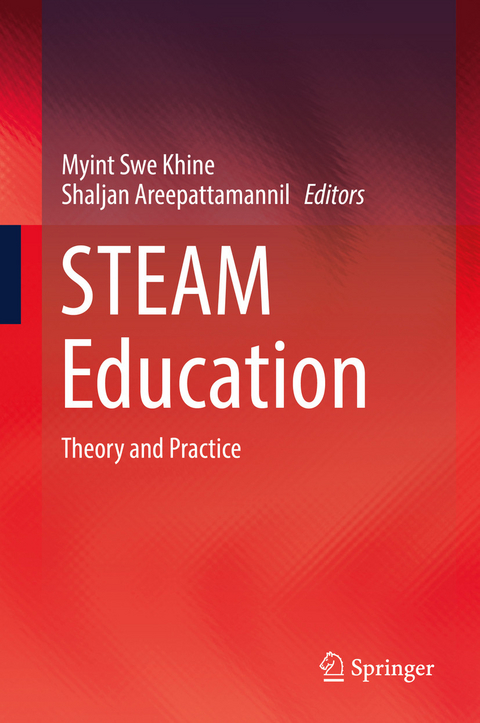
STEAM Education (eBook)
IX, 188 Seiten
Springer International Publishing (Verlag)
978-3-030-04003-1 (ISBN)
This book looks at the value of integrating the arts and sciences in the school curriculum. It argues that this will help students further their understanding of analytical concepts through the use of creativity. The authors illustrate how schools can work towards presenting common practices, concepts, and content. Coverage features case studies and lessons learned from classrooms across the United States.
The notion of STEAM (Science, Technology, Engineering, Arts, and Mathematics) is an emerging discipline unique in its desire to provide a well-rounded approach to education. The chapters of this volume examine STEAM in a variety of settings, from kindergarten to higher education. Readers will learn about the practical considerations involved when introducing the arts and creativity into traditionally left brain processes. This includes best practices for creating and sustaining successful STEAM initiatives in any school, college, or university. For instance, one chapter discusses novel approaches to teach writing with the scientific method in order to help students better present their ideas.
The authors also detail how the arts can engage more diverse learners, including students who are not traditionally interested in STEM subjects. They provide three concrete examples of classroom-tested inquiries: designing a prosthetic arm for a child, making a paleontology investigation, and taking a closer look at the arts within roller coaster engineering. This book is an invaluable resource for teachers and teacher trainers, university faculty, researchers, and school administrators. It will also be of interest to science, mathematics, engineering, computer science, information technology, arts and design and technology teachers.
Dr Myint Swe Khine is a Professor and Chair of Assessment and Evaluation Centre, Emirates College for Advanced Education, United Arab Emirates and Adjunct Professor at the Science and Mathematics Education Centre, Curtin University, Perth, Australia. He obtained Master degrees from the University of Southern California, Los Angeles, USA and University of Surrey, Guildford, UK, and Doctor of Science Education from Curtin University, Australia. Before joining ECAE, he worked at the National Institute of Education, Nanyang Technological University in Singapore. He has published widely and edited books on science education. Recent book Visual-spatial Ability in STEM Education: Transforming Research into Practice (2017) is published by Springer in Switzerland.
Dr Shaljan Areepattamannil holds a Ph.D. in Education from Queen's University at Kingston, Ontario, Canada. He is currently an Assistant Professor in the Division of Curriculum and Instructional Technology at Abu Dhabi Government's Emirates College for Advanced Education (ECAE). Prior to joining ECAE, Dr Shaljan was a research scientist in the Office of Education Research and an Assistant Professor in the Division of Curriculum, Teaching and Learning at the National Institute of Education, Nanyang Technological University, Singapore. Previously, he served as a teaching fellow in quantitative methods in the Faculty of Education at Queen's University. His research interests primarily revolve around the role of psychology in STEAM education.
Dr Myint Swe Khine is a Professor and Chair of Assessment and Evaluation Centre, Emirates College for Advanced Education, United Arab Emirates and Adjunct Professor at the Science and Mathematics Education Centre, Curtin University, Perth, Australia. He obtained Master degrees from the University of Southern California, Los Angeles, USA and University of Surrey, Guildford, UK, and Doctor of Science Education from Curtin University, Australia. Before joining ECAE, he worked at the National Institute of Education, Nanyang Technological University in Singapore. He has published widely and edited books on science education. Recent book Visual-spatial Ability in STEM Education: Transforming Research into Practice (2017) is published by Springer in Switzerland. Dr Shaljan Areepattamannil holds a Ph.D. in Education from Queen’s University at Kingston, Ontario, Canada. He is currently an Assistant Professor in the Division of Curriculum and Instructional Technology at Abu Dhabi Government’s Emirates College for Advanced Education (ECAE). Prior to joining ECAE, Dr Shaljan was a research scientist in the Office of Education Research and an Assistant Professor in the Division of Curriculum, Teaching and Learning at the National Institute of Education, Nanyang Technological University, Singapore. Previously, he served as a teaching fellow in quantitative methods in the Faculty of Education at Queen’s University. His research interests primarily revolve around the role of psychology in STEAM education.
STEAM Education 1
Introduction 5
References 7
Contents 8
Chapter 1: Inquiry, Investigative Processes, Art, and Writing in STEAM 9
Introduction 9
Dewey and the Importance of Experience 10
Piaget and the Learning Cycle 11
Defining Roles for the Teacher and Student 12
Methods of Investigation: Scientific Inquiry and the Engineering Design Process 14
Interactive Notebooks 17
Photo Narrative 20
Conclusions 24
References 25
Chapter 2: Structuring STEAM Inquiries: Lessons Learned from Practice 27
Structuring STEAM Inquiries: Lessons Learned from Practice 27
Full STEAM Ahead: Project Overview 29
Project Background 29
A Focus on Content Standards and Practices 31
Creation of STEAM Inquiries 32
Three Classroom-Tested Inquiries 33
Three Classroom-Tested Inquires 33
Designing a Prosthetic Arm for a Kindergartener 33
A Paleontology Investigation 35
A Closer Look at the Arts Within Roller-Coaster Engineering 37
Suggestions for STEAM Implementation 39
Lessons Learned 39
Tips for Practice 40
Concluding Remarks 41
References 41
Chapter 3: Creating a STEAM Map: A Content Analysis of Visual Art Practices in STEAM Education 44
STEAM Is Hot 44
STEAM Curriculum Approaches 45
Design Education-Based STEAM Approach 46
Collaborative Approach to STEAM 47
Approaching STEAM Through Arts Integration 48
Approaching STEAM Through Project-Based Learning and the Maker Movement 49
Summary: Many Shades of STEAM 51
Creating a STEAM Map 52
Method 52
Drawing the Map 54
Stories the Map Tells 56
Beyond the Map 57
Future Directions of STEAM Education 58
References 59
Chapter 4: Design Thinking Gives STEAM to Teaching: A Framework That Breaks Disciplinary Boundaries 63
Introduction: A Design Framework for STEAM 63
Design Melds STEAM Together 65
Design and STEAM: Creative, Interdisciplinary, Human-Centered Problem-Solving 66
Design Thinking and Teachers: A Path to Creative Learning Design 68
Design Thinking in the Stanford Design Model 69
Overview of the Course: Design Thinking for Addressing Problems of Practice 71
Building Toward STEAM: Examples in Teachers’ Curriculum Development 72
Design Thinking in Biology: Creative Problem-Solving 73
Making Design-STEAM Connections 75
Breaking Traditions in Spanish: Going to the Real World 76
Making Design-STEAM Connections 78
Designing Math for Authentic Engagement: Failing Better 79
Making Design-STEAM Connections 81
Conclusions 81
References 82
Chapter 5: Investigating the Impact of a Community Makers’ Guild Training Program on Elementary and Middle School Educator Perceptions of STEM (Science, Technology, Engineering, and Mathematics) 85
Introduction 85
Background Understanding Makerspace Learning Environments 86
Current Factors Impacting STEM Education Training Programs 87
STEM Professional Development Trends 88
Technology Integration Training Approaches 89
STEM Research Trends 90
Makers’ Guild Research Program 91
Research Design and Methodology 91
Instrumentation 94
Results 96
Discussion and Conclusions 101
References 104
Chapter 6: The Emergence of the Creativity in STEM: Fostering an Alternative Approach for Science, Technology, Engineering, and Mathematics Instruction Through the Use of the Arts 107
Introduction 107
The Evolution of Science, Technology, Engineering, and Mathematics (STEM) to Include the Arts 108
The Emergence of Science, Technology, Engineering, Art and Mathematics (STEAM) in the Field of Higher Education 109
Interjecting the Arts into STEM to Create an Interdisciplinary Education 110
Leveraging Connections and Information in STEAM Courses to Improve Learning Outcomes 111
Determining the Impact of STEAM by Examining Student Satisfaction in These Courses 112
STEAM and Student Satisfaction 112
Increasing Student Satisfaction Through a Framework That Engages and Challenges Students 113
Charting the Future of Creativity and Arts in a Forthcoming STEAM Course 114
The Foundation of STEAM’s Future Resides with Learner Engagement and Instructional Design Processes 115
Shaping Critical Thought Processes with New Media Literacies 115
The Utilization of Emerging STEAM Technologies 116
Conclusion 118
References 119
Chapter 7: Developing a Rhetoric of Aesthetics: The (Often) Forgotten Link Between Art and STEM 122
Introduction 122
Rationale for the Rhetoric 123
Instrumental and Aesthetic: The Yin and Yang of Motivations for Science 125
Why the Aesthetic Is Sexy: One Possible Answer 126
Framing a Rhetoric of Aesthetics: Theory and Research 127
A Rhetoric of Aesthetics for STEAM: Three Fractal Frames 134
Lessons for Practice: Designing a Rhetoric of Aesthetics in STEM 139
Conclusion 142
References 144
Chapter 8: Moving Toward Transdisciplinary Instruction: A Longitudinal Examination of STEAM Teaching Practices 147
Introduction 147
Theoretical Framework 148
Social Practice Theory 148
Understanding the Current Field of STEAM Education 149
Conceptualizing Transdisciplinary STEAM Education 151
Methodology 153
Context 153
Observation Tool 154
STEAM Curricula 154
Reflective Journal 154
Data Analysis 155
Vignettes: Understanding Transdisciplinarity in STEAM Contexts 155
Implications 162
Conceptualization 162
Curricular Design 163
Implementation 164
Conclusion 165
References 165
Chapter 9: Multidisciplinary Group Composition in the STEAM Classroom 169
Introduction 169
Background 170
Collaborative Learning 170
Rationale for Implementing Collaborative Learning 172
Online Collaborative Learning and Wikis 173
Group Composition and Group Formation 173
Methodology 175
The Course 176
Wiki Projects and Group Composition 177
The Survey 178
Results 179
Students’ Self-Evaluation of Their Group’s Wiki Page 179
Students’ Self-Evaluation of Their Group’s Collaboration 180
Discussion 181
Satisfaction with the Learning Experience in Heterogeneous and Homogeneous Groups 181
Collaboration in Heterogeneous vs. Homogeneous Groups 183
Conclusions: Summary, Limitations, and Future Research 186
Appendices 187
Appendix A: Wiki Project Description 187
Appendix B: List of Academic Majors of Students in GER 280 188
Appendix C: Survey 189
References 190
| Erscheint lt. Verlag | 30.1.2019 |
|---|---|
| Zusatzinfo | IX, 188 p. 24 illus. |
| Verlagsort | Cham |
| Sprache | englisch |
| Themenwelt | Sozialwissenschaften ► Pädagogik ► Schulpädagogik / Grundschule |
| Technik | |
| Schlagworte | arts education • Arts integration • creativity in education • design thinking • digital humanities • engineering design process • future education • Instructional Design • multidisciplinary education • scholarly thought • science education • sociocultural capabilities • STEAM-based experiences • STEAM curriculum • STEAM initiatives • stem • STEM Education • Teacher Education • transdisciplinary education |
| ISBN-10 | 3-030-04003-8 / 3030040038 |
| ISBN-13 | 978-3-030-04003-1 / 9783030040031 |
| Informationen gemäß Produktsicherheitsverordnung (GPSR) | |
| Haben Sie eine Frage zum Produkt? |
 PDF (Wasserzeichen)
DRM: Digitales Wasserzeichen
Dieses eBook enthält ein digitales Wasserzeichen und ist damit für Sie personalisiert. Bei einer missbräuchlichen Weitergabe des eBooks an Dritte ist eine Rückverfolgung an die Quelle möglich.
Dateiformat: PDF (Portable Document Format)
Mit einem festen Seitenlayout eignet sich die PDF besonders für Fachbücher mit Spalten, Tabellen und Abbildungen. Eine PDF kann auf fast allen Geräten angezeigt werden, ist aber für kleine Displays (Smartphone, eReader) nur eingeschränkt geeignet.
Systemvoraussetzungen:
PC/Mac: Mit einem PC oder Mac können Sie dieses eBook lesen. Sie benötigen dafür einen PDF-Viewer - z.B. den Adobe Reader oder Adobe Digital Editions.
eReader: Dieses eBook kann mit (fast) allen eBook-Readern gelesen werden. Mit dem amazon-Kindle ist es aber nicht kompatibel.
Smartphone/Tablet: Egal ob Apple oder Android, dieses eBook können Sie lesen. Sie benötigen dafür einen PDF-Viewer - z.B. die kostenlose Adobe Digital Editions-App.
Buying eBooks from abroad
For tax law reasons we can sell eBooks just within Germany and Switzerland. Regrettably we cannot fulfill eBook-orders from other countries.
aus dem Bereich