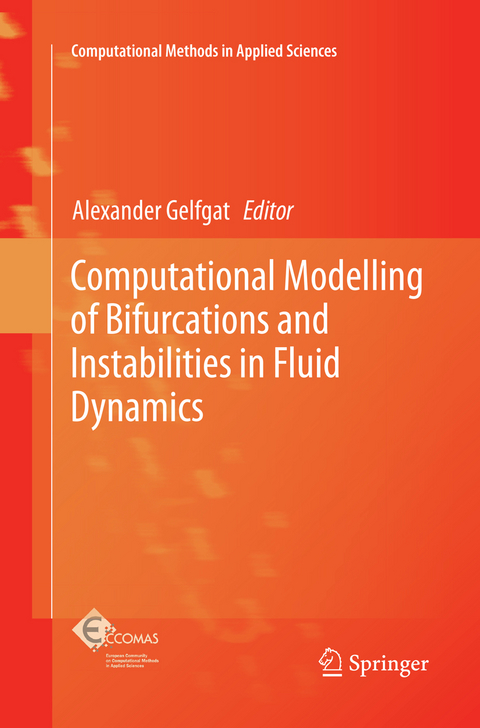
Computational Modelling of Bifurcations and Instabilities in Fluid Dynamics
Springer International Publishing (Verlag)
978-3-030-08260-4 (ISBN)
Instabilities of fluid flows and the associated transitions between different possible flow states provide a fascinating set of problems that have attracted researchers for over a hundred years. This book addresses state-of-the-art developments in numerical techniques for computational modelling of fluid instabilities and related bifurcation structures, as well as providing comprehensive reviews of recently solved challenging problems in the field.
Preface.- Part 1: Novel methods and approaches.- Order-of-magnitude speedup for steady states and traveling waves via Stokes preconditioning in Channelflow and Openpipeflow, by L. S. Tuckerman, J. Langham, and A.Willis.- Time-stepping and Krylov methods for large-scale instability problems, by J.-Ch. Loiseau, M. A. Bucci, S. Cherubini, and J.-Ch Robinet.- Spatial and temporal adaptivity in numerical studies of instabilities, with applications to fluid flows, by A.L. Hazel.- Computation of Unstable Periodically Forced Navier-Stokes Solutions-Towards Physical Modal Expansions, by M. Morzynski, B. R. Noack.- On acceleration of Krylov-subspace-based Newton and Arnoldi iterations for incompressible CFD: replacing time steppers and generation of initial guess, by A.Gelfgat.- Part 2: Reviews of methods, approaches, and problems.- Stationary flows and periodic dynamics of binary mixtures in tall laterally heated slots, by J.S.Umbria and M. Net.- A brief history of simple invariant solutions in turbulence, by L.van Veen.- The lid driven cavity, by H. Kuhlmann, and F. Romano.- Instabilities in the wake of an inclined prolate spheroid, by H. I. Andersson, F. Jiang, V. L. Okulov.- Global Galerkin method for stability studies in incompressible CFD and other possible applications, by A. Gelfgat.- Part 3: Some recently solved problems.- Instabilities in extreme magnetoconvection, by O. Zikanov, Y. Listratov, X. Zhang, and V. Sviridov.- A mathematical and numerical framework for the simulation of oscillatory buoyancy and Marangoni convection in rectangular cavities with variable cross section, by M. Lappa.- Continuation for thin film hydrodynamics and related scalar problems, by S. Engelnkemper, S. V. Gurevich, H. Uecker, D. Wetzel, and U. Thiele.- Numerical Bifurcation Analysis of Marine Ice Sheet Models, by T. E. Mulder, H. A. Dijkstra, and F. W. Wubs.
"The book addresses state-of-the-art developments in numerical techniques for computational modelling of fluid instabilities and related bifurcation structures and thereby provides a comprehensive review of recently solved challenging problems in the field." (Titus Petrila, zbMATH 1398.76005, 2018)
“The book addresses state-of-the-art developments in numerical techniques for computational modelling of fluid instabilities and related bifurcation structures and thereby provides a comprehensive review of recently solved challenging problems in the field.” (Titus Petrila, zbMATH 1398.76005, 2018)
| Erscheinungsdatum | 14.01.2019 |
|---|---|
| Reihe/Serie | Computational Methods in Applied Sciences |
| Zusatzinfo | VIII, 527 p. 204 illus. |
| Verlagsort | Cham |
| Sprache | englisch |
| Maße | 155 x 235 mm |
| Gewicht | 813 g |
| Themenwelt | Technik ► Maschinenbau |
| Schlagworte | 3D fluid dynamics stability • Bifurcations and stability theory • computational fluid dynamics • fluid- and aerodynamics • High Performance Computing • Solution branching • Solution path following |
| ISBN-10 | 3-030-08260-1 / 3030082601 |
| ISBN-13 | 978-3-030-08260-4 / 9783030082604 |
| Zustand | Neuware |
| Informationen gemäß Produktsicherheitsverordnung (GPSR) | |
| Haben Sie eine Frage zum Produkt? |
aus dem Bereich