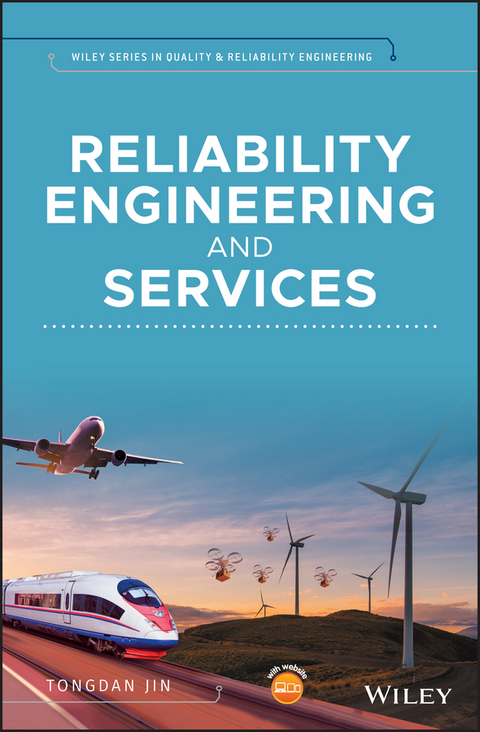
Reliability Engineering and Services (eBook)
John Wiley & Sons (Verlag)
978-1-119-16704-4 (ISBN)
Offers a holistic approach to guiding product design, manufacturing, and after-sales support as the manufacturing industry transitions from a product-oriented model to service-oriented paradigm
This book provides fundamental knowledge and best industry practices in reliability modelling, maintenance optimization, and service parts logistics planning. It aims to develop an integrated product-service system (IPSS) synthesizing design for reliability, performance-based maintenance, and spare parts inventory. It also presents a lifecycle reliability-inventory optimization framework where reliability, redundancy, maintenance, and service parts are jointly coordinated. Additionally, the book aims to report the latest advances in reliability growth planning, maintenance contracting and spares inventory logistics under non-stationary demand condition.
Reliability Engineering and Service provides in-depth chapter coverage of topics such as: Reliability Concepts and Models; Mean and Variance of Reliability Estimates; Design for Reliability; Reliability Growth Planning; Accelerated Life Testing and Its Economics; Renewal Theory and Superimposed Renewals; Maintenance and Performance-Based Logistics; Warranty Service Models; Basic Spare Parts Inventory Models; Repairable Inventory Systems; Integrated Product-Service Systems (IPPS), and Resilience Modeling and Planning
- Guides engineers to design reliable products at a low cost
- Assists service engineers in providing superior after-sales support
- Enables managers to respond to the changing market and customer needs
- Uses end-of-chapter case studies to illustrate industry best practice
- Lifecycle approach to reliability, maintenance and spares provisioning
Reliability Engineering and Service is an important book for graduate engineering students, researchers, and industry-based reliability practitioners and consultants.
Tongdan Jin, PhD, is an Associate Professor in the Ingram School of Engineering at Texas State University. He obtained his Ph.D. in Industrial and Systems Engineering, and MS in Electrical and Computer Engineering, both from Rutgers University. His BS in Electrical and Automation Engineering is from Shaanxi University of Science and Technology, Xian, China. Prior to his academic appointment, he has five-year reliability design and management experience in Teradyne Inc., Boston. He is a recipient of best papers in several international conferences, including Evans-McElroy best paper in 2014 Reliability and Maintainability Conference. He has authored and co-authored over 140 journal and conference papers in reliability modeling and optimization with applications in manufacturing and energy systems. His research has been sponsored by NSF, the US Department of Agriculture, and the US Department of Education. He is the member of IEEE, INFORMS and IISE.
Offers a holistic approach to guiding product design, manufacturing, and after-sales support as the manufacturing industry transitions from a product-oriented model to service-oriented paradigm This book provides fundamental knowledge and best industry practices in reliability modelling, maintenance optimization, and service parts logistics planning. It aims to develop an integrated product-service system (IPSS) synthesizing design for reliability, performance-based maintenance, and spare parts inventory. It also presents a lifecycle reliability-inventory optimization framework where reliability, redundancy, maintenance, and service parts are jointly coordinated. Additionally, the book aims to report the latest advances in reliability growth planning, maintenance contracting and spares inventory logistics under non-stationary demand condition. Reliability Engineering and Service provides in-depth chapter coverage of topics such as: Reliability Concepts and Models; Mean and Variance of Reliability Estimates; Design for Reliability; Reliability Growth Planning; Accelerated Life Testing and Its Economics; Renewal Theory and Superimposed Renewals; Maintenance and Performance-Based Logistics; Warranty Service Models; Basic Spare Parts Inventory Models; Repairable Inventory Systems; Integrated Product-Service Systems (IPPS), and Resilience Modeling and Planning Guides engineers to design reliable products at a low cost Assists service engineers in providing superior after-sales support Enables managers to respond to the changing market and customer needs Uses end-of-chapter case studies to illustrate industry best practice Lifecycle approach to reliability, maintenance and spares provisioning Reliability Engineering and Service is an important book for graduate engineering students, researchers, and industry-based reliability practitioners and consultants.
Tongdan Jin, PhD, is an Associate Professor in the Ingram School of Engineering at Texas State University. He obtained his Ph.D. in Industrial and Systems Engineering, and MS in Electrical and Computer Engineering, both from Rutgers University. His BS in Electrical and Automation Engineering is from Shaanxi University of Science and Technology, Xian, China. Prior to his academic appointment, he has five-year reliability design and management experience in Teradyne Inc., Boston. He is a recipient of best papers in several international conferences, including Evans-McElroy best paper in 2014 Reliability and Maintainability Conference. He has authored and co-authored over 140 journal and conference papers in reliability modeling and optimization with applications in manufacturing and energy systems. His research has been sponsored by NSF, the US Department of Agriculture, and the US Department of Education. He is the member of IEEE, INFORMS and IISE.
1
Basic Reliability Concepts and Models
1.1 Introduction
Reliability is a statistical approach to describing the dependability and the ability of a system or component to function under stated conditions for a specified period of time in the presence of uncertainty. In this chapter, we provide the statistical definition of reliability, and further introduce the concepts of failure rate, hazard rate, bathtub curve, and their relation with the reliability function. We also present several lifetime metrics that are commonly used in industry, such as mean time between failures, mean time to failure, and mean time to repair. For repairable systems, failure intensity rate, mean time between replacements and system availability are the primary reliability measures. The role of line replaceable unit and consumable items in the repairable system is also elaborated. Finally, we discuss the parametric models commonly used for lifetime prediction and failure analysis, which include Bernoulli, binomial, Poisson, exponential, Weibull, normal, lognormal, and gamma distributions. The chapter is concluded with the reliability inference using Bayesian theory and Markov models.
1.2 Reliability Definition and Hazard Rate
1.2.1 Managing Reliability for Product Lifecycle
Reliability engineering is an interdisciplinary field that studies, evaluates, and manages the lifetime performance of components and systems, such as automobile, wind turbines (s), aircraft, Internet, medical devices, power system, and radars, among many others (Blischke and Murthy 2000; Chowdhury and Koval 2009). These systems and equipment are widely used in commercial and defense sectors, ranging from manufacturing, energy, transportation, healthcare, communication, and military operations.
The lifecycle of a product typically consist of five phases: design/development, new product introduction, volume shipment, market saturation, and phase‐out. Figure 1.1 depicts the inter‐dependency of five phases. Reliability plays a dual role across the lifecycle of a product: reliability as engineering () and reliability as services (s). RAE encompasses reliability design, reliability growth planning, and warranty and maintenance. RAS concentrates on the planning and management of a repairable inventory system, spare parts supply, and recycling and remanufacturing of end‐of‐life products. RAE and RAS have been studied intensively, but often separately in reliability engineering and operations management communities. The merge of RAE and RAS is driven primarily by the intense global competition, compressed product design cycle, supply chain volatility, environmental sustainability, and changing customer needs. There is a growing trend that RAE and RAS will be seamlessly integrated under the so‐called product‐service system, which offers a bundled reliability solution to the customers. This book aims to present an integrated framework that allows the product manufacturer to develop and market reliable products with low cost from a product's lifecycle perspective.
Figure 1.1The role of reliability in the lifecycle of a product.
In many industries, reliability engineers are affiliated with a quality control group, engineering design team, supply chain logistics, and after‐sales service group. Due to the complexity of a product, reliability engineers often work in a cross‐functional setting in terms of defining the product reliability goal, advising corrective actions, and planning spare parts. When a new product is introduced to the market, the initial reliability could be far below the design target due to infant mortality, variable usage, latent failures, and other uncertainties. Reliability engineers must work with the hardware and software engineers, component purchasing group, manufacturing and operations department, field support and repair technicians, logistics and inventory planners, and marketing team to identify and eliminate the key root causes in a timely, yet cost‐effective manner. Hence, a reliability engineer requires a wide array of skill sets ranging from engineering, physics, mathematics, statistics, and operations research to business management. Last but not the least, a reliability engineer must possess strong communication capability in order to lead initiatives for corrective actions, resolve conflicting goals among different organization units, and make valuable contributions to product design, volume production, and after‐sales support.
1.2.2 Reliability Is a Probabilistic Measure
Reliability is defined as the ability of a system or component to perform its required functions under stated conditions for a specified period of time (Elsayed 2012; O'Connor 2012). It is often measured as a probability of failure or a possibility of availability. Let T be a non‐negative random variable representing the lifetime of a system or component. Then the reliability function, denoted as R(t), is expressed as
It is the probability that T exceeds an expected lifetime t which is typically specified by the manufacturer or customer. For example, in the renewable energy industry, the owner of the solar park would like to know the reliability of the photovoltaic () system at the end of t = 20 years. Then the reliability of the solar photovoltaic system can be expressed as R(20) = P {T > 20}. As another example, as more electric vehicles (s) enter the market, the consumers are concerned about the reliability of the battery once the cumulative mileage reaches 100 000 km. In that case, t = 100 000 km and the reliability of the EV battery can be expressed as R(100 000) = P {T > 100 000}. Depending on the actual usage profile, the lifetime T can stand for a product's calendar age, mileage, or charge–recharge cycles (e.g. EV battery). The key elements in the definition of Eq. 1.2.1 are highlighted below.
- Reliability is predicted based on “intended function” or “operation” without failure. However, if individual parts are good but the system as a whole does not achieve the intended performance, then it is still classified as a failure. For instance, a solar photovoltaic system has no power output in the night. Therefore, the reliability of energy supply is zero even if solar panels and DC–AC inverters are good.
- Reliability is restricted to operation under explicitly defined conditions. It is virtually impossible to design a system for unlimited conditions. An EV will have different operating conditions than a battery‐powered golf car even if they are powered by the same type of battery. The operating condition and surrounding environment must be addressed during design and testing of a new product.
- Reliability applies to a specified period of time. This means that any system eventually will fail. Reliability engineering ensures that the system with a specified chance will operate without failure before time t.
The relationship between the time‐to‐failure distribution F(t) and the reliability function R(t) is governed by
In statistics, F(t) is also referred to as the cumulative distribution function (). Let f(t) be the probability density function (); the relation between R(t) and f(t) is given as follows:
Example 1.1
High transportation reliability is critical to our society because of increasing mobility of human beings. Between 2008 and 2016 China has built the world's longest high‐speed rail with a total length of 25 000 km. The annual ridership is three billion on average. Since the inception, the cumulative death toll is 40 as of 2016 (Wikipedia 2017). Hence the annual death rate is 40/(2016 − 2008) = 5. The reliability of the ridership is 1 − 5/(3 × 109) = 0.999 999 998. As another example, according to the Aviation Safety Network (ASN 2017), 2016 is the second safest year on record with 325 deaths. Given 3.5 billion passengers flying in the air in that year, the reliability of airplane ridership is 1 − 325/(3.5 × 109) = 0.999 999 91. This example shows that both transportation systems achieve super reliable ridership with eight “9”s for high‐speed rail and seven “9”s in civil aviation.
1.2.3 Failure Rate and Hazard Rate Function
Let t be the start of an interval and Δt be the length of the interval. Given that the system is functioning at time t, the probability that the system will fail in the interval of [t, t + Δt] is
The result is derived based on the Bayes theorem by realizing P{A, B} = P{A}, where A is the event that the system fails in the interval [t, t + Δt] and B is the event that the...
| Erscheint lt. Verlag | 20.12.2018 |
|---|---|
| Reihe/Serie | Quality and Reliability Engineering Series | Wiley Series in Quality and Reliability Engineering |
| Sprache | englisch |
| Themenwelt | Technik ► Elektrotechnik / Energietechnik |
| Technik ► Maschinenbau | |
| Wirtschaft ► Betriebswirtschaft / Management | |
| Schlagworte | Accelerated Life Testing • accelerated stress screening • adaptive inventory • big data informatics • Condition-based Maintenance • corrective action • design for reliability and maintainability • Electrical & Electronics Engineering • Elektrotechnik u. Elektronik • Failure Intensity • Failure in time • failure rate • fault tree analysis, failure mode, effect and criticality analysis • Hazard Rate • installed base • integrated product-service system (IPSS) • latent failure • <p>reliability modeling • Multi-Objective Optimization • multi-state system • new product introduction • no-fault-found • performance-based logistics • product design for reliability • Qualität u. Zuverlässigkeit • Quality & Reliability • Quality Engineering • redundancy allocation • reliability allocation • reliability growth • reliability importance • Reliability Optimization • reliability technologies • reliability variance • renewal integral equation • repairable inventory • Repairable System • Resilience management • resilient system</p> • Service Engineering • service parts logistics management • superimposed renewal • Technische Zuverlässigkeit • two-dimensional warranty • warranty servicing |
| ISBN-10 | 1-119-16704-3 / 1119167043 |
| ISBN-13 | 978-1-119-16704-4 / 9781119167044 |
| Informationen gemäß Produktsicherheitsverordnung (GPSR) | |
| Haben Sie eine Frage zum Produkt? |
 EPUB (Adobe DRM)
Kopierschutz: Adobe-DRM
Adobe-DRM ist ein Kopierschutz, der das eBook vor Mißbrauch schützen soll. Dabei wird das eBook bereits beim Download auf Ihre persönliche Adobe-ID autorisiert. Lesen können Sie das eBook dann nur auf den Geräten, welche ebenfalls auf Ihre Adobe-ID registriert sind.
Details zum Adobe-DRM
Dateiformat: EPUB (Electronic Publication)
EPUB ist ein offener Standard für eBooks und eignet sich besonders zur Darstellung von Belletristik und Sachbüchern. Der Fließtext wird dynamisch an die Display- und Schriftgröße angepasst. Auch für mobile Lesegeräte ist EPUB daher gut geeignet.
Systemvoraussetzungen:
PC/Mac: Mit einem PC oder Mac können Sie dieses eBook lesen. Sie benötigen eine
eReader: Dieses eBook kann mit (fast) allen eBook-Readern gelesen werden. Mit dem amazon-Kindle ist es aber nicht kompatibel.
Smartphone/Tablet: Egal ob Apple oder Android, dieses eBook können Sie lesen. Sie benötigen eine
Geräteliste und zusätzliche Hinweise
Buying eBooks from abroad
For tax law reasons we can sell eBooks just within Germany and Switzerland. Regrettably we cannot fulfill eBook-orders from other countries.
aus dem Bereich