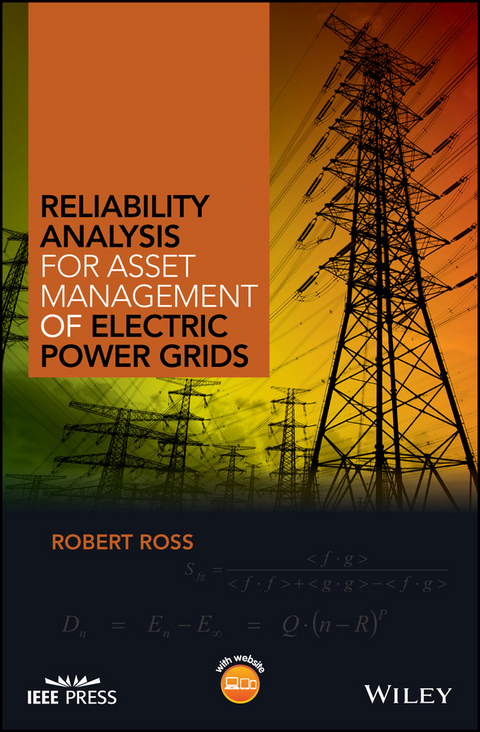
Reliability Analysis for Asset Management of Electric Power Grids (eBook)
John Wiley & Sons (Verlag)
978-1-119-12519-8 (ISBN)
A practical guide to facilitate statistically well-founded decisions in the management of assets of an electricity grid
Effective and economic electric grid asset management and incident management involve many complex decisions on inspection, maintenance, repair and replacement. This timely reference provides statistically well-founded, tried and tested analysis methodologies for improved decision making and asset management strategy for optimum grid reliability and availability.
The techniques described are also sufficiently robust to apply to small data sets enabling asset managers to deal with early failures or testing with limited sample sets. The book describes the background, concepts and statistical techniques to evaluate failure distributions, probabilities, remaining lifetime, similarity and compliancy of observed data with specifications, asymptotic behavior of parameter estimators, effectiveness of network configurations and stocks of spare parts. It also shows how the graphical representation and parameter estimation from analysis of data can be made consistent, as well as explaining modern upcoming methodologies such as the Health Index and Risk Index.
Key features:
- Offers hands-on tools and techniques for data analysis, similarity index, failure forecasting, health and risk indices and the resulting maintenance strategies.
- End-of-chapter problems and solutions to facilitate self-study via a book companion website.
The book is essential reading for advanced undergraduate and graduate students in electrical engineering, quality engineers, utilities and industry strategists, transmission and distribution system planners, asset managers and risk managers.
ROBERT ROSS is a professor at TU Delft, director of IWO (Institute for Science & Development, Ede), a professor at HAN University of Applied Sciences and an Asset Management Research Strategist at TenneT (TSO in the Netherlands and part of Germany). At KEMA he worked on reliability and post-failure forensic investigations.
His interests concern reliability statistics, electro-technical materials, sustainable technology and superconductivity. For energy inventions he was granted the 2004 SenterNovem Annual award and nominated 2006 Best Energy Researcher by the World Technology Network.
This book is based on studies at KEMA and IWO, lectures at KIM (Royal Institute for the Navy), and experience with utilities.
A practical guide to facilitate statistically well-founded decisions in the management of assets of an electricity grid Effective and economic electric grid asset management and incident management involve many complex decisions on inspection, maintenance, repair and replacement. This timely reference provides statistically well-founded, tried and tested analysis methodologies for improved decision making and asset management strategy for optimum grid reliability and availability. The techniques described are also sufficiently robust to apply to small data sets enabling asset managers to deal with early failures or testing with limited sample sets. The book describes the background, concepts and statistical techniques to evaluate failure distributions, probabilities, remaining lifetime, similarity and compliancy of observed data with specifications, asymptotic behavior of parameter estimators, effectiveness of network configurations and stocks of spare parts. It also shows how the graphical representation and parameter estimation from analysis of data can be made consistent, as well as explaining modern upcoming methodologies such as the Health Index and Risk Index. Key features: Offers hands-on tools and techniques for data analysis, similarity index, failure forecasting, health and risk indices and the resulting maintenance strategies. End-of-chapter problems and solutions to facilitate self-study via a book companion website. The book is essential reading for advanced undergraduate and graduate students in electrical engineering, quality engineers, utilities and industry strategists, transmission and distribution system planners, asset managers and risk managers.
ROBERT ROSS is a professor at TU Delft, director of IWO (Institute for Science & Development, Ede), a professor at HAN University of Applied Sciences and an Asset Management Research Strategist at TenneT (TSO in the Netherlands and part of Germany). At KEMA he worked on reliability and post-failure forensic investigations. His interests concern reliability statistics, electro-technical materials, sustainable technology and superconductivity. For energy inventions he was granted the 2004 SenterNovem Annual award and nominated 2006 Best Energy Researcher by the World Technology Network. This book is based on studies at KEMA and IWO, lectures at KIM (Royal Institute for the Navy), and experience with utilities.
Robert Ross?s book gives a deep insight in useful statistical analysis methods for asset management practice. It covers all the basics and specific distributions in a structured and understandable way, before it sets out to give its insight into system and component reliability. I particularly liked the way the subject matter is structured in small and understandable topics. This way it?s easy to ?pick and mix? throughout the different subject matters of the book to acquire the relevant knowledge. One of the other strong suits of the book is the application to real life asset and incident management. Robert links theory and practice together in a way which really shows the value of a statistical and reliability driven approach to asset management. - Marcel Hooijmans, Sr. Specialist Asset Management, Stedin DSO, The Netherlands
This is a well-grounded book that is really good to read! It is informative and accessible and something that would be suitable as a source book for a more general course on engineering statistics and not one specifically directed towards electric power grid assets. Overall the book develops a very solid statistical basis of use in engineering and, particularly reliability analysis. I believe the book is of such general value that it could be used as part of a manufacturing engineering course with relative ease. I think this should probably be on the bookcase of anyone working in asset management of utilities. The material is presented with a logical and paced approach, taking the reader through basic statistics to some quite advanced concepts. - Professor Alistair Duffy, Professor of Electromagnetics and Director of the Institute of Engineering Sciences at De Montfort University, Leicester, UK
Robert Ross creates a comprehensive interface between the statistical analysis and the Asset Management tasks and problems of the electric grid. Many practical examples give a clear and easy understanding of the different subjects?the book is suitable for a direct entry into the topic. Later it can also be used as a reference work, particularly regarding the synoptic tables. This makes the book ideal for students as well as for practical use by asset managers. - Dr. Horst Gunter Bender, TenneT TSO GmbH, Germany
The book features ten chapters, with the main focus on the fundamentals of statistics. The way the book is written makes it possible to be used as supplement to lectures at universities about asset management because of the following points. Each chapter features an introductory paragraph and a section at the end with a summary of the topics covered by that chapter. Furthermore, each chapter provides exemplary questions and exercises which facilitate understanding of the chapter. Additionally, the author supports his argumentation with easily understandable practical examples from the field of electrical engineering. - Nicholas Hill, TU Braunschweig, Germany
Anybody working in asset and incident management of electric power grids will greatly welcome this book if they want to understand and apply the mathematics used for assessing the reliability and availability of components and systems. The author makes a decisive step forward in presenting the knowledge and skills needed for analyzing failure data and constructing reliable systems. Throughout the book, readers can taste the thorough experience of Ross both as a practitioner and as a researcher in the field of reliability analysis. This makes the book a must-have for engineers, asset managers and risk managers who are interested in decision analysis for managing assets of electric power grids. - Rene Janssen, Associate Professor of Mathematics and Operations Research at the Netherlands Defence Academy
Preface
Reliability Analysis for Asset Management of Electric Power Grids aims to provide understanding and skills for analysing data in order to assess the reliability of components and systems. The understanding and skills support not only asset management and maintenance, but also incident management. The latter deals with unexpected failures that need to be evaluated to assist in decision‐making.
The structure of the book is presented in Table 1 below. After an introduction (Chapter 1) that pictures asset management and incident management in qualitative terms, seven chapters follow. The subjects of these chapters are: the basics of statistics (Chapter 2), measures to quantify (Chapter 3), a range of statistical distributions with their aims and properties (Chapter 4), graphical analysis of data (Chapter 5), distribution parameter estimation (Chapter 6), system and component reliability (Chapter 7) and, finally, system states with their reliability, availability and redundancy (Chapter 8). These provide an arsenal of techniques that form a foundation for statistical analysis in asset and incident management. These eight chapters form the core of the course in reliability analysis.
Table 1 Overview of the subjects treated in the book.
Qualitative introduction on:
| Chapter 1 |
| ↓ |
Basics of statistics, addressing:
| Chapter 2 |
| ↓ |
Measures in statistics:
| Chapter 3 |
| ↓ |
The purpose, characteristics and use of various specific distributions:
| Chapter 4 |
| ↓ |
Graphical data analysis and representations of distributions:
| Chapter 5 |
| ↓ |
Parameter estimation:
| Chapter 6 |
| ↓ |
System and component reliability:
| Chapter 7 |
| ↓ |
System states in terms of working versus down:
| Chapter 8 |
| ↕↕ |
Practical applications to asset management and incident management:
| Chapter 9 |
| ↕↕↕ |
Miscellaneous background subjects:
| Chapter 10 |
| Graph template and data tables | Appendices |
The final two chapters (Chapters 9 and 10) aim to provide deeper insight and may be used in parallel with Chapters 1–8. Chapter 9 discusses a range of practical cases from asset management and incident management while using the techniques as explained in the previous chapters. Per case, it is indicated from which section the information is taken. Elements of the sections can be used for illustration during the course to complement the teaching from other chapters. Interested readers from the electric power industry may choose to start with Chapter 9 and select the aspects of reliability analysis that they would like to study more deeply, then follow the references.
Chapter 10 also aims at providing deeper insight, not so much by treating practical cases, but rather by studying a range of subjects in more depth. Depending on the courses given, the topics from this chapter may be added to lectures on Chapters 1–8.
The book covers some relatively new subjects and approaches, such as:
- The difference in the meaning of statistical distribution and probability, as discussed and followed throughout the text.
- Child mortality and the bath tub model, discussed with two different meanings. Statistically often associated with a declining hazard rate, in practice the meaning of child mortality is often encountered as a weak subpopulation which does not necessarily mean a declining hazard rate at all. The two models are discussed.
- The power law concept associated with the ageing dose concept and used for discussing accelerated ageing and testing.
- Asymptotic behaviour of bias and variances, described with a three‐parameter power function. This approach leads to an elegant unbiasing method in parameter estimation.
- The power function also used to approximate the normal distribution.
- The similarity index, introduced to compare distributions, which is useful for evaluating whether two distributions are the same and for estimating the number of failures yet to come. Determining the significance is discussed, and various examples are elaborated.
- Consistency between graphical analysis and parameter estimation, which means that the best fit in a graph is identical to the best fit from parameter estimation.
- Comparable views on the confidence limits based on random sampling (beta distribution) versus linear regression.
- The relation between Monte Carlo simulations and sampling from the ranked cumulative distribution space. Numerical integration and mapping the ranked F‐space is discussed. The effect of quality control testing on the resulting ranked F‐space and confidence limits is demonstrated.
- Much attention is paid to analysing small data sets. It is acknowledged that large data sets are necessary for accurate statistics. On the other hand, data are often scarce, with incident management and timely decision‐making required. While conclusions may not be very accurate, for decision‐making after unexpected failures they may be good enough and – more important – can support timely decision‐making.
- The statistical models related to maintenance models, like corrective, period‐based, condition‐based and risk‐based maintenance, as well as models like the health index, risk index and combined health index.
As shown in Table 1, a range of distributions and plotting methods are discussed, including the Poisson distribution and Crow/AMSAA plots. Five distributions stand out in the discussions:
- Weibull, because it is the asymptotic distribution for the weakest link in the chain, which applies to many failure incidents.
- Exponential, because maintained components and systems tend to have a more or less constant hazard rate, which is a property of the exponential distribution.
- Normal, because it is the asymptotic distribution for the mean and standard deviation. It helps in evaluating the accuracy of regression analysis.
- Beta, for confidence limits and ranked sampling.
- Uniform, which is fundamental to random sampling.
Additional distributions are discussed due to their peculiar properties.
The book is a considerable extension of the manuscript used for courses on system reliability at the Netherlands...
| Erscheint lt. Verlag | 28.12.2018 |
|---|---|
| Reihe/Serie | IEEE Press |
| Wiley - IEEE | Wiley - IEEE |
| Sprache | englisch |
| Themenwelt | Naturwissenschaften ► Physik / Astronomie |
| Technik ► Elektrotechnik / Energietechnik | |
| Schlagworte | Betriebswirtschaft • Betriebswirtschaft u. Operationsforschung • Business & Management • compliancy with specifications • Electrical & Electronics Engineering • Electrical Power • Electricity Grid • electric power systems • Elektrische Energietechnik • Elektrotechnik u. Elektronik • Energie • Energy • failure probability • Health index • Management Science/Operational Research • network configurations • Qualität u. Zuverlässigkeit • Quality & Reliability • remaining lifetime • Risk Index • Technische Zuverlässigkeit • Wirtschaft u. Management |
| ISBN-10 | 1-119-12519-7 / 1119125197 |
| ISBN-13 | 978-1-119-12519-8 / 9781119125198 |
| Informationen gemäß Produktsicherheitsverordnung (GPSR) | |
| Haben Sie eine Frage zum Produkt? |
 EPUB (Adobe DRM)
Kopierschutz: Adobe-DRM
Adobe-DRM ist ein Kopierschutz, der das eBook vor Mißbrauch schützen soll. Dabei wird das eBook bereits beim Download auf Ihre persönliche Adobe-ID autorisiert. Lesen können Sie das eBook dann nur auf den Geräten, welche ebenfalls auf Ihre Adobe-ID registriert sind.
Details zum Adobe-DRM
Dateiformat: EPUB (Electronic Publication)
EPUB ist ein offener Standard für eBooks und eignet sich besonders zur Darstellung von Belletristik und Sachbüchern. Der Fließtext wird dynamisch an die Display- und Schriftgröße angepasst. Auch für mobile Lesegeräte ist EPUB daher gut geeignet.
Systemvoraussetzungen:
PC/Mac: Mit einem PC oder Mac können Sie dieses eBook lesen. Sie benötigen eine
eReader: Dieses eBook kann mit (fast) allen eBook-Readern gelesen werden. Mit dem amazon-Kindle ist es aber nicht kompatibel.
Smartphone/Tablet: Egal ob Apple oder Android, dieses eBook können Sie lesen. Sie benötigen eine
Geräteliste und zusätzliche Hinweise
Buying eBooks from abroad
For tax law reasons we can sell eBooks just within Germany and Switzerland. Regrettably we cannot fulfill eBook-orders from other countries.
aus dem Bereich