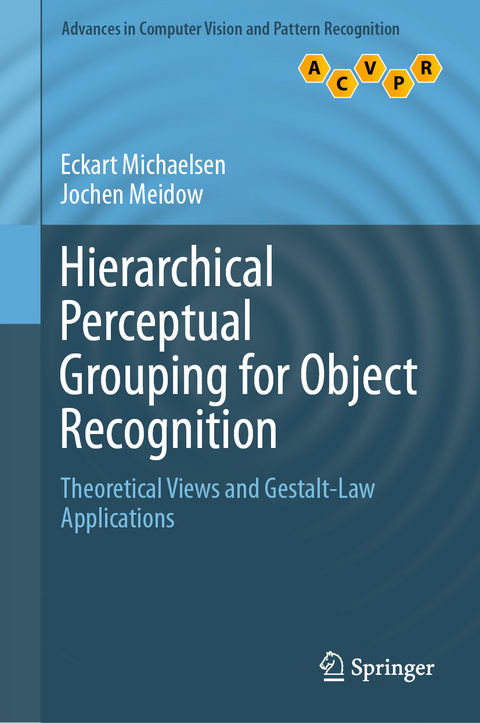
Hierarchical Perceptual Grouping for Object Recognition (eBook)
XI, 195 Seiten
Springer International Publishing (Verlag)
978-3-030-04040-6 (ISBN)

This unique text/reference presents a unified approach to the formulation of Gestalt laws for perceptual grouping, and the construction of nested hierarchies by aggregation utilizing these laws. The book also describes the extraction of such constructions from noisy images showing man-made objects and clutter. Each Gestalt operation is introduced in a separate, self-contained chapter, together with application examples and a brief literature review. These are then brought together in an algebraic closure chapter, followed by chapters that connect the method to the data - i.e., the extraction of primitives from images, cooperation with machine-readable knowledge, and cooperation with machine learning.
Topics and features: offers the first unified approach to nested hierarchical perceptual grouping; presents a review of all relevant Gestalt laws in a single source; covers reflection symmetry, frieze symmetry, rotational symmetry, parallelism and rectangular settings, contour prolongation, and lattices; describes the problem from all theoretical viewpoints, including syntactic, probabilistic, and algebraic perspectives; discusses issues important to practical application, such as primitive extraction and any-time search; provides an appendix detailing a general adjustment model with constraints.This work offers new insights and proposes novel methods to advance the field of machine vision, which will be of great benefit to students, researchers, and engineers active in this area.
Dr.-Ing. Eckart Michaelsen is a researcher at the Object Recognition Department of Fraunhofer IOSB, Ettlingen, Germany.
Dr.-Ing. Jochen Meidow is a researcher at the Scene Analysis Department of the same institution.
Dr.-Ing. Eckart Michaelsen is a researcher at the Object Recognition Department of Fraunhofer IOSB, Ettlingen, Germany.Dr.-Ing. Jochen Meidow is a researcher at the Scene Analysis Department of the same institution.
Preface 6
Contents 8
Notations 12
1 Introduction 13
1.1 Examples of Pictures with Hierarchical Gestalt 13
1.2 The State of the Art of Automatic Symmetry and Gestalt Recognition 17
1.3 The Gestalt Domain 23
1.4 Assessments for Gestalten 26
1.5 Statistically Best Mean Direction or Axis 30
1.6 The Structure of this Book 31
References 33
2 Reflection Symmetry 35
2.1 Introduction to Reflection Symmetric Gestalten 35
2.2 The Reflection Symmetry Constraint as Defined for Extracted Primitive Objects 37
2.3 Reformulation of the Constraint as a Continuous Score Function 39
2.4 Optimal Fitting of Reflection Symmetry Aggregate Features 41
2.5 The Role of Proximity in Evidence for Reflection Symmetry 43
2.6 The Role of Similarity in Evidence for Reflection Symmetry and How to Combine the Evidences 45
2.7 Nested Symmetries Reformulated as Successive Scoring on Rising Scale 47
2.8 Clustering Reflection Symmetric Gestalten with Similar Axes 53
2.9 The Theory of A Contrario Testing and its Application to Finding Reflection Symmetric Patches in Images 58
2.10 The Minimum Description Length Approach for Nested Reflection Symmetry 60
2.11 Projective Symmetry 60
References 62
3 Good Continuation in Rows or Frieze Symmetry 64
3.1 Related Work on Row Gestalt Grouping 66
3.2 The Row Gestalt as Defined on Locations 67
3.3 Proximity for Row Gestalten 69
3.4 The Role of Similarity in Row Gestalten 70
3.4.1 Vector Features 71
3.4.2 Scale Features 73
3.4.3 Orientation Features 74
3.5 Sequential Search 75
3.5.1 The Combinatorics of Row Gestalten 75
3.5.2 Greedy Search for Row Prolongation 76
3.6 The A Contrario Approach to Row Grouping 78
3.7 Perspective Foreshortening of Rows 78
References 80
4 Rotational Symmetry 82
4.1 The Rotational Gestalt Law as Defined on Locations 83
4.2 Fusion with Other Gestalt Laws 86
4.2.1 Proximity Assessments for Rotational Gestalten 86
4.2.2 Similarity Assessments for Rotational Gestalten 88
4.3 Search for Rotational Gestalten 89
4.3.1 Greedy Search for Rotational Gestalten 89
4.3.2 A Practical Example with Rotational Gestalten of Level 1 90
4.4 The Rotational Group and the Dihedral on Group 93
4.5 Perspective Foreshortening of Rotational Gestalts 93
References 95
5 Closure—Hierarchies of Gestalten 96
5.1 Gestalt Algebra 97
5.2 Empirical Experiments with Closure 101
5.3 Transporting Evidence through Gestalt Algebra Terms 103
5.3.1 Considering Additional Features 104
5.3.2 Propagation of Adjustments through the Hierarchy 106
References 111
6 Search 112
6.1 Stratified Search 112
6.2 Recursive Search 113
6.3 Monte Carlo Sampling with Preferences 114
6.4 Any-time Search Using a Blackboard 115
References 116
7 Illusions 118
7.1 Literature about Illusions in Seeing 118
7.2 Deriving Illusion from Top-down Search 119
7.3 Illusion as Tool to Counter Occlusion 119
References 120
8 Prolongation in Good Continuation 121
8.1 Related Work on Contour Chaining, Line Prolongation, and Gap Filling 122
8.2 Tensor Voting 122
8.3 The Linear Prolongation Law and Corresponding Assessment Functions 126
8.4 Greedy Search for Maximal Line Prolongation and Gap Closing 131
8.5 Prolongation in Good Continuation as Control Problem 131
8.6 Illusory Contours at Line Ends 133
References 135
9 Parallelism and Rectangularity 136
9.1 Close Parallel Contours 136
9.2 Drawing on Screens as Graphical User Interface 138
9.3 Orthogonality and Parallelism for Polygons 139
References 142
10 Lattice Gestalten 143
10.1 Related Work on Lattice Grouping 144
10.2 The Lattice Gestalt as Defined on Locations 144
10.3 The Role of Similarity in Lattice Gestalt Grouping 146
10.4 Searching for Lattices 147
10.5 An Example from SAR Scatterers 149
10.6 Projective Distortion 151
References 151
11 Primitive Extraction 153
11.1 Threshold Segmentation 154
11.2 Super-Pixel Segmentation 156
11.3 Maximally Stable Extremal Regions 158
11.4 Scale-Invariant Feature Transform 160
11.5 Multimodal Primitives 162
11.6 Segmentation by Unsupervised Machine Learning 162
11.6.1 Learning Characteristic Colors from a Standard Three Bytes Per Pixel Image 163
11.6.2 Learning Characteristic Spectra from a Hyper-Spectral Image 164
11.7 Local Non-maxima Suppression 167
References 169
12 Knowledge and Gestalt Interaction 170
12.1 Visual Inference 170
12.2 A Small Review on Knowledge-Based Image Analysis 173
12.3 An Example from Remotely Sensed Hyper-spectral Imagery 176
12.4 An Example from Synthetic Aperture RADAR Imagery 178
References 180
13 Learning 181
13.1 Labeling of Imagery for Evaluation and Performance Improvement 181
13.2 Learning Assessment Weight Parameters 184
13.3 Learning Proximity Parameters with Reflection Ground Truth 185
13.4 Assembling Orientation Statistics with Frieze Ground Truth 187
13.5 Estimating Parametric Mixture Distributions from Orientation Statistics 189
References 193
A General Adjustment Model with Constraints 195
References 197
Index 198
| Erscheint lt. Verlag | 1.1.2019 |
|---|---|
| Reihe/Serie | Advances in Computer Vision and Pattern Recognition | Advances in Computer Vision and Pattern Recognition |
| Zusatzinfo | XI, 195 p. 100 illus., 9 illus. in color. |
| Verlagsort | Cham |
| Sprache | englisch |
| Themenwelt | Mathematik / Informatik ► Informatik |
| Mathematik / Informatik ► Mathematik | |
| Technik ► Architektur | |
| Schlagworte | Gestalt laws • Machine vision • Nested hiearchical symmetries • Object recognition • Perceptual grouping • Remote Sensing/Photogrammetry |
| ISBN-10 | 3-030-04040-2 / 3030040402 |
| ISBN-13 | 978-3-030-04040-6 / 9783030040406 |
| Informationen gemäß Produktsicherheitsverordnung (GPSR) | |
| Haben Sie eine Frage zum Produkt? |
 PDF (Wasserzeichen)
DRM: Digitales Wasserzeichen
Dieses eBook enthält ein digitales Wasserzeichen und ist damit für Sie personalisiert. Bei einer missbräuchlichen Weitergabe des eBooks an Dritte ist eine Rückverfolgung an die Quelle möglich.
Dateiformat: PDF (Portable Document Format)
Mit einem festen Seitenlayout eignet sich die PDF besonders für Fachbücher mit Spalten, Tabellen und Abbildungen. Eine PDF kann auf fast allen Geräten angezeigt werden, ist aber für kleine Displays (Smartphone, eReader) nur eingeschränkt geeignet.
Systemvoraussetzungen:
PC/Mac: Mit einem PC oder Mac können Sie dieses eBook lesen. Sie benötigen dafür einen PDF-Viewer - z.B. den Adobe Reader oder Adobe Digital Editions.
eReader: Dieses eBook kann mit (fast) allen eBook-Readern gelesen werden. Mit dem amazon-Kindle ist es aber nicht kompatibel.
Smartphone/Tablet: Egal ob Apple oder Android, dieses eBook können Sie lesen. Sie benötigen dafür einen PDF-Viewer - z.B. die kostenlose Adobe Digital Editions-App.
Buying eBooks from abroad
For tax law reasons we can sell eBooks just within Germany and Switzerland. Regrettably we cannot fulfill eBook-orders from other countries.
aus dem Bereich