Fundamentals of Electroceramics (eBook)
John Wiley & Sons (Verlag)
978-1-119-05728-4 (ISBN)
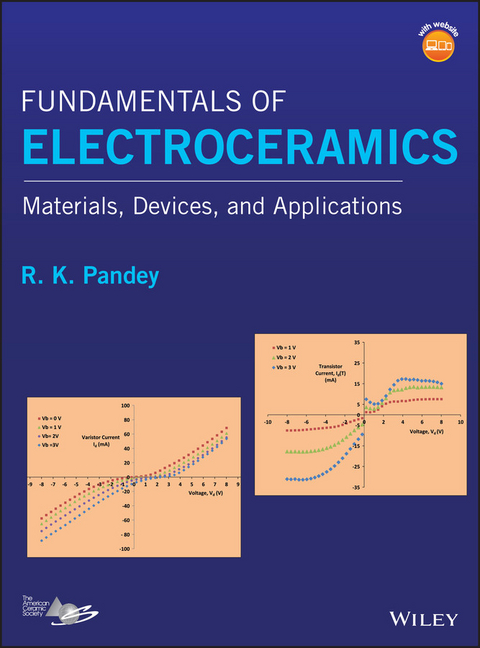
The first textbook to provide in-depth treatment of electroceramics with emphasis on applications in microelectronics, magneto-electronics, spintronics, energy storage and harvesting, sensors and detectors, magnetics, and in electro-optics and acousto-optics
Electroceramics is a class of ceramic materials used primarily for their electrical properties. This book covers the important topics relevant to this growing field and places great emphasis on devices and applications. It provides sufficient background in theory and mathematics so that readers can gain insight into phenomena that are unique to electroceramics. Each chapter has its own brief introduction with an explanation of how the said content impacts technology. Multiple examples are provided to reinforce the content as well as numerous end-of-chapter problems for students to solve and learn. The book also includes suggestions for advanced study and key words relevant to each chapter.
Fundamentals of Electroceramics: Materials, Devices and Applications offers eleven chapters covering: 1.Nature and types of solid materials; 2. Processing of Materials; 3. Methods for Materials Characterization; 4. Binding Forces in Solids and Essential Elements of Crystallography; 5. Dominant Forces and Effects in Electroceramics; 6. Coupled Nonlinear Effects in Electroceramics; 7. Elements of Semiconductor; 8. Electroceramic Semiconductor Devices; 9. Electroceramics and Green Energy; 10.Electroceramic Magnetics; and 11. Electro-optics and Acousto-optics.
Provides an in-depth treatment of electroceramics with the emphasis on fundamental theoretical concepts, devices, and applications with focus on non-linear dielectrics
- Emphasizes applications in microelectronics, magneto-electronics, spintronics, energy storage and harvesting, sensors and detectors, magnetics and in electro-optics and acousto-optics
- Introductory textbook for students to learn and make an impact on technology
- Motivates students to get interested in research on various aspects of electroceramics at undergraduate and graduate levels leading to a challenging career path.
- Includes examples and problem questions within every chapter that prepare students well for independent thinking and learning.
Fundamentals of Electroceramics: Materials, Devices and Applications is an invaluable academic textbook that will benefit all students, professors, researchers, scientists, engineers, and teachers of ceramic engineering, electrical engineering, applied physics, materials science, and engineering.
R. K. Pandey, PhD, is Ingram Professor Emeritus of Texas State University, San Marcos, TX, Cudworth Professor Emeritus of the University of Alabama, Tuscaloosa, AL, and Professor Emeritus of Texas A&M University, College Station, TX. He is also a Fellow of the American Ceramic Society, a Life Senior Member of the IEEE, and a Senior Member of the American Physical Society.
R. K. Pandey, PhD, is Ingram Professor Emeritus of Texas State University, San Marcos, TX, Cudworth Professor Emeritus of the University of Alabama, Tuscaloosa, AL, and Professor Emeritus of Texas A&M University, College Station, TX. He is also a Fellow of the American Ceramic Society, a Life Senior Member of the IEEE, and a Senior Member of the American Physical Society.
Preface
Let us remember: One book, one pen, one child, and one teacher can change the world.
Malala Yousafzai
The word ceramic may be most misunderstood scientific concept so far as its public image is concerned. Most people, when they hear the word ceramic, are likely to think of such things as coffee mugs, glazed pottery, floor tile, or bathroom toilets. It is largely unknown to the public, or even to many scientific communities, that the use of ceramic materials goes far beyond these products.
Ceramic materials by definition are based on inorganic raw materials. Oxides form the leading group of electroceramic materials. Aluminum oxide (Al2O3), silicon carbide (SiC), silicon nitride (Si3N4), titanium oxide (TiO2), iron oxides (FeO, Fe2O3, Fe3O4), zinc oxide (ZnO) and tin oxide (SnO2) are typical examples. As for non‐traditional applications ceramics are used in aerospace and other extreme temperature applications due to their excellent thermal properties; in the medical field, ceramics are used because of their compatible with the human bone; and, in the military ceramics are used for applications such as body armor due to their extreme hardness.
The subject of this book is Electroceramic which is a special category of electronic materials. Electroceramic materials, as the name suggests, conduct electric currents obeying various physical mechanisms of current transport. These materials can exhibit a host of physical properties including high temperature superconductivity, magnetism, semiconductor, electro-optic, acousto-optic and nonlinear dielectrics. Because of their multi-faceted physical and mechanical properties these materials are poised to impact the advancement of ultrafast computer memory technology, green energy technology, sensors and detector technology as well as many other emerging areas of applied sciences and engineering. The field of electroceramic devices and applications is vast and diverse. It already impacts many areas of engineering and basic sciences such as microelectronics, solid‐state sciences, microwave engineering, communication engineering, signal processing, actuators and sensors and micro‐electro mechanical systems (MEMS) technology.
Electroceramic materials possess many interesting physical phenomena and that is what makes them fascinating and attractive for scientific discoveries leading to novel innovations. The physical principles involved in the origin of electroceramic phenomena are intriguing and so diverse that its intellectual challenges can be felt in a wide range of engineering and basic science disciplines. Yet electroceramic is not the household word even among electrical engineers, materials scientists, and applied physicists. Hardly anywhere a course devoted to electroceramics is offered in the US universities for electrical engineers, materials scientists, and physicists. As a result students are deprived of the knowledge in topics specific to electroceramic and its applications. Some examples may include noncentrosymmetric crystals, symmetry elements, piezoelectricity, ferroelectricity, pyroelectricity, multiferroic materials and phenomena, magnetoelectronics, spintronics, coupled hybrid devices, colossal magnetoresistive effect, giant photovoltaic effect, and energy harvesting.
The ignorance about electroceramics is pervasive. For example, many of the electrical engineering graduates and practitioners have never heard of varistor devices though almost all electrical engineering curriculums include a course or two on solid‐state materials and devices. It is disappointing and yet amusing. Bipolar varistors diodes are very useful devices that are present in practically all electrical and electronic circuits as circuit protectors against abrupt surges of current or voltage. Not only that varistors are forerunners of transistors, which are named so because of certain attributes they share with varistors.
Those of us working in the area of electroceramic materials and devices believe that it deserves its own separate presence in the curriculum of electrical engineering, materials science and applied physics; as well as of ceramic engineering, and perhaps also of mechanical and chemical engineering. The nature of elecroceramics is interdisciplinary and therefore, such a course could be cross listed to be taught in many technical disciplines.
The motivation to write this book came to me in the Fall of 2010 when for the first time I offered a special topic course on electroceramics for electrical engineering and physics students at Texas State University, San Marcos, TX. After teaching for 30 plus years, courses on electronic materials and solid‐state sciences at graduate and undergraduate levels at Texas A&M University and at the University of Alabama, I was confident that I would have no problems in handling this course. I had more than enough of my own lecture notes and homework problems on topics related to electroceramics. But finding a good textbook to recommend to students became a formidable enterprise. There are many books on electroceramics, but just one or two that could qualify for a text book. But they are simply too old by now and therefore inadequate for a text book. Many of the new advancements and discoveries made during the last 10–15 years are conspicuously absent in these books. As a result my resolve became stronger to undertake the task of writing a text book on electroceramics. I discussed this informally with many of my friends and colleagues at different universities, and all of us agreed that we need a new text book on the subject. Mr. Mark Mecklenborg and Mr. Greg Geiger of the American Ceramic Society also encouraged me to write such a book.
The book is divided in 11 chapters beginning with the essential elements of solid‐state science and ending in electro‐optics and acousto‐optics. I have done my best to develop each chapter in such a way that a good student can follow the materials easily and enjoy learning about them. Separate chapters are devoted to materials processing, characterization, and crystallography including noncentrosymmetric crystals and symmetry elements. Coupled dielectric phenomena such as piezoelectricity, ferroelectricity, and pyroelectricity have been covered in two chapters; a separate chapter is devoted to electroceramic semiconductors, and so are individual chapters on green energy, magnetism, electro‐optics and acousto‐optics. Each chapter includes some practical examples that should be helpful in understanding the theoretical concepts discussed. I have purposely tried to keep the use of advanced mathematics just adequate enough to make the theoretical concepts understandable without intimidating the students.
Each chapter also includes suggestions for advanced reading for the benefit of interested readers. At the end of each chapter, a glossary of technical terms has been added. Students are advised to look at them first before beginning to read the materials covered in the chapter. Also a set of homework problems have been added to each Chapter. I encourage students to work out all of them thoroughly and completely because it will solidify and amplify their insight into the subject matter and give them confidence and pleasure of learning.
I owe gratitude to a long list of individuals and institutions. First and foremost, I must thank my dear wife, Dr. Christa Pandey, who has been an inspiring influence throughout my long journey in life and supportive of all my professional endeavors. Her unwavering confidence in my abilities to excel professionally has been my strength and has given me the confidence to undertake the challenges that comes naturally in executing a project such as writing a text book.
I also must thank all my former students at Texas A&M University at College Station, and at the University of Alabama at Tuscaloosa, AL, whom I had the honor of teaching one or more courses during the span of 30 years. That experience and the challenges I had to face made me a better class room teacher and a good researcher. But the driving force behind this book were my students at Texas State University at San Marcos, TX, whom I had the pleasure of teaching a special topic course on electroceramics three times. Their enthusiasm and dedication to learning and doing research in labs even as undergraduate seniors were contagious. To all these students, I owe gratitude and give my very sincere thanks for the doors they opened. Thanks also to two of my former graduate students, Dr. Jian Zhong and Dr. Hui Han, who critically reviewed one chapter each and pointed out to some of the lapses which I subsequently corrected.
My gratitude and thanks also to my friends and colleagues, Professor Rick Wilkins of Prairie View A&M University and Professors Ravi Droopad, Harold Stern and William A. Stapleton of Ingram School of Engineering at Texas State University. They were gracious and patient enough to go over two or more chapters and provide me with their suggestions and comments. All of them were valuable suggestions and I have revised these chapters incorporating all of their suggestions,
My thanks go also to my gifted grand‐daughter, Dr. Alysha Kishan, for proposing multiple designs for the cover page and for teaching me the fine points of making good graphics. This has added to the looks and quality of the book. I am thankful to all the publishers who have been gracious enough to grant us permission for reproducing their copyrighted materials. I also owe thanks to institutions such as Sterling C. Evans Library at Texas A&M University and Rodgers Library for Science and Engineering of the University of Alabama for the privilege of...
| Erscheint lt. Verlag | 13.12.2018 |
|---|---|
| Sprache | englisch |
| Themenwelt | Naturwissenschaften ► Chemie |
| Technik ► Elektrotechnik / Energietechnik | |
| Technik ► Maschinenbau | |
| Schlagworte | advanced structural ceramics • Anorganische Elektronik • applied physics • Ceramic Engineering • Ceramics • ceramic technology • Chemie • Chemistry • Electrical Engineering • electroceramic applications • electroceramic devices • electroceramic materials • electroceramic mathematics • electroceramic phenomena • Electroceramics • electroceramic theory • Electrochemistry • Elektrochemie • Elektrokeramik • functional ceramics • Inorganic Electronics • Keramik (Techn.) • keramische Werkstoffe • Materials Science • Materials science and engineering • Materialwissenschaften • physical ceramics • physical properties of ceramics |
| ISBN-10 | 1-119-05728-0 / 1119057280 |
| ISBN-13 | 978-1-119-05728-4 / 9781119057284 |
| Informationen gemäß Produktsicherheitsverordnung (GPSR) | |
| Haben Sie eine Frage zum Produkt? |
 EPUB (Adobe DRM)
Kopierschutz: Adobe-DRM
Adobe-DRM ist ein Kopierschutz, der das eBook vor Mißbrauch schützen soll. Dabei wird das eBook bereits beim Download auf Ihre persönliche Adobe-ID autorisiert. Lesen können Sie das eBook dann nur auf den Geräten, welche ebenfalls auf Ihre Adobe-ID registriert sind.
Details zum Adobe-DRM
Dateiformat: EPUB (Electronic Publication)
EPUB ist ein offener Standard für eBooks und eignet sich besonders zur Darstellung von Belletristik und Sachbüchern. Der Fließtext wird dynamisch an die Display- und Schriftgröße angepasst. Auch für mobile Lesegeräte ist EPUB daher gut geeignet.
Systemvoraussetzungen:
PC/Mac: Mit einem PC oder Mac können Sie dieses eBook lesen. Sie benötigen eine
eReader: Dieses eBook kann mit (fast) allen eBook-Readern gelesen werden. Mit dem amazon-Kindle ist es aber nicht kompatibel.
Smartphone/Tablet: Egal ob Apple oder Android, dieses eBook können Sie lesen. Sie benötigen eine
Geräteliste und zusätzliche Hinweise
Buying eBooks from abroad
For tax law reasons we can sell eBooks just within Germany and Switzerland. Regrettably we cannot fulfill eBook-orders from other countries.
aus dem Bereich