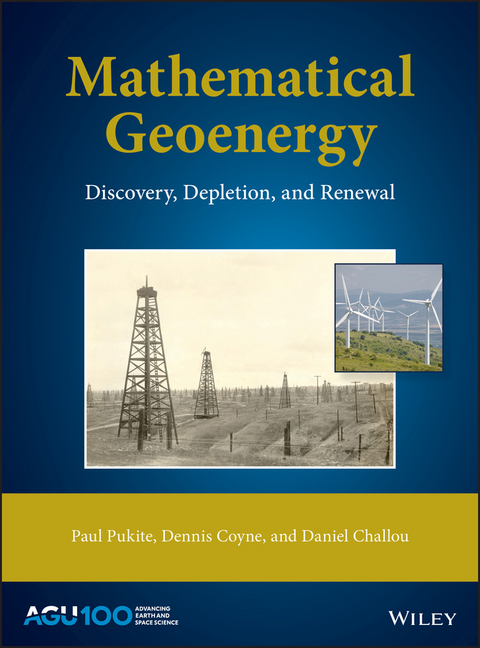
Mathematical Geoenergy (eBook)
384 Seiten
John Wiley & Sons (Verlag)
978-1-119-43433-7 (ISBN)

GeoEnergy encompasses the range of energy technologies and sources that interact with the geological subsurface. Fossil fuel availability studies have historically lacked concise modeling, tending instead toward heuristics and overly-complex processes. Mathematical GeoEnergy: Oil Discovery, Depletion and Renewal details leading-edge research based on a mathematically-oriented approach to geoenergy analysis.
Volume highlights include:
* Applies a formal mathematical framework to oil discovery, depletion, and analysis
* Employs first-order applied physics modeling, decreasing computational resource requirements
* Illustrates model interpolation and extrapolation to fill out missing or indeterminate data
* Covers both stochastic and deterministic mathematical processes for historical analysis and prediction
* Emphasizes the importance of up-to-date data, accessed through the companion website
* Demonstrates the advantages of mathematical modeling over conventional heuristic and empirical approaches
* Accurately analyzes the past and predicts the future of geoenergy depletion and renewal using models derived from observed production data
Intuitive mathematical models and readily available algorithms make Mathematical GeoEnergy: Oil Discovery, Depletion and Renewal an insightful and invaluable resource for scientists and engineers using robust statistical and analytical tools applicable to oil discovery, reservoir sizing, dispersion, production models, reserve growth, and more.
Paul Pukite, BAE Systems, USA Dennis Coyne, PeakOilBarrel.com, USA Daniel Challou, University of Minnesota, USA
Preface vii
1. Introduction to Mathematical Geoenergy 1
2. Stochastic Modeling 5
Part I: Depletion
3. Fossil Fuel Depletion Modeling 13
4. Discovering Oil Reserves 17
5. Analysis of Production and the Shock Model .41
6. Characterizing Discovery, Production, and Reserve Growth 61
7. Comparing the Oil Production Model to Data 85
8. Alternative Characterization and Models 109
9. Models for Future Production 131
Part II: Renewal
10. Energy Transition: Applying Probabilities and Physics 157
11. Wind Energy 167
12. Wave Energy 179
13. Geophysical Energy 205
14. Thermal Energy: Diffusion and Heat Content 213
15. Latent Energy: Hydrological Cycle 225
16. Gravitational Potential Energy: Terrain and Topography 233
17. Solar Energy: Thermodynamic Balance 267
18. Geoenergy Conversion .273
19. Dissipative Energy: Resilience, Durability, and Reliability 291
20. Dispersed Energy: Particulates and Transport in the Environment 305
21. Electromagnetic Energy: Noise and Uncertainty .319
Epilogue 327
Appendix A: The Effect and Role of Feedback 329
Appendix B: Using Pipes and Flow to Compute Convolution 331
Appendix C: Dispersion Analogies 333
Appendix D: Regional Oil Discovery and Production Profiles 341
Appendix E: Compartment Models 343
Appendix F: US Reserve Growth 345
Appendix G: Table of Acronyms 349
Index 351a
| Erscheint lt. Verlag | 30.11.2018 |
|---|---|
| Reihe/Serie | Geophysical Monograph Series | Geophysical Monograph Series |
| Sprache | englisch |
| Themenwelt | Naturwissenschaften ► Geowissenschaften ► Geologie |
| Technik ► Elektrotechnik / Energietechnik | |
| Schlagworte | Angewandte u. ökonomische Geologie • earth sciences • Economic & Applied Geology • Energie • Energy • Erneuerbare Energie • Erneuerbare Energien • Geologie • Geologie u. Geophysik • Geology & Geophysics • Geowissenschaften • renewable energy |
| ISBN-10 | 1-119-43433-5 / 1119434335 |
| ISBN-13 | 978-1-119-43433-7 / 9781119434337 |
| Informationen gemäß Produktsicherheitsverordnung (GPSR) | |
| Haben Sie eine Frage zum Produkt? |
 EPUB (Adobe DRM)
Kopierschutz: Adobe-DRM
Adobe-DRM ist ein Kopierschutz, der das eBook vor Mißbrauch schützen soll. Dabei wird das eBook bereits beim Download auf Ihre persönliche Adobe-ID autorisiert. Lesen können Sie das eBook dann nur auf den Geräten, welche ebenfalls auf Ihre Adobe-ID registriert sind.
Details zum Adobe-DRM
Dateiformat: EPUB (Electronic Publication)
EPUB ist ein offener Standard für eBooks und eignet sich besonders zur Darstellung von Belletristik und Sachbüchern. Der Fließtext wird dynamisch an die Display- und Schriftgröße angepasst. Auch für mobile Lesegeräte ist EPUB daher gut geeignet.
Systemvoraussetzungen:
PC/Mac: Mit einem PC oder Mac können Sie dieses eBook lesen. Sie benötigen eine
eReader: Dieses eBook kann mit (fast) allen eBook-Readern gelesen werden. Mit dem amazon-Kindle ist es aber nicht kompatibel.
Smartphone/Tablet: Egal ob Apple oder Android, dieses eBook können Sie lesen. Sie benötigen eine
Geräteliste und zusätzliche Hinweise
Buying eBooks from abroad
For tax law reasons we can sell eBooks just within Germany and Switzerland. Regrettably we cannot fulfill eBook-orders from other countries.
aus dem Bereich