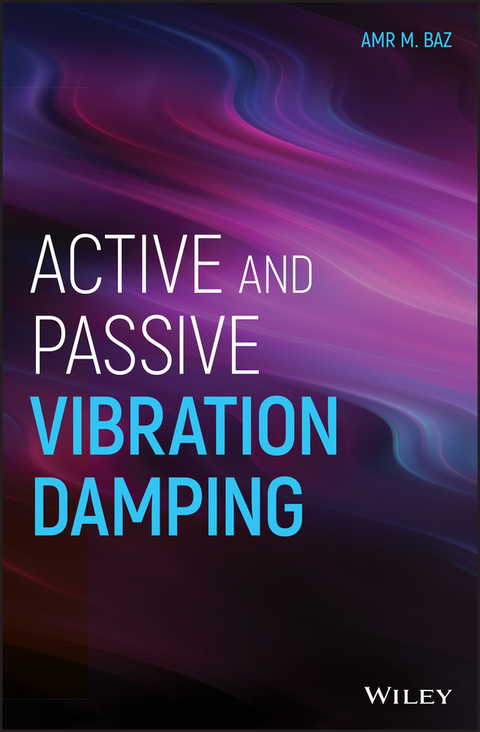
Active and Passive Vibration Damping (eBook)
John Wiley & Sons (Verlag)
978-1-118-53760-2 (ISBN)
A guide to the application of viscoelastic damping materials to control vibration and noise of structures, machinery, and vehicles
Active and Passive Vibration Damping is a practical guide to the application of passive as well as actively treated viscoelastic damping materials to control vibration and noise of structures, machinery and vehicles. The author - a noted expert on the topic - presents the basic principles and reviews the potential applications of passive and active vibration damping technologies. The text presents a combination of the associated physical fundamentals, governing theories and the optimal design strategies of various configurations of vibration damping treatments.
The text presents the basics of various damping effective treatments such as constrained layers, shunted piezoelectric treatments, electromagnetic and shape memory fibers. Classical and new models are included as well as aspects of viscoelastic materials models that are analyzed from the experimental characterization of the material coefficients as well as their modeling. The use of smart materials to augment the vibration damping of passive treatments is pursued in depth throughout the book. This vital guide:
- Contains numerical examples that reinforce the understanding of the theories presented
- Offers an authoritative text from an internationally recognized authority and pioneer on the subject
- Presents, in one volume, comprehensive coverage of the topic that is not available elsewhere
- Presents a mix of the associated physical fundamentals, governing theories and optimal design strategies of various configurations of vibration damping treatments
Written for researchers in vibration damping and research, engineers in structural dynamics and practicing engineers, Active and Passive Vibration Damping offers a hands-on resource for applying passive as well as actively treated viscoelastic damping materials to control vibration and noise of structures, machinery and vehicles.
AMR M. BAZ, PHD, is Minta-Martin Chair Professor and Director of Smart Materials and Structures Research Center, Mechanical Engineering Department, University of Maryland, USA. His research interests include active and passive control of vibration and noise, active constrained layer damping, magnetic composites, virtual reality design of smart structures, active periodic structures, active acoustic meta-materials, and non-reciprocal acoustic metamaterials.
A guide to the application of viscoelastic damping materials to control vibration and noise of structures, machinery, and vehicles Active and Passive Vibration Damping is a practical guide to the application of passive as well as actively treated viscoelastic damping materials to control vibration and noise of structures, machinery and vehicles. The author a noted expert on the topic presents the basic principles and reviews the potential applications of passive and active vibration damping technologies. The text presents a combination of the associated physical fundamentals, governing theories and the optimal design strategies of various configurations of vibration damping treatments. The text presents the basics of various damping effective treatments such as constrained layers, shunted piezoelectric treatments, electromagnetic and shape memory fibers. Classical and new models are included as well as aspects of viscoelastic materials models that are analyzed from the experimental characterization of the material coefficients as well as their modeling. The use of smart materials to augment the vibration damping of passive treatments is pursued in depth throughout the book. This vital guide: Contains numerical examples that reinforce the understanding of the theories presented Offers an authoritative text from an internationally recognized authority and pioneer on the subject Presents, in one volume, comprehensive coverage of the topic that is not available elsewhere Presents a mix of the associated physical fundamentals, governing theories and optimal design strategies of various configurations of vibration damping treatments Written for researchers in vibration damping and research, engineers in structural dynamics and practicing engineers, Active and Passive Vibration Damping offers a hands-on resource for applying passive as well as actively treated viscoelastic damping materials to control vibration and noise of structures, machinery and vehicles.
AMR M. BAZ, PHD, is Minta-Martin Chair Professor and Director of Smart Materials and Structures Research Center, Mechanical Engineering Department, University of Maryland, USA. His research interests include active and passive control of vibration and noise, active constrained layer damping, magnetic composites, virtual reality design of smart structures, active periodic structures, active acoustic meta-materials, and non-reciprocal acoustic metamaterials.
List of Symbols
| Symbol | Meaning | Units |
| a | Dimension of a plate side | m |
| a | Dilatation or contraction scaling parameter of wavelets Area | —m2 |
| A | Magnetic potential | Ampere |
| A ATF | Affinity of the ATF model (=−∂f ATF /∂z ) | N m−2 °K−1 |
| [ ] | The correspondence concentration factors of phase, r | — |
| b | Dimension of a plate side | m |
| b | Translation parameter of wavelets | s |
| B | Input state‐space matrix | — |
| B | Magnetic induction | Tesla |
| B* , 0 | Characteristics complex length of passive treatments | m |
| B 0 | The magnetic flux density | Tesla |
| B F | The structural susceptance matrix | m (Ns)−1 |
| [ ] | The correspondence concentration factors of phase, r | — |
| c | The sound speed | m s−1 |
| c c | The critical damping coefficient ( ) | Ns m−1 |
| c d | Damping coefficient of dissipative element | Ns m−2 |
| [c *] | Complex stiffness matrix | N m−2 |
| [ ] | Complex stiffness matrix of phase, r | N m−2 |
| C | Measurement state‐space matrix Capacitance | —Farad |
| C G | Control parameter | — |
| C S | Strain‐free capacitance | Farad |
| C T | Stress‐free capacitance | Farad |
| d ij | Piezo‐strain constants in the i and j directions due to applied electric field in the k direction | m V−1 |
| D | Energy dissipated during a full vibration cycle of the viscoelastic material | Nm |
| D | Denominator of a transfer function | — |
| D | Nano‐particle diameter | m |
| D a | Distance between neutral axis of entire sandwiched beam and piezo‐actuator | m |
| D i | Electrical displacement along the ith direction | Coulomb m−2 |
| Complex bending stiffness (= D t (1 + iη B )) | Nm2 |
| [D i ] | Stiffness matrix relating the stress and strain vectors | N m−2 |
| e | Electron charge (=1.60217662 × 10⁻¹⁹ Coulombs) | Coulomb |
| e | Power flow error | Nm s−1 |
| e 31 | Piezoelectric charge/strain constant (= ) | m3 (N V) −1 |
| E | Young's modulus | N m−2 |
| E i | Electrical field along the ith direction | V m−1 |
| E n | Total energy (E n = PE + KE ) | Nm |
| E(t) | Relaxation modulus | N m−2 |
| E′ | Storage modulus | N m−2 |
| E ″ | Loss modulus | N m−2 |
| E * | Complex relaxation modulus | N m−2 |
| E 0 | Equilibrium modulus | N m−2 |
| E i | Relaxation strength | N m−2 |
| E ∞ | Instantaneous modulus of GMM Un‐relaxed or high frequency modulus of elasticity | N m−2 |
| E i A i | Longitudinal rigidity | N |
| E i I i | Flexural rigidity | Nm2 |
| EQ | Product of elastic modulus and first moment of area | Nm2 |
| f | Frequency | rad s−1, Hz |
| f ATF | Helmholtz free energy density of the ATF model | N m−2 |
| F | Force | N |
| F c | Control force | N |
| F m | Magnetic forces | N |
| {F} | Force and moment vector | N, NM |
| g | The shear factor of constrained damping treatments | — |
| g 31 | The piezoelectric voltage constant (=d 31/ε 33 ) | m V−1 |
| G′ | Storage modulus in shear | N m−2 |
| G ″ | Loss modulus in shear | N m−2 |
| G * | Complex modulus in shear | N m−2 |
| G F | The structural conductance matrix | m (Ns) −1 |
| h | Layer thickness | m |
| h P | Plank constant (= 6.626 × 10⁻³⁴) | m2 kg s−1 |
| H | Magnetic field | Ampere m−1 |
| i | The “unit” imaginary number = | — |
| I | Area moment of inertia | m4 |
| I | Performance Index | — |
| I | Current density | Amperes m−2 |
| I x,y | Structural intensity | Nm (sm) −1 |
| J * | Complex creep compliance | m2 N−1 |
| J j | Retardation strength | N m−2 |
| Fourier transform of creep compliance | m |
| J | Performance index | — |
| J | Jacobian matrix | — |
| K, k | Stiffness | N m−1 |
| K d,p | Derivative and proportional controller gains | — |
| K geo e | Element geometric matrix | — |
| K g | Gain of the controller | — |
| K v,D | Gain of velocity (or derivative) feedback controller | Ns m−1 |
| The electro‐mechanical coupling factor | — |
| Complex bending wave number ( ) | 1 m−1 |
| k r | Ratio between derivative and proportional control gains | — |
| k x,y | Wave numbers in the x and y directions | 1 m−1 |
| k r,i | Real and imaginary... |
| Erscheint lt. Verlag | 7.12.2018 |
|---|---|
| Sprache | englisch |
| Themenwelt | Technik ► Maschinenbau |
| Schlagworte | Active and passive periodic structures • active piezoelectric damping composites • Aeronautic & Aerospace Engineering • augmented temperature field • Cole-Cole plot • complex modulus • creep compliance • Dämpfung • damping by nano-particle composites. Vibration energy flow distribution by damping control • desirable damping characteristics • different sinusoidal excitations • DMTA • dynamic mechanical thermal analysis • Elastomers • Electrical & Electronics Engineering • Elektrotechnik u. Elektronik • fading memory phenomenon • fractional derivatives • glass transition temperature • Golla-Hughes-McTavish model • Guide to Active and Passive Vibration Damping • Intelligente Systeme u. Agenten • Intelligent Systems & Agents • Luft- u. Raumfahrttechnik • magnetic damping treatments • Maschinenbau • Maschinenbau - Entwurf • master curves • mechanical engineering • Mechanical Engineering - Design • mechanisms for dissipating the energy of vibrating structure • modal strain energy • multi-modal shunted piezoelectric networks • Piezoelectric • propagation parameter • quantitative measure of VEM • relaxation modulus • Resource to Active and Passive Vibration Damping • shear deformation • stand-off damping treatment • Storage Modulus • Text on Active and Passive Vibration Damping • topology optimization of damping treatments • Understanding Active and Passive Vibration Damping • VEM • Vibration • viscoelastic damping layer • wave propagates between adjacent cells • Wicket plot |
| ISBN-10 | 1-118-53760-2 / 1118537602 |
| ISBN-13 | 978-1-118-53760-2 / 9781118537602 |
| Informationen gemäß Produktsicherheitsverordnung (GPSR) | |
| Haben Sie eine Frage zum Produkt? |
 EPUB (Adobe DRM)
Kopierschutz: Adobe-DRM
Adobe-DRM ist ein Kopierschutz, der das eBook vor Mißbrauch schützen soll. Dabei wird das eBook bereits beim Download auf Ihre persönliche Adobe-ID autorisiert. Lesen können Sie das eBook dann nur auf den Geräten, welche ebenfalls auf Ihre Adobe-ID registriert sind.
Details zum Adobe-DRM
Dateiformat: EPUB (Electronic Publication)
EPUB ist ein offener Standard für eBooks und eignet sich besonders zur Darstellung von Belletristik und Sachbüchern. Der Fließtext wird dynamisch an die Display- und Schriftgröße angepasst. Auch für mobile Lesegeräte ist EPUB daher gut geeignet.
Systemvoraussetzungen:
PC/Mac: Mit einem PC oder Mac können Sie dieses eBook lesen. Sie benötigen eine
eReader: Dieses eBook kann mit (fast) allen eBook-Readern gelesen werden. Mit dem amazon-Kindle ist es aber nicht kompatibel.
Smartphone/Tablet: Egal ob Apple oder Android, dieses eBook können Sie lesen. Sie benötigen eine
Geräteliste und zusätzliche Hinweise
Buying eBooks from abroad
For tax law reasons we can sell eBooks just within Germany and Switzerland. Regrettably we cannot fulfill eBook-orders from other countries.
aus dem Bereich