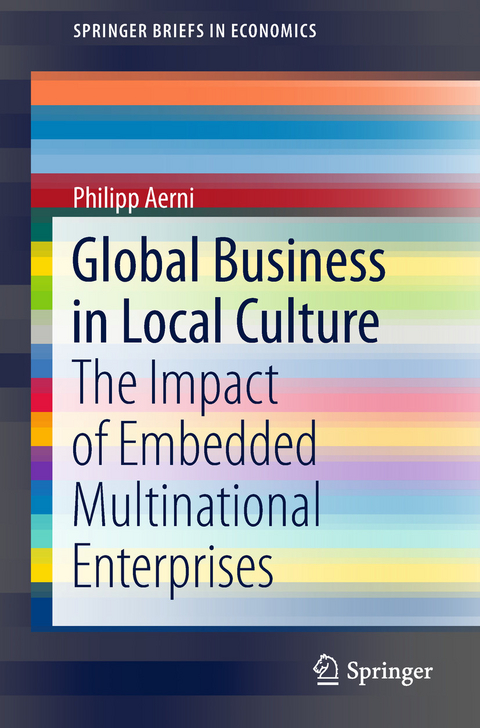
Global Business in Local Culture (eBook)
122 Seiten
Springer-Verlag
9783030037987 (ISBN)
Philipp Aerni is Director of the Center for Corporate Responsibility and Sustainability (CCRS). He received his Master’s in Geography from the University of Zurich and completed his PhD in agricultural economics at the ETH Zurich. Prior to his position at the CCRS, Dr. Aerni was a research fellow at Harvard University, the ETH Zurich, the University of Berne, and the Food and Agriculture Organisation of the United Nations (FAO).
Preface 6
Contents 11
Acronyms 14
1 Introduction 16
1.1 Karl Polanyi’s Influence in the Globalization Debate of the 21st Century 18
1.2 The Bipolar Mindset in Academia, Civil Society and Government 19
1.3 Acknowledging the Value of Companies Committed to ‘Principled Embeddedness’ 21
1.4 When MNEs Become Part of the Solution Rather Than Part of the Problem 23
1.5 Of Myths and Movements 24
2 Societal Foundations of Economic Development 27
2.1 Polanyi as the Common Denominator of Post-structuralism and Neoclassical Economics 28
2.2 No Such Thing as a ‘Globalization Paradox’ 28
2.3 Polanyi as ‘Intellectual Guide’ in Economics and Anthropology 32
3 Neoliberalism: A Mythical and Meaningful Term Devoid of Any Deep Thought 34
3.1 Did the Rent-Seeking Economy of Feudalism Serve the Needs of the People? 35
3.2 The Enclosure Movement in the UK as the Beginning of Industrial Agriculture 36
3.3 Blaming Agricultural Trade Has Never Solved Any Food Security Problem 37
3.4 Fernand Braudel’s Criticism of Polanyi’s Interpretation of History 38
3.5 Why Polanyi’s Bipolar Framing Finds Fertile Ground 39
4 The Impact of Popular Stereotypes in Academic Research and Public Policy 42
4.1 Echo Chambers: The Attack on Democracy from Within 43
4.2 Embedded Liberalism: A Flawed Concept 44
4.2.1 The Artificial Separation of the ‘Authentic’ Local from the ‘Generic’ Global Product 45
4.2.2 Governments as the Blameless Defenders Against Careless Big Business 46
4.2.3 Why More Regulation Does not Lead to More Public Trust: The Case of GMOs 47
4.2.4 Self-Regulation in Industry as a Base for Subsequent Government Regulation 48
4.2.5 Why the Ruggie Framework May Not Be Harmless 48
4.3 Indigenous Communities as Projection Screens for Preserved Cultural Embeddedness 49
4.3.1 How the Indian Chipko Movement Became a Symbol of NIMBY Environmentalism 51
4.3.2 Myths Embodied in Scientific Models that Guide Academic Research 54
4.3.3 ‘Epistemic Brokers’ in Postmaterial Societies: The Case of Vandana Shiva 56
4.3.4 Cultural Appropriation and Denial of Local Agency 59
4.3.5 The Temptation in Academia to Uncritically Embrace Environmental Narratives 61
5 The New Understanding of the Term ‘Embeddedness’ in Economic Sociology 63
5.1 The Moral Dimension of Entrepreneurship 64
5.2 Embeddedness as a Way to Address Three Major Coordination Problems 64
5.3 Value as a Coordination Problem 65
5.4 Competition as a Coordination Problem 66
5.5 Cooperation as a Coordination Problem 68
5.6 Embeddedness in the Context of Economic Complexity 70
6 Economic Globalization as a “Disembedding” Force? 72
6.1 Why Disembedding Traditional Structures May Help Outsiders 73
6.2 Disembedding Post-Colonial Structures 74
6.3 How FDI Contributed to Catch-up Growth and Economic Empowerment 75
6.4 ‘Knowledge’, an Underused Resource in Efforts to Cope with Environmental Challenges 77
6.5 The Failure of Foreign Aid to Empower Local Entrepreneurs Through Economic Integration 78
6.5.1 Self-Serving Nature of Swiss Sustainable Trade Promotion and Development Research 79
6.5.2 How the Anti-business Rhetoric of Epistemic Brokers Supports Incumbents 82
6.5.3 Local Growth-Oriented Entrepreneurs as Drivers of Economic Integration 82
7 Embedded MNEs and Their Contribution to Sustainable Change 84
7.1 Coping with Business Coordination Problems Through a Strategy of ‘Principled Embeddedness’ 85
7.2 The UNGP and Its Potential Conflict with Principled Embeddedness 86
7.3 The Role of Subsidiaries of MNEs in Developing Countries 87
7.4 Selected Cases of ‘Principled Embeddedness’ of Subsidiaries of MNEs 88
7.4.1 Nestlé Philippines: An Locally Embedded Company 89
7.4.2 Syngenta’s Contribution to Capacity Development for Agricultural Innovation 90
7.4.3 Bata Shoes: Creating Welfare by Taking Rather Than Avoiding Risk 92
7.4.4 The Responsible Entrepreneur and the Selfless Communist 94
7.4.5 Chiquita: A Pioneer in Sustainable Banana Production with a Legacy Problem 95
7.4.6 The Problem with Business to Consumer Labels in Agriculture 97
7.5 Embeddedness and Its Link to Sustainability and Corporate Responsibility 98
8 Development Cooperation as a Catalyst for Sustainable Long-Term FDI 100
8.1 How Development Assistance (DA) Could Encourage Foreign Direct Investment (FDI) 102
8.1.1 Sourcing Ingredients for Beer Production in Uganda 103
8.1.2 Empowering Pastoralists Through Business Development in Kenya 104
8.1.3 Enabling Access to Finance: The Case of Vodafone 105
8.2 Lessons Learned from Public-Private Partnerships (PPPs) 107
9 Concluding Remarks 109
References 121
| Erscheint lt. Verlag | 8.12.2018 |
|---|---|
| Reihe/Serie | SpringerBriefs in Economics | SpringerBriefs in Economics |
| Zusatzinfo | XVI, 122 p. |
| Verlagsort | Cham |
| Sprache | englisch |
| Themenwelt | Recht / Steuern ► EU / Internationales Recht |
| Sozialwissenschaften ► Soziologie | |
| Technik | |
| Wirtschaft ► Betriebswirtschaft / Management ► Unternehmensführung / Management | |
| Schlagworte | Anti-globalization rhetoric • Corporate Social Responsibility • Embeddedness • Foreign Direct Investments • Globalization • Global knowledge economy • GMOs • Human Rights • Karl Polanyi • Multinational Enterprises • Public-private Partnerships • sustainability • UN Sustainable Development Goals |
| ISBN-13 | 9783030037987 / 9783030037987 |
| Informationen gemäß Produktsicherheitsverordnung (GPSR) | |
| Haben Sie eine Frage zum Produkt? |
 PDF (Wasserzeichen)
DRM: Digitales Wasserzeichen
Dieses eBook enthält ein digitales Wasserzeichen und ist damit für Sie personalisiert. Bei einer missbräuchlichen Weitergabe des eBooks an Dritte ist eine Rückverfolgung an die Quelle möglich.
Dateiformat: PDF (Portable Document Format)
Mit einem festen Seitenlayout eignet sich die PDF besonders für Fachbücher mit Spalten, Tabellen und Abbildungen. Eine PDF kann auf fast allen Geräten angezeigt werden, ist aber für kleine Displays (Smartphone, eReader) nur eingeschränkt geeignet.
Systemvoraussetzungen:
PC/Mac: Mit einem PC oder Mac können Sie dieses eBook lesen. Sie benötigen dafür einen PDF-Viewer - z.B. den Adobe Reader oder Adobe Digital Editions.
eReader: Dieses eBook kann mit (fast) allen eBook-Readern gelesen werden. Mit dem amazon-Kindle ist es aber nicht kompatibel.
Smartphone/Tablet: Egal ob Apple oder Android, dieses eBook können Sie lesen. Sie benötigen dafür einen PDF-Viewer - z.B. die kostenlose Adobe Digital Editions-App.
Buying eBooks from abroad
For tax law reasons we can sell eBooks just within Germany and Switzerland. Regrettably we cannot fulfill eBook-orders from other countries.
aus dem Bereich