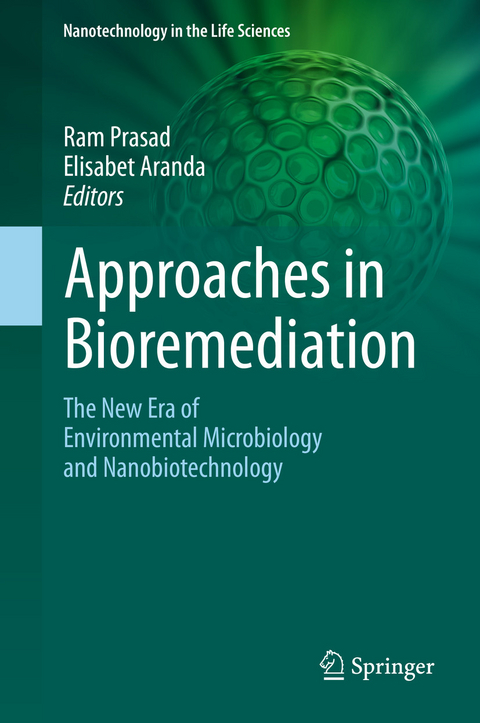
Approaches in Bioremediation (eBook)
403 Seiten
Springer International Publishing (Verlag)
978-3-030-02369-0 (ISBN)

Bioremediation refers to the clean-up of pollution in soil, groundwater, surface water, and air using typically microbiological processes. It uses naturally occurring bacteria and fungi or plants to degrade, transform or detoxify hazardous substances to human health or the environment.
For bioremediation to be effective, microorganisms must enzymatically attack the pollutants and convert them to harmless products. As bioremediation can be effective only where environmental conditions permit microbial growth and action, its application often involves the management of ecological factors to allow microbial growth and degradation to continue at a faster rate. Like other technologies, bioremediation has its limitations. Some contaminants, such as chlorinated organic or high aromatic hydrocarbons, are resistant to microbial attack. They are degraded either gradually or not at all, hence, it is not easy to envisage the rates of clean-up for bioremediation implementation.Bioremediation represents a field of great expansion due to the important development of new technologies. Among them, several decades on metagenomics expansion has led to the detection of autochthonous microbiota that plays a key role during transformation. Transcriptomic guides us to know the expression of key genes and proteomics allow the characterization of proteins that conduct specific reactions. In this book we show specific technologies applied in bioremediation of main interest for research in the field, with special attention on fungi, which have been poorly studied microorganisms. Finally, new approaches in the field, such as CRISPR-CAS9, are also discussed. Lastly, it introduces management strategies, such as bioremediation application for managing affected environment and bioremediation approaches. Examples of successful bioremediation applications are illustrated in radionuclide entrapment and retardation, soil stabilization and remediation of polycyclic aromatic hydrocarbons, phenols, plastics or fluorinated compounds. Other emerging bioremediation methods include electro bioremediation, microbe-availed phytoremediation, genetic recombinant technologies in enhancing plants in accumulation of inorganic metals, and metalloids as well as degradation of organic pollutants, protein-metabolic engineering to increase bioremediation efficiency, including nanotechnology applications are also discussed.
Ram Prasad, Ph.D. is associate with Amity Institute of Microbial Technology, Amity University, Uttar Pradesh, India since 2005. His research interest includes plant-microbe-interactions, sustainable agriculture and microbial nanobiotechnology. Dr. Prasad has more than hundred publications to his credit, including research papers, review articles & book chapters and five patents issued or pending, and edited or authored several books. Dr. Prasad has twelve years of teaching experience and he has been awarded the Young Scientist Award (2007) & Prof. J.S. Datta Munshi Gold Medal (2009) by the International Society for Ecological Communications; FSAB fellowship (2010) by the Society for Applied Biotechnology; the American Cancer Society UICC International Fellowship for Beginning Investigators, USA (2014); Outstanding Scientist Award (2015) in the field of Microbiology by Venus International Foundation; BRICPL Science Investigator Award (ICAABT-2017) and Research Excellence Award (2018). He has been serving as editorial board members: Frontiers in Microbiology, Frontiers in Nutrition, Academia Journal of Biotechnology including Series editor of Nanotechnology in the Life Sciences, Springer Nature, USA. Previously, Dr. Prasad served as Visiting Assistant Professor, Whiting School of Engineering, Department of Mechanical Engineering at Johns Hopkins University, USA and presently, working as Research Associate Professor at School of Environmental Sciences and Engineering, Sun Yat-Sen University, Guangzhou, China. Elisabet Aranda, PhD is Ramon y Cajal Researcher at the Microbiology Department of the University of Granada (UGR), and member of the Institute of Water Research (UGR). She has more than sixteen years of research experience. She has several pre and post-doctoral research stays (Estación Experimental del Zaidín, Spanish National Research Council (CSIC), Spain; University of Naples Federico II, Italy; Institute of Mass Spectrometry, Proteomic and Molecular Biology, Italy; IHIZ Zittau-Technical University of Dresde, Germany; Lawrence Berkeley National Laboratory of the University of California, USA, among others). Her main research expertise is in the field of fungal bioremediation, fungal degradation mechanisms of priority micropollutants and emerging contaminants, in water and soil systems, and the application of molecular tools such as NGS (Illumina) and proteomic approaches in this field. She has published more than fifty publications in this topic (including research papers, review articles and book chapters). She is the inventor of two patents. She is associate Editor in Frontiers in Microbiology, and member of Board of Directors of the specialized group “Biodeterioration, Biodegradation and Bioremediation” of the Spanish Society of Microbiology (SEM). Among the prizes with which it has been awarded, stands out the “Innova Sustainable” award from the Aquae foundation.
Foreword 6
Preface 8
Contents 10
Contributors 12
About the Editors 16
Chapter 1: Stepwise Strategies for the Bioremediation of Contaminated Soils: From the Microbial Isolation to the Final Application 18
1.1 Introduction 19
1.2 Niche: Selection of the Right Place for Microbial Isolation 19
1.2.1 Bioremediation Strategies and Microorganisms 19
1.3 Microbial Isolation 22
1.3.1 Soil Sampling Design 23
1.3.1.1 Sample Collection and Transportation 24
1.3.1.2 Samples Processing and Storage 25
1.3.2 Isolation of Microorganisms and Metagenomic Analysis 26
1.3.2.1 Metagenomic Analysis 26
1.4 Bacterial Population Extraction from the Soil Matrix 26
1.4.1 Bioremediation-Oriented Microbial Isolation 27
1.4.2 Selection and Characterization of Microorganisms for Soil Bioremediation 28
1.4.2.1 Selection of Microorganisms for Bioremediation 28
1.4.2.2 Characterization of Selected Microorganisms 29
Morphological Characterization 29
Metabolic Characterization 30
Enzymatic Characterization 30
Biosurfactant Production 31
Siderophore Synthesis 32
1.5 Molecular Omics Technologies in Microorganisms’ Selection and Characterization 32
1.5.1 Metagenomics 32
1.5.2 Metatranscriptomics 33
1.5.3 Metaproteomics 33
1.5.4 Metabolomics 34
1.6 Microbial Features Involved in Resistance Against Pollutants 35
1.6.1 Removal of the Pollutant by Biomineralization 36
1.6.2 Synthesis of Carotenoids 37
1.6.3 Production of Exocellular Polymeric Substances 38
1.7 Taking Advantage of Special Features Observed in Microorganisms That Tolerate Pollutants and Extreme Conditions 39
1.8 Final Comments 39
References 40
Chapter 2: Transcriptomics as a First Choice Gate for Fungal Biodegradation Processes Description 46
2.1 Introduction: Fungal Bioremediation (Mycoremediation) 46
2.2 Molecular Approaches in Fungal Bioremediation 48
2.3 Fungal Transcriptomic Perspectives 54
2.4 Concluding Remarks 55
References 56
Chapter 3: Omics Approaches: Impact on Bioremediation Techniques 60
3.1 The Uprising of the “Omics” 60
3.2 The Promises of Metagenomics 62
3.3 Transcriptomics 64
3.4 Proteomic in a Degradation Concept 65
3.4.1 Metaproteomic 69
References 75
Chapter 4: Potential for CRISPR Genetic Engineering to Increase Xenobiotic Degradation Capacities in Model Fungi 77
4.1 Xenobiotic Compounds 77
4.2 Environmental Biotechnology Using Fungi 79
4.3 The Relevance of Gene Databases in Fungal Engineering 81
4.4 Earlier Biotechnologies for Gene Manipulation 83
4.5 An Introduction to CRISPR/Cas Theory and Methodology 86
4.6 Potential Experiments and Future Directions for Manipulating Fungal Xenobiotic Metabolism 88
4.7 Conclusion 89
References 89
Chapter 5: Phytoremediation and Fungi: An Underexplored Binomial 95
5.1 Environmental Pollution: A General Background 95
5.2 Remediation Technologies 96
5.3 Biological Treatments 99
5.3.1 Bacteria 100
5.3.2 Fungi 101
5.3.3 Phytoremediation 102
5.4 Phytoremediation and Fungi: Cases of Study and Perspectives 104
References 107
Chapter 6: Bioremediation of Polythenes and Plastics: A Microbial Approach 112
6.1 Introduction 112
6.2 Environmental Effects of Plastic Pollution 113
6.3 Microbial Role in Biodegradation of Plastics 116
6.4 Bacteria Involved in Biodegradation of Plastics and Polythenes 117
6.5 Fungi Involved in Plastic Biodegradation 119
6.6 Factors Involved in Biodegradation of Plastics 121
6.7 Different Steps of Plastic Degradation by Microorganisms 123
6.8 Enzymes Involved in Biodegradation of Plastics and Polythenes 124
6.9 Conclusion 126
References 127
Chapter 7: Microbial Dynamics During the Bioremediation of Petroleum Hydrocarbon-Contaminated Soils Through Biostimulation: An Overview 130
7.1 Introduction 130
7.2 Bioremediation 133
7.3 Biostimulation 134
7.4 Microbial Dynamics During the Biostimulation of Petroleum Hydrocarbon-Contaminated Soils 135
7.4.1 Activity of Soil Microbial Communities 135
7.4.2 Abundance of Soil Microbial Communities 136
7.4.3 Taxonomic Composition of Soil Microbial Communities 137
7.4.3.1 Bacterial Communities 138
7.4.3.2 Archaeal Communities 140
7.4.3.3 Fungal Communities 141
7.5 Conclusions and Final Remarks 143
References 144
Chapter 8: Microalgae-Bacteria Consortia for the Removal of Phenolic Compounds from Industrial Wastewaters 150
8.1 Phenolic Compounds (PCs): Definition, Occurrence in the Environment, Sources, and Toxicity for Living Organisms 151
8.2 Overview of the Strategies for the Removal of PCs from Wastewaters 153
8.2.1 Physicochemical Methods 153
8.2.2 Biological Treatments 155
8.3 Removal of PCs by Bacteria and Archaea 156
8.4 Removal of PCs by Fungi 164
8.5 Removal of PCs by Microalgae 167
8.6 The Potential of Microalgae-Bacteria Consortia for the Removal/Biodegradation of PCs from Industrial Wastewaters 174
8.6.1 Selection of Microalgae and Bacteria for the Construction of Consortia Able to Remove PCs 175
8.6.1.1 Adaptation of Strains to the Target Pollutants 175
8.6.1.2 Ecological Microalgae-Bacteria Interactions 176
8.6.2 Cultivation of Microalgae and Microalgae-Bacteria Consortia. Photobioreactors (PBRs) 178
8.6.2.1 Types of PBRs 180
8.6.2.2 Optimization of Operating Conditions for the Removal of PCs by Microalgae-Bacteria Consortia in PBRs 181
8.6.3 Removal of PCs by Microalgae-Bacteria Consortia in PBRs 183
8.7 Conclusions and Future Prospects 189
References 190
Chapter 9: Fungal Technology Applied to Distillery Effluent Treatment 200
9.1 Sugarcane Vinasse: Physicochemical Characteristics and Conventional Management Practices 200
9.2 Fungal Technology Applied to the Treatment of Distillery Effluents: Basic Principles 203
9.3 Fungus-Treated Sugarcane Vinasse 205
9.4 Autochthonous Vinasse-Degrading Fungus 207
9.4.1 Experimental Procedures 208
9.4.2 Data Interpretation and Statistical Approaches 208
9.5 Concluding Remarks 210
References 211
Chapter 10: Constructed Wetlands to Treat Petroleum Wastewater 213
10.1 Petroleum Industry 214
10.1.1 Petroleum Refining Wastewater Types 214
10.2 Petroleum Contaminants 215
10.2.1 Organic Pollutants 218
10.2.2 Heavy Metals 219
10.2.3 Nutrients 220
10.3 Constructed Wetlands for Treatment of Petroleum Refining Wastewater 220
10.3.1 Conventional Wastewater Treatment Technologies 220
10.3.2 Constructed Wetland Design 221
10.3.3 Constructed Wetlands for Petroleum Refinery Wastewater 222
10.4 Potential of CWs to Treat Petroleum Wastewater 224
10.4.1 Surface Flow CWs 224
10.4.2 Subsurface Flow CWs 225
10.4.2.1 Vertical Subsurface Flow CWs 225
10.4.2.2 Horizontal Subsurface Flow CWs 230
10.4.3 Hybrid CWs 231
10.5 Removal Pathways in Constructed Wetlands 232
10.6 Components of Constructed Wetland Treatment 235
10.6.1 The Macrophyte Component 235
10.6.1.1 Role and Macrophytes Used in Treatment Wetlands 235
10.7 Microorganisms 238
10.7.1 Microbial Ecology of Petroleum-Degrading Constructed Wetlands 238
10.7.2 Potential of Hydrocarbon-Degrading Microorganisms 239
10.8 Role of the Substrate Media of the Constructed Wetland 240
10.9 Capital, Operation and Maintenance Costs 242
References 243
Chapter 11: Strategies for Biodegradation of Fluorinated Compounds 252
11.1 Introduction: Fluorinated Organic Compounds 253
11.2 Environmental Concerns 253
11.3 Naturally Produced Fluorinated Compounds 254
11.4 Biodegradation of Fluorinated Organic Compounds 256
11.4.1 Mechanisms of Biodegradation 256
11.4.2 Selection/Attainment of Degrading Organisms 258
11.4.3 Effects of Co-contamination in Biodegradation 265
11.4.4 Enantioselectivity in Biodegradation 266
11.4.5 Mineralization Versus Biotransformation 267
11.4.6 Analytical Methods Used for Monitoring the Degradation of Fluorinated Compounds 271
11.5 Bioaugmentation as an Approach for the Degradation of Fluorinated Compounds 273
11.5.1 Principles and Strategies 273
11.5.2 Delivery Approaches for Introduction of the Specific Degraders 275
11.5.3 Application of Bioaugmentation Processes to Improve Fluoroorganics Removal 277
11.6 Conclusion 279
References 280
Chapter 12: Marine-Derived Fungi: Promising Candidates for Enhanced Bioremediation 294
12.1 Introduction 294
12.2 Diverse Potentials of Marine-Derived Fungi Relevant to Bioremediation 295
12.2.1 Marine-Derived Fungi in Biofilm Formation 295
12.2.2 Marine-Derived Fungi in Heavy Metal(oid) Removal 297
12.2.3 Marine-Derived Fungi and Treatment of Synthetic Dyes and Textile-Dye Effluent 299
12.2.4 Marine-Derived Fungi and Plastic Degradation 300
12.2.4.1 Polyhydroxyalkanoates (PHAs) 301
12.2.4.2 Polyethylenes (PE) 302
12.2.5 Marine-Derived Fungi in Petroleum Oil Degradation 303
12.3 Conclusion 307
References 307
Chapter 13: Environmental Nanotechnology: Applications of Nanoparticles for Bioremediation 314
13.1 Introduction 314
13.2 Emergence of Nanotechnology 315
13.3 Nanoremediation 316
13.3.1 Nanoiron and Its Derivatives 317
13.3.2 Nanocrystals and Carbon Nanotubes 318
13.3.3 Single-Enzyme Nanoparticles 319
13.3.4 Engineered Polymeric Nanoparticles 320
13.3.5 Biogenic Uraninite Nanoparticles 320
13.3.6 Dendrimers 320
13.3.7 Titanium Dioxide (TiO2)-Based Nanoparticles 321
13.3.8 Bimetallic Nanoparticles 322
13.4 Potential Harmful Effects of Nanoparticles 323
13.5 Conclusion 324
References 324
Chapter 14: Fungal Nanoparticles Formed in Saline Environments Are Conducive to Soil Health and Remediation 329
14.1 Introduction 329
14.2 Isolation and Characterizations of Halotolerant or Halophilic Fungi 333
14.3 Nanoparticles Synthesized by Halotolerant or Halophilic Fungi 337
14.4 Roles of Fungi and Nanoparticles in Soil Mycoremediation and Health 341
14.5 Remarks and Prospects 344
References 346
Chapter 15: Nanobioremediation: An Innovative Approach to Fluoride (F) Contamination 354
15.1 Introduction 354
15.2 Sources of Fluoride 356
15.3 Effects of Fluoride on Life-Forms 356
15.4 Nanotechnology for Fluoride Remediation 357
15.4.1 Nanotubes 358
15.4.2 Nanoscale Iron Nanoparticles 359
15.4.3 Graphene-Based Nanomaterials 360
15.5 Advantages and Disadvantages 360
15.6 Conclusion 361
References 362
Chapter 16: Nanotechnology: A New Scientific Outlook for Bioremediation of Dye Effluents 365
16.1 Introduction 365
16.2 Dyes and Their Classification 367
16.3 Toxicology Effects of Dye 367
16.3.1 Acute Toxicity of Textile Dye 368
16.3.2 Chronic Toxicity of Textile Dye 368
16.4 Nanotechnology for Textile Dye Effluent Remediation 370
16.4.1 Nano-adsorbents 370
16.4.1.1 Oxide-Based Nano-adsorbents 371
16.4.1.2 Carbon-Based Adsorbents 371
Activated Carbon 371
Carbon Nanotube 372
16.4.2 Nano-catalysts 373
16.4.3 Nanofiltration Membranes 374
16.5 Mechanism for Textile Dye Effluents Adsorption 374
16.6 Advantages and Disadvantages 375
16.7 Conclusion 376
References 376
Chapter 17: Carbon-Based Nanostructured Materials for Energy and Environmental Remediation Applications 379
17.1 Introduction 380
17.2 Dimensionality-Based Classification of Carbon Nanostructures 381
17.2.1 Zero-Dimensional Materials 382
17.2.1.1 Fullerenes 382
17.2.2 One-Dimensional Materials 383
17.2.2.1 Carbon Nanotubes and Nanofibers 383
17.2.3 Two-Dimensional Materials 383
17.2.3.1 Graphene 383
17.2.4 Three-Dimensional Materials 384
17.2.4.1 Carbon Sponges 384
17.3 Environmental Remediation Applications 385
17.3.1 Chemical Contaminants 385
17.3.2 Gaseous Contaminants 388
17.3.3 Biological Contaminants 389
17.3.4 Use of Carbon-Based Nanomaterials in Environmental Remediation Applications 390
17.4 Energy Applications 392
17.4.1 Dye-Sensitized Solar Cells 392
17.4.2 Supercapacitors 393
17.4.3 Batteries 394
17.5 Conclusion and Future Prospects 394
References 395
Index 403
| Erscheint lt. Verlag | 8.12.2018 |
|---|---|
| Reihe/Serie | Nanotechnology in the Life Sciences | Nanotechnology in the Life Sciences |
| Zusatzinfo | XVI, 403 p. 58 illus., 38 illus. in color. |
| Verlagsort | Cham |
| Sprache | englisch |
| Themenwelt | Naturwissenschaften ► Biologie ► Botanik |
| Technik | |
| Schlagworte | Environmental Microbiology • Environmental Toxicology • microbial nanotechnology • nanobiotechnology • Soil Biology • Soil Pollution |
| ISBN-10 | 3-030-02369-9 / 3030023699 |
| ISBN-13 | 978-3-030-02369-0 / 9783030023690 |
| Informationen gemäß Produktsicherheitsverordnung (GPSR) | |
| Haben Sie eine Frage zum Produkt? |
 PDF (Wasserzeichen)
DRM: Digitales Wasserzeichen
Dieses eBook enthält ein digitales Wasserzeichen und ist damit für Sie personalisiert. Bei einer missbräuchlichen Weitergabe des eBooks an Dritte ist eine Rückverfolgung an die Quelle möglich.
Dateiformat: PDF (Portable Document Format)
Mit einem festen Seitenlayout eignet sich die PDF besonders für Fachbücher mit Spalten, Tabellen und Abbildungen. Eine PDF kann auf fast allen Geräten angezeigt werden, ist aber für kleine Displays (Smartphone, eReader) nur eingeschränkt geeignet.
Systemvoraussetzungen:
PC/Mac: Mit einem PC oder Mac können Sie dieses eBook lesen. Sie benötigen dafür einen PDF-Viewer - z.B. den Adobe Reader oder Adobe Digital Editions.
eReader: Dieses eBook kann mit (fast) allen eBook-Readern gelesen werden. Mit dem amazon-Kindle ist es aber nicht kompatibel.
Smartphone/Tablet: Egal ob Apple oder Android, dieses eBook können Sie lesen. Sie benötigen dafür einen PDF-Viewer - z.B. die kostenlose Adobe Digital Editions-App.
Buying eBooks from abroad
For tax law reasons we can sell eBooks just within Germany and Switzerland. Regrettably we cannot fulfill eBook-orders from other countries.
aus dem Bereich