


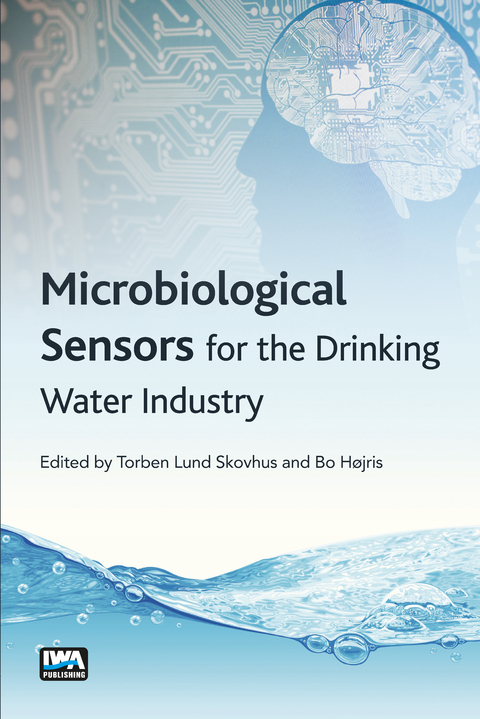
Microbiological Sensors for the Drinking Water Industry (eBook)
400 Seiten
IWA Publishing (Verlag)
978-1-78040-955-9 (ISBN)
Editorial preface
Foreword by Eberhard Morgenroth
Foreword by Koen Huysman
About the Editors
List of Contributors
Section 1 - Background and perspectives
Chapter 1 - History and perspective – the challenge of the gap between legislation and scientific achievements: The new era of enlightenment
Chapter 2 - The need for speed – rapid evolution of microbiological testing in drinking water
Chapter 3 - Microbiological sensors for drinking water: Terminology and central concepts
Section 2 - Industry needs
Chapter 4 - Water quality monitoring at Danish utilities – current state and needs for the future
Chapter 5 - On-line monitoring of bacteria in drinking water systems: Expected benefits and new challenges for utility operators
Section 3 - Sensor technologies
Chapter 6 - Use of fully automated bacterial monitors for enhanced water safety
Chapter 7 - Online flow cytometry: Towards a rapid, robust, and reliable microbial sensor
Chapter 8 - Adenosine Triphosphate (ATP) measurement technology
Chapter 9 - Counting totally matters – using GRUNDFOS BACMON for network monitoring
Chapter 10 - Safety and quality control in drinking water systems by online monitoring of enzymatic activity of faecal indicators and total bacteria
Chapter 11 - Mean oxidation state of organic carbon: A novel application to evaluate the extent of oxidation of natural organic matter in drinking water biological treatment
Section 4 - Data collection and interpretation
Chapter 12 - Test of sensor technologies for monitoring of microbiological drinking water quality
Chapter 13 - From sensor to decision – augmented and automated decision-making based on real-time data
Section 5 - Water safety, education and legislation
Chapter 14 - HACCP in drinking water systems
Chapter 15 - Enhancing knowledge of microbiological sensors through education
Chapter 16 - Challenges of regulatory compliance using sensor technology for drinking water distribution systems
Index
| Erscheint lt. Verlag | 15.6.2019 |
|---|---|
| Verlagsort | London |
| Sprache | englisch |
| Themenwelt | Naturwissenschaften |
| Technik ► Bergbau | |
| Technik ► Umwelttechnik / Biotechnologie | |
| ISBN-10 | 1-78040-955-9 / 1780409559 |
| ISBN-13 | 978-1-78040-955-9 / 9781780409559 |
| Informationen gemäß Produktsicherheitsverordnung (GPSR) | |
| Haben Sie eine Frage zum Produkt? |
 EPUB (Adobe DRM)
Kopierschutz: Adobe-DRM
Adobe-DRM ist ein Kopierschutz, der das eBook vor Mißbrauch schützen soll. Dabei wird das eBook bereits beim Download auf Ihre persönliche Adobe-ID autorisiert. Lesen können Sie das eBook dann nur auf den Geräten, welche ebenfalls auf Ihre Adobe-ID registriert sind.
Details zum Adobe-DRM
Dateiformat: EPUB (Electronic Publication)
EPUB ist ein offener Standard für eBooks und eignet sich besonders zur Darstellung von Belletristik und Sachbüchern. Der Fließtext wird dynamisch an die Display- und Schriftgröße angepasst. Auch für mobile Lesegeräte ist EPUB daher gut geeignet.
Systemvoraussetzungen:
PC/Mac: Mit einem PC oder Mac können Sie dieses eBook lesen. Sie benötigen eine
eReader: Dieses eBook kann mit (fast) allen eBook-Readern gelesen werden. Mit dem amazon-Kindle ist es aber nicht kompatibel.
Smartphone/Tablet: Egal ob Apple oder Android, dieses eBook können Sie lesen. Sie benötigen eine
Geräteliste und zusätzliche Hinweise
Buying eBooks from abroad
For tax law reasons we can sell eBooks just within Germany and Switzerland. Regrettably we cannot fulfill eBook-orders from other countries.
aus dem Bereich


