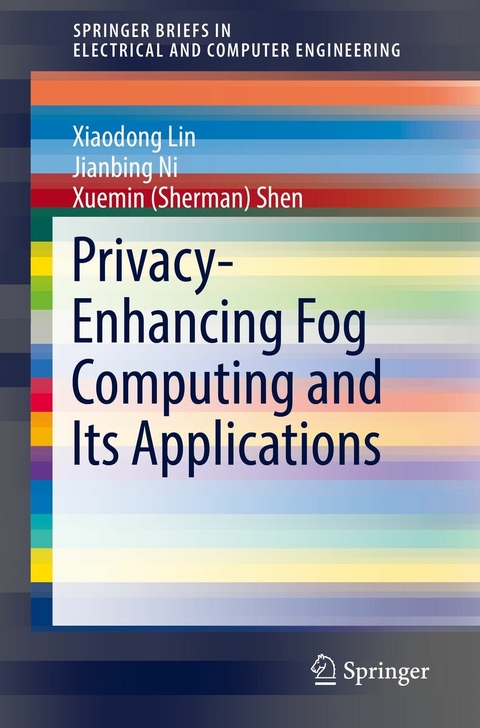
Privacy-Enhancing Fog Computing and Its Applications (eBook)
XII, 89 Seiten
Springer International Publishing (Verlag)
978-3-030-02113-9 (ISBN)
This SpringerBrief covers the security and privacy challenges in fog computing, and proposes a new secure and privacy-preserving mechanisms to resolve these challenges for securing fog-assisted IoT applications. Chapter 1 introduces the architecture of fog-assisted IoT applications and the security and privacy challenges in fog computing. Chapter 2 reviews several promising privacy-enhancing techniques and illustrates examples on how to leverage these techniques to enhance the privacy of users in fog computing. Specifically, the authors divide the existing privacy-enhancing techniques into three categories: identity-hidden techniques, location privacy protection and data privacy enhancing techniques. The research is of great importance since security and privacy problems faced by fog computing impede the healthy development of its enabled IoT applications.
With the advanced privacy-enhancing techniques, the authors propose three secure and privacy-preserving protocols for fog computing applications, including smart parking navigation, mobile crowdsensing and smart grid. Chapter 3 introduces identity privacy leakage in smart parking navigation systems, and proposes a privacy-preserving smart parking navigation system to prevent identity privacy exposure and support efficient parking guidance retrieval through road-side units (fogs) with high retrieving probability and security guarantees. Chapter 4 presents the location privacy leakage, during task allocation in mobile crowdsensing, and propose a strong privacy-preserving task allocation scheme that enables location-based task allocation and reputation-based report selection without exposing knowledge about the location and reputation for participators in mobile crowdsensing. Chapter 5 introduces the data privacy leakage in smart grid, and proposes an efficient and privacy-preserving smart metering protocol to allow collectors (fogs) to achieve real-time measurement collection with privacy-enhanced data aggregation. Finally, conclusions and future research directions are given in Chapter 6.
This brief validates the significant feature extension and efficiency improvement of IoT devices without sacrificing the security and privacy of users against dishonest fog nodes. It also provides valuable insights on the security and privacy protection for fog-enabled IoT applications. Researchers and professionals who carry out research on security and privacy in wireless communication will want to purchase this SpringerBrief. Also, advanced level students, whose main research area is mobile network security will also be interested in this SpringerBrief.
1 Introduction.- 2 Privacy-enhancing Technologies.- 3 Identity Privacy Protection in Smart Parking Navigation.- 4 Location Privacy Protection in Mobile Crowdsensing.- 5 Data Privacy Protection in Smart Grid.- 6 Conclusions and Future Directions.
| Erscheint lt. Verlag | 12.11.2018 |
|---|---|
| Reihe/Serie | SpringerBriefs in Electrical and Computer Engineering | SpringerBriefs in Electrical and Computer Engineering |
| Zusatzinfo | XII, 89 p. 14 illus., 13 illus. in color. |
| Verlagsort | Cham |
| Sprache | englisch |
| Themenwelt | Mathematik / Informatik ► Informatik |
| Technik ► Nachrichtentechnik | |
| Schlagworte | cyber security • data privacy • Fog Computing • identity privacy • Internet of Things (IoT) • location privacy • mobile crowdsensing • Mobile Sensing • privacy • privacy conversion • privacy-enhanced technology • security • Smart Grid • Smart-Metering • Smart Parking • Vehicular ad hoc network |
| ISBN-10 | 3-030-02113-0 / 3030021130 |
| ISBN-13 | 978-3-030-02113-9 / 9783030021139 |
| Informationen gemäß Produktsicherheitsverordnung (GPSR) | |
| Haben Sie eine Frage zum Produkt? |
 PDF (Wasserzeichen)
DRM: Digitales Wasserzeichen
Dieses eBook enthält ein digitales Wasserzeichen und ist damit für Sie personalisiert. Bei einer missbräuchlichen Weitergabe des eBooks an Dritte ist eine Rückverfolgung an die Quelle möglich.
Dateiformat: PDF (Portable Document Format)
Mit einem festen Seitenlayout eignet sich die PDF besonders für Fachbücher mit Spalten, Tabellen und Abbildungen. Eine PDF kann auf fast allen Geräten angezeigt werden, ist aber für kleine Displays (Smartphone, eReader) nur eingeschränkt geeignet.
Systemvoraussetzungen:
PC/Mac: Mit einem PC oder Mac können Sie dieses eBook lesen. Sie benötigen dafür einen PDF-Viewer - z.B. den Adobe Reader oder Adobe Digital Editions.
eReader: Dieses eBook kann mit (fast) allen eBook-Readern gelesen werden. Mit dem amazon-Kindle ist es aber nicht kompatibel.
Smartphone/Tablet: Egal ob Apple oder Android, dieses eBook können Sie lesen. Sie benötigen dafür einen PDF-Viewer - z.B. die kostenlose Adobe Digital Editions-App.
Buying eBooks from abroad
For tax law reasons we can sell eBooks just within Germany and Switzerland. Regrettably we cannot fulfill eBook-orders from other countries.
aus dem Bereich