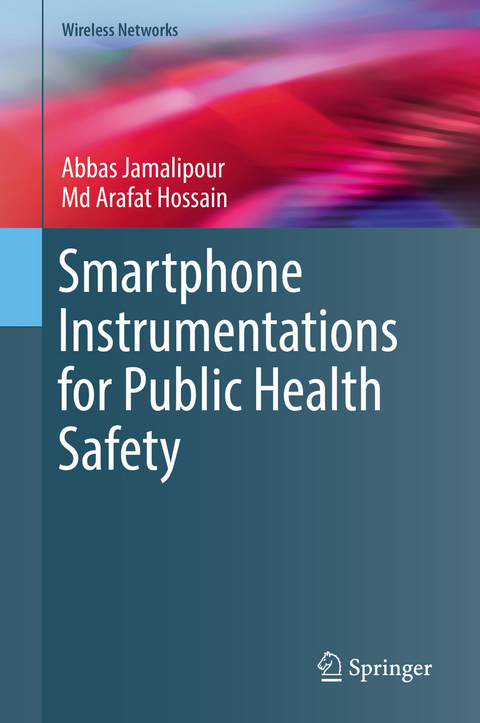
Smartphone Instrumentations for Public Health Safety (eBook)
98 Seiten
Springer International Publishing (Verlag)
978-3-030-02095-8 (ISBN)
A significant and convenient approach to detection and analysis of biological, environmental and agricultural items is the harnessing of features in widely available smartphones to create field-deployable scientific instruments, allowing measurements to be made onsite and in real-time. This book will cover a number of self-contained smartphone instruments with the particular focus on spectroscopic-based measurements. Measurement and analysis on precision of such low-cost instrumentations are provided to compare with more expensive commercial equipment.
This book also discusses some limitations, possible recommendations and scopes for further instrumentations using smartphones and other smart devices. Particularly, the opportunity to integrate the devices into the global Internet-of-Things (IoT) platform will be discussed.
Researchers and instrumentation designers in optical and photonic sensing, smart and IoT-based sensing, biological and environmental analysts, agricultural, and food quality researchers (and public health authorities) will find this book useful as reference. Students in science and engineering disciplines for teaching and educational purposes will also find this book useful as a secondary textbook.
Abbas Jamalipour is the Professor of Ubiquitous Mobile Networking at the University of Sydney, Australia, and holds a PhD in Electrical Engineering from Nagoya University, Japan. He is a Fellow of the Institute of Electrical and Electronics Engineers (IEEE), the Institute of Electrical, Information, and Communication Engineers (IEICE), and the Institution of Engineers Australia; also an ACM Professional Member and an IEEE Distinguished Lecturer. He has authored nine technical books, eleven book chapters, over 450 technical papers, and five patents, all in the area of wireless and mobile communications. Dr. Jamalipour is an elected member of the Board of Governors, Executive Vice-President, Chair of Fellow Evaluation Committee, and the Editor-in-Chief of the Mobile World, of IEEE Vehicular Technology Society. He was the Editor-in-Chief IEEE Wireless Communications, Vice President-Conferences and a member of Board of Governors of the IEEE Communications Society, and has been an editor for several journals. He has been a General Chair or Technical Program Chair for a number of conferences, including IEEE ICC, GLOBECOM, WCNC and PIMRC. He is the recipient of a number of prestigious awards such as the 2016 IEEE ComSoc Distinguished Technical Achievement Award in Communications Switching and Routing, 2010 IEEE ComSoc Harold Sobol Award, the 2006 IEEE ComSoc Best Tutorial Paper Award, as well as 15 Best Paper Awards.Md Arafat Hossain is a ‘2017 Endeavour Research Fellow’ of The University of Sydney and currently serving as an Assistant Professor of the Department of Electrical and Electronic Engineering (EEE) of Khulna University of Engineering and Technology (KUET). He received a PhD on smart sensing and instrumentation from the School of Electrical and Information Engineering of The University of Sydney. His research focuses on harnessing smart device technologies including smartphone towards the development of low-cost scientific instruments for public health sensing and many industrial characterizations by optical sensing. Among his several research outcomes, smartphone spectrometers and smartphone laser beam profiler are well-known. He is also one of the key members of the design and fabrication team at interdisciplinary Photonics Laboratories (iPL) which generated the world’s first optical fiber from a desktop 3D printer. He received the Hitachi Social Innovation Award on Smart Agriculture, ResMed Award on Biomedical Engineering and has authored 16 journals and 30 conferences papers, and filed 2 provisional patents in the area of smart sensing and photonics. He is a current member of IEEE and IEB.
Preface 6
Acknowledgment 8
Contents 9
Nomenclature 11
Chapter 1: Introduction 15
1.1 Smartphone Devices and Sensors 15
1.2 Smartphone Instrumentation in Public Health Safety: A Brief Review 17
1.2.1 Smartphone Colorimetry 18
1.2.2 Smartphone Microscopy 20
1.2.3 Smartphone Fluorimetry: Intensity Fluorimeter 20
1.2.4 Smartphone Spectroscopy 21
1.2.5 Other Smartphone Instrumentations 23
1.3 Research Opportunities on the Track 24
1.4 Lab-in-a-Phone: The Technology Outlined in this Book 26
Chapter 2: Smartphone Intensity Fluorimeter 29
2.1 Introduction 29
2.2 Basics of Fluorimeter and Components Available in a Smartphone 30
2.3 A Smartphone Intensity Fluorimeter: Materials and Methods 32
2.3.1 Optical Design and Operation 32
2.3.2 Smartphone Data Acquisition Technique 34
2.4 Fluorimeter Design and Fabrication 35
2.5 Chemosensor Material: Properties and Applications 37
2.6 Smartphone Fluorimeter App 38
2.7 Fluorimeter Calibration 41
2.8 pH Measurements of Water 42
2.8.1 Environmental Water 43
2.8.2 Drinking Tap Water 45
2.9 Water Quality Monitoring and Mapping 46
2.10 Summary 50
Chapter 3: Temperature-tunable Smartphone Fluorimeter 51
3.1 Introduction 51
3.2 Temperature-tunable Smartphone Intensity Fluorimeter 52
3.2.1 The Fluorimeter Components and Operation 52
3.2.2 3D Design, Fabrication and Packaging 54
3.3 Time-resolved Fluorescence Measuring Smartphone App 56
3.4 Calibration 56
3.4.1 Temperature Calibration 57
3.4.2 Battery Lifecycle 58
3.5 Temperature-dependent Fluorescence Measurements 59
3.5.1 Steady-state Fluorescence Measurements 59
3.5.2 Time-resolved Fluorescence Measurements 60
3.6 Summary 64
Chapter 4: Smartphone “Dual” Spectrometer 65
4.1 Introduction 65
4.2 Basics of an Absorption and Fluorescence Spectrometer 66
4.2.1 Dispersive Elements for Smartphone Spectrometer 68
4.3 Smartphone “Dual” Spectrometers 71
4.3.1 Optical Layout 72
4.3.2 3D Design and Fabrication 73
4.3.3 Smartphone Spectrometer App 74
4.3.4 Calibration 75
4.3.5 Spectrum Measurements 76
4.3.5.1 Absorption Spectroscopy 77
4.3.5.2 Fluorescence Spectroscopy 78
4.3.5.3 [Zn2+] Detection in Water 78
4.4 Summary 80
Chapter 5: Smartphone Optical Fiber Spectrometers 81
5.1 Introduction 81
5.2 Optical Fiber Smartphone Spectrometer 82
5.2.1 Optical Design, Materials and Methods 82
5.2.2 Spectral Calibration 84
5.2.2.1 Wavelength Calibration 84
5.2.2.2 Intensity Calibration 85
5.2.3 Performance Analysis with Slits and a Lens 88
5.2.4 Spectral Measurements 88
5.2.4.1 Visible Absorption Spectroscopy of Apple 90
5.3 Optical Fiber Smartphone Spectrofluorimeter 92
5.3.1 Optical Design and Fabrication 92
5.3.2 Smartphone Application Software 93
5.3.3 Fluorescence Spectroscopy of Olive Oils 96
5.3.3.1 Samples 96
5.3.3.2 Classifications of Oils 97
5.3.3.3 Storage Effects 98
5.3.3.4 Photo-degradation 99
5.3.3.5 Thermal Degradation 100
5.4 Summary 101
Bibliography 102
| Erscheint lt. Verlag | 30.10.2018 |
|---|---|
| Reihe/Serie | Wireless Networks | Wireless Networks |
| Zusatzinfo | XIV, 98 p. 57 illus. |
| Verlagsort | Cham |
| Sprache | englisch |
| Themenwelt | Technik ► Elektrotechnik / Energietechnik |
| Technik ► Nachrichtentechnik | |
| Schlagworte | 3D design and fabrication • 3D Printing • Absorption spectroscopy • Colorimetry • Data acquisition • Fabrication • Fluorescence spectroscopy • fluorimeter • Instrumentation • internet of things • IOT • Lab-in-a-phone • Microscopy • optical devices and technologies • pH measurement • smartphones • spectro-fluorimeter • Spectrometer • spectroscopy • Water Quality Monitoring |
| ISBN-10 | 3-030-02095-9 / 3030020959 |
| ISBN-13 | 978-3-030-02095-8 / 9783030020958 |
| Informationen gemäß Produktsicherheitsverordnung (GPSR) | |
| Haben Sie eine Frage zum Produkt? |
 PDF (Wasserzeichen)
DRM: Digitales Wasserzeichen
Dieses eBook enthält ein digitales Wasserzeichen und ist damit für Sie personalisiert. Bei einer missbräuchlichen Weitergabe des eBooks an Dritte ist eine Rückverfolgung an die Quelle möglich.
Dateiformat: PDF (Portable Document Format)
Mit einem festen Seitenlayout eignet sich die PDF besonders für Fachbücher mit Spalten, Tabellen und Abbildungen. Eine PDF kann auf fast allen Geräten angezeigt werden, ist aber für kleine Displays (Smartphone, eReader) nur eingeschränkt geeignet.
Systemvoraussetzungen:
PC/Mac: Mit einem PC oder Mac können Sie dieses eBook lesen. Sie benötigen dafür einen PDF-Viewer - z.B. den Adobe Reader oder Adobe Digital Editions.
eReader: Dieses eBook kann mit (fast) allen eBook-Readern gelesen werden. Mit dem amazon-Kindle ist es aber nicht kompatibel.
Smartphone/Tablet: Egal ob Apple oder Android, dieses eBook können Sie lesen. Sie benötigen dafür einen PDF-Viewer - z.B. die kostenlose Adobe Digital Editions-App.
Buying eBooks from abroad
For tax law reasons we can sell eBooks just within Germany and Switzerland. Regrettably we cannot fulfill eBook-orders from other countries.
aus dem Bereich