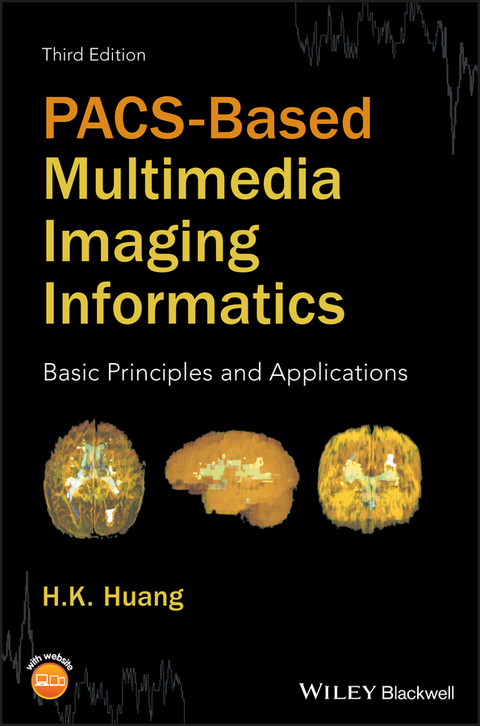
PACS-Based Multimedia Imaging Informatics (eBook)
John Wiley & Sons (Verlag)
978-1-118-79576-7 (ISBN)
Thoroughly revised to present the very latest in PACS-based multimedia in medical imaging informatics-from the electronic patient record to the full range of topics in digital medical imaging-this new edition by the founder of PACS and multimedia image informatics features even more clinically applicable material than ever before. It uses the framework of PACS-based image informatics, not physics or engineering principles, to explain PACS-based multimedia informatics and its application in clinical settings and labs. New topics include Data Grid and Cloud Computing, IHE XDS-I Workflow Profile (Integrating the Healthcare Enterprise Cross-enterprise Document Sharing for Imaging), extending XDS to share images, and diagnostic reports and related information across a group of enterprise health care sites.
PACS-Based Multimedia Imaging Informatics is presented in 4 sections. Part 1 covers the beginning and history of Medical Imaging, PACS, and Imaging Informatics. The other three sections cover Medical Imaging, Industrial Guidelines, Standards, and Compliance; Informatics, Data Grid, Workstation, Radiation Therapy, Simulators, Molecular Imaging, Archive Server, and Cloud Computing; and multimedia Imaging Informatics, Computer-Aided Diagnosis (CAD), Image-Guide Decision Support, Proton Therapy, Minimally Invasive Multimedia Image-Assisted Surgery, BIG DATA.
- New chapter on Molecular Imaging Informatics
- Expanded coverage of PACS and eHR's (Electronic Health Record), with HIPPA compliance
- New coverage of PACS-based CAD (Computer-Aided Diagnosis)
- Reorganized and expanded clinical chapters discuss one distinct clinical application each
- Minimally invasive image assisted surgery in translational medicine
- Authored by the world's first and still leading authority on PACS and medical imaging
PACS-Based Multimedia Imaging Informatics: Basic Principles and Applications, 3rd Edition is the single most comprehensive and authoritative resource that thoroughly covers the critical issues of PACS-based hardware and software design and implementation in a systematic and easily comprehensible manner. It is a must-have book for all those involved in designing, implementing, and using PACS-based Multimedia Imaging Informatics.
H.K. 'Bernie' Huang, D.Sc., FRCR (Hon.), is Professor Emeritus of Radiology and Biomedical Engineering at the University of Southern California, and Professor at the Shanghai Institute of Technical Physics, The Chinese Academy of Sciences. He was former Professor and Vice Chair of Radiology at the University of California, Los Angeles; and the University of California, San Francisco; and Chair Professor of Imaging informatics at the Hong Kong Polytechnic University.
Thoroughly revised to present the very latest in PACS-based multimedia in medical imaging informatics from the electronic patient record to the full range of topics in digital medical imaging this new edition by the founder of PACS and multimedia image informatics features even more clinically applicable material than ever before. It uses the framework of PACS-based image informatics, not physics or engineering principles, to explain PACS-based multimedia informatics and its application in clinical settings and labs. New topics include Data Grid and Cloud Computing, IHE XDS-I Workflow Profile (Integrating the Healthcare Enterprise Cross-enterprise Document Sharing for Imaging), extending XDS to share images, and diagnostic reports and related information across a group of enterprise health care sites. PACS-Based Multimedia Imaging Informatics is presented in 4 sections. Part 1 covers the beginning and history of Medical Imaging, PACS, and Imaging Informatics. The other three sections cover Medical Imaging, Industrial Guidelines, Standards, and Compliance; Informatics, Data Grid, Workstation, Radiation Therapy, Simulators, Molecular Imaging, Archive Server, and Cloud Computing; and multimedia Imaging Informatics, Computer-Aided Diagnosis (CAD), Image-Guide Decision Support, Proton Therapy, Minimally Invasive Multimedia Image-Assisted Surgery, BIG DATA. New chapter on Molecular Imaging Informatics Expanded coverage of PACS and eHR's (Electronic Health Record), with HIPPA compliance New coverage of PACS-based CAD (Computer-Aided Diagnosis) Reorganized and expanded clinical chapters discuss one distinct clinical application each Minimally invasive image assisted surgery in translational medicine Authored by the world's first and still leading authority on PACS and medical imaging PACS-Based Multimedia Imaging Informatics: Basic Principles and Applications, 3rd Edition is the single most comprehensive and authoritative resource that thoroughly covers the critical issues of PACS-based hardware and software design and implementation in a systematic and easily comprehensible manner. It is a must-have book for all those involved in designing, implementing, and using PACS-based Multimedia Imaging Informatics.
H.K. "Bernie" Huang, D.Sc., FRCR (Hon.), is Professor Emeritus of Radiology and Biomedical Engineering at the University of Southern California, and Professor at the Shanghai Institute of Technical Physics, The Chinese Academy of Sciences. He was former Professor and Vice Chair of Radiology at the University of California, Los Angeles; and the University of California, San Francisco; and Chair Professor of Imaging informatics at the Hong Kong Polytechnic University.
Title Page 5
Copyright Page 6
Contents in Brief 9
Contents 11
Foreword 1 31
Foreword 2 33
Foreword 3 35
Preface to the Third Edition 37
Prefaceto the Second Edition 41
Acknowledgments 45
H.K. Huang Short Biography 47
List of Acronyms 49
Part 1 The Beginning: Retrospective 63
Chapter 1 Medical Imaging, PACS and Imaging Informatics: Retrospective 65
Part I Technology Development and Pioneers 66
1.1 Medical Imaging 66
1.1.1 The Pattern Recognition Laboratory and Professor Robert S. Ledley 66
1.1.2 The ACTA: The Whole Body CT Scanner 70
1.1.3 Dr Ledley’s Lifetime Accomplishments 70
1.2 PACS and its Development 70
1.2.1 PACS 70
1.2.2 The Department of Radiological Sciences and the Biomedical Physics Graduate Program 72
1.2.3 Professor Moses Greenfield 73
1.2.4 Professor Hooshang Kangarloo 74
1.2.5 The Image Processing Laboratory (IPL) at UCLA 75
1.3 Key Technologies: Computer and Software, Storage, and Communication Networks 77
1.3.1 The VAX 11/750 Computer System 77
1.3.2 Multiple Display Controller 77
1.3.3 Hierarchical Storage System 78
1.3.4 Personal Image Filing System 78
1.3.5 Image Compression 78
1.3.6 Laser Film Printer for X?Ray Images 78
1.3.7 Asynchronous Transfer Mode (ATM) Communication Technology 79
1.4 Key Technologies: Medical Imaging Related 79
1.4.1 Laser Film Scanner 79
1.4.2 Computed Radiography (CR) 79
1.4.3 Direct Digital Input from CR to PACS 80
1.4.4 Digital Radiography 82
1.4.5 Interactive Display with Multiple Monitors 82
Part II?Collaborations and Supports 84
1.5 Collaboration with Government Agencies, Industry and Medical Imaging Associations 84
1.5.1 The US Government Agencies 84
1.5.2 The Netherlands National Foundation and the UCLA PACS 85
1.5.3 The NATO Advanced Science Institute (ASI) and the UCLA PACS 85
1.5.4 Collaboration of the UCLA Team with the US Medical Imaging Industry 87
1.5.5 Japan Medical Imaging Technology and the UCLA PACS 88
1.5.6 SPIE, EuroPACS, CARS and UCLA PACS Team 89
1.5.6.1 SPIE 89
1.5.6.2 EuroPACS 90
1.5.6.3 CARS 91
1.5.7 Patents and Copyrights 91
1.6 Medical Imaging Informatics 91
1.6.1 Biomedical Informatics 91
1.6.2 The 1970s Concept: Chromosome Karyotyping 92
1.6.3 Medical Imaging Informatics Today 92
1.7 Summary 94
1.7.1 The Golden Era of Medical Imaging Technology Research Support 94
1.7.2 After the First 10 Years of PACS 95
1.7.3 The PACS End Users 95
1.7.4 The Diligent Contributors 96
1.8 Acknowledgments 96
References 97
Part 2 Medical Imaging, Industrial Guidelines, Standards, and Compliance 99
Chapter 2 Digital Medical Imaging 101
2.1 Digital Medical Imaging Fundamentals 101
2.1.1 Digital Image 101
2.1.2 Digital Medical Image 102
2.1.3 Image Size 102
2.1.4 Image Display 102
2.1.5 Density Resolution, Spatial Resolution, and Signal?To?Noise Ratio 103
2.1.6 Radiology Workflow 106
2.2 Two?Dimensional Medical Imaging 108
2.2.1 Conventional Direct Digital 2?D Projection Radiography 108
2.2.2 Examples of the CR (Computed Radiography) Systems 108
2.2.3 Full-Field Direct Digital Mammography 108
2.2.3.1 Screen/Film Cassette and Digital Mammography 108
2.2.3.2 Slot?Scanning Full?Field Direct Digital Mammography 109
2.2.4 Nuclear Medicine Imaging 110
2.2.4.1 Principles of Nuclear Medicine Scanning 110
2.2.4.2 The Gamma Camera and Associated Imaging System 113
2.2.5 Two?Dimensional (2?D) Ultrasound Imaging (US) 113
2.2.5.1 B?Mode (Brightness) Ultrasound Scanning 113
2.2.5.2 Sampling Modes and Image Display 114
2.2.5.3 Color Doppler Ultrasound Imaging 115
2.2.5.4 Cine Loop Ultrasound 115
2.2.6 Two?Dimensional (2?D) Light and Endoscopic Imaging 116
2.2.6.1 2?D Light Imaging 116
2.2.6.2 2?D Endoscopic Imaging 116
2.3 Three?Dimensional Medical Imaging 117
2.3.1 Two?Dimensional Transmission X?Ray Computed Tomography (CT) from 1?D Projections 117
2.3.2 Transmission X?Ray Computed Tomography (3D?CT) 120
2.3.2.1 Convention Transmission X?Ray Computed Tomography (CT) 120
2.3.2.2 Whole Body CT Scan 121
2.3.2.3 Components and Data Flow of a 3?D CT Scanner 121
2.3.2.4 CT Image Data 122
2.3.3 Emission Computed Tomography (ECT) 123
2.3.3.1 Single Photo Emission CT: Rotating Camera System 125
2.3.3.2 Positron Emission Tomography (PET) 127
2.3.4 Three?Dimensional Ultrasound Imaging (3?D US) 130
2.3.5 Magnetic Resonance Imaging (MRI) 130
2.3.5.1 MRI Basics 130
2.3.5.2 Magnetic Resonance Image Production 131
2.3.5.3 Steps in Producing an MRI 132
2.3.5.4 MR Imaging (MRI) 133
2.3.5.5 Other Types of Images from MR Signals 134
2.3.6 3?D Fluorescence Confocal Microscopy: Light Imaging 138
2.3.7 3?D Micro Imaging and Small Animal Imaging 138
2.4 Four?Dimensional, Multimodality, and Fusion Imaging 140
2.4.1 Basics of 4?D, Multimodality, and Fusion Medical Imaging 140
2.4.1.1 From 3?D to 4?D Imaging 140
2.4.1.2 Multimodality 3?D and 4?D Imaging 141
2.4.1.3 Image Registration 144
2.4.1.4 Image Fusion 144
2.4.1.5 Display of 4?D Medical Images and Fusion Images 144
2.4.2 4?D Medical Imaging 145
2.4.2.1 4?D Ultrasound Imaging 145
2.4.2.2 Selected Data from 4?D X?Ray CT Imaging 145
2.4.2.3 4?D PET?CT Imaging 147
2.5 Image Compression 147
2.5.1 Some Terminology 147
2.5.2 Acceptable Compression Ratio 149
2.5.3 The Wavelet Transform Method 150
2.5.3.1 2?D Wavelet Transform 152
2.5.3.2 3?D Wavelet Transform 152
2.5.3.3 Examples of 3?D Wavelet Transform 153
Further Reading 155
Chapter 3 PACS Fundamentals 159
3.1 PACS Components and Network 159
3.1.1 PACS Components 159
3.1.2 Data and Image Acquisition Gateways 160
3.1.3 PACS Server and Archive 161
3.1.4 Display Workstations 161
3.1.5 Application Servers 162
3.1.6 System Networks 162
3.2 PACS Infrastructure Design Concept 163
3.2.1 Industry Standards 163
3.2.2 Connectivity and Open Architecture 164
3.2.3 Data Reliability 164
3.2.4 Security 165
3.3 Generic PACS?Based Multimedia Architecture and Workflow 165
3.4 PACS?Based Architectures 167
3.4.1 Stand?Alone PACS?Based Model and Data Flow 167
3.4.1.1 Advantages 167
3.4.1.2 Disadvantages 168
3.4.2 PACS?Based Client–Server Model and Data Flow 168
3.4.2.1 Advantages 168
3.4.2.2 Disadvantages 169
3.4.3 Web?Based Model 169
3.4.4 Teleradiology Model 170
3.4.4.1 Pure Teleradiology Model 170
3.4.4.2 PACS and Teleradiology Combined Model 171
3.4.5 Enterprise PACS?Based Multimedia and ePR System with Image Distribution 172
3.5 Communication and Networks 172
3.5.1 Network Standards – OSI and DOD 172
3.5.2 Network Technology 175
3.5.2.1 Ethernet and Gigabit Ethernet 175
3.5.2.2 ATM (Asynchronous Transfer Mode) Technology 177
3.5.2.3 Wireless Networks 177
3.5.2.4 Ethernet and Internet 178
3.5.2.5 Internet 2 179
Further Reading 183
Chapter 4 Industrial Standards: Health Level 7 (HL7), Digital Imaging and Communications in Medicine (DICOM) and Integrating the Healthcare Enterprise (IHE) 185
4.1 Industrial Standards 186
4.2 The Health Level 7 (HL7) Standard 186
4.2.1 Health Level 7 186
4.2.2 An Example 187
4.2.3 The Trend in HL7 188
4.2.3.1 Benefits 189
4.2.3.2 Challenges 189
4.3 From ACR?NEMA to DICOM 189
4.3.1 ACR?NEMA and DICOM 189
4.3.2 Digital Imaging and Communications in Medicine (DICOM 3.0) 190
4.3.3 DICOM Standard PS 3.1 ? 2008 190
4.3.4 DICOM Supplements 191
4.4 DICOM 3.0 Standard 191
4.4.1 DICOM Data Format 191
4.4.2 DICOM Model of the Real World 191
4.4.3 DICOM File Format 194
4.4.4 Object Class and Service Class 195
4.4.5 DICOM Services 196
4.4.6 DICOM Communication 197
4.4.7 DICOM Conformance 198
4.5 Examples of using DICOM 198
4.5.1 Send and Receive 198
4.5.2 Query and Retrieve 200
4.6 DICOM Organizational Structure and New Features 200
4.6.1 DICOM New Features since 2010 200
4.6.1.1 Visible Light (VL) Images 201
4.6.1.2 Mammography Computer?Aided Detection (CADe) 201
4.6.1.3 Waveform IOD 202
4.6.1.4 Structured Reporting (SR) 202
4.6.1.5 Content Mapping Resource 202
4.6.2 DICOM’s Organizational Structure 202
4.6.3 Current DICOM Strategic Document 203
4.7 IHE (Integrating the Healthcare Enterprise) 204
4.7.1 History and what is IHE? 204
4.7.1.1 IHE History 204
4.7.1.2 What is IHE? 204
4.7.1.3 IHE Activities 206
4.7.2 IHE Technical Framework and Integration Profiles 206
4.7.2.1 Data Model, Actors and Integration Profiles 206
4.7.2.2 IHE Profiles 206
4.7.3 Some Examples of IHE Workflow Profiles 211
4.7.4 The Future of IHE 211
4.7.4.1 Multidisciplinary Effort 211
4.7.4.2 International Expansion 211
4.7.4.3 IHE 2020 Vision 213
4.8 Some Operating Systems and Programming Languages useful to HL7, DICOM and IHE 213
4.8.1 UNIX Operating System 214
4.8.2 Windows NT/XP Operating Systems 214
4.8.3 C and C++ Programming Languages 214
4.8.4 SQL (Structural Query Language) 214
4.8.5 XML (Extensible Markup Language) 215
4.9 Summary of Industrial Standards: HL7, DICOM and IHE 215
References 215
Further Reading 216
Chapter 5 DICOM?Compliant Image Acquisition Gateway and Integration of HIS, RIS, PACS and ePR 217
5.1 DICOM Acquisition Gateway 218
5.2 DICOM?Compliant Image Acquisition Gateway 219
5.2.1 DICOM Compliance 219
5.2.2 DICOM?Based Image Acquisition Gateway 220
5.2.2.1 Gateway Computer Components and Database Management 220
5.2.2.2 Determination of the End of an Image Series 222
5.3 Automatic Image Data Recovery Scheme for DICOM Conformance Device 224
5.3.1 Missing Images and Data 224
5.3.2 Automatic Image Data Recovery 224
5.3.2.1 Basis for the Image Recovery Scheme 224
5.3.2.2 The Image Recovery Algorithm 224
5.4 Interface PACS Modalities with the Gateway Computer 226
5.4.1 PACS Modality Gateway and HI?PACS (Hospital Integrated Gateway) 226
5.4.2 An Example – Interface the US (Ultrasound) Modality with the PACS Gateway 227
5.5 DICOM Compliance PACS Broker 228
5.5.1 Concept of the DICOM Broker 228
5.5.2 Implementation of a PACS Broker 228
5.6 Image Preprocessing and Display 229
5.7 Clinical Operation and Reliability of the Gateway 230
5.7.1 The Weakness of the Gateway as a Single Point of Failure 230
5.7.2 A Fail?Safe Gateway Design 230
5.8 Hospital Information System (HIS), Radiology Information System (RIS), and PACS 231
5.8.1 Hospital Information System 231
5.8.2 Radiology Information System 233
5.8.3 Interfacing PACS with HIS and RIS 234
5.8.3.1 Database?to?Database Transfer 234
5.8.3.2 Interface Engine 234
5.8.3.3 Rationale of Interfacing PACS with HIS and RIS 235
5.8.3.4 Common Data in HIS, RIS and PACS 236
5.8.3.5 Implementation of RIS–PACS Interface 236
5.8.3.6 An Example: The IHE (integrating the healthcare enterprise) Patient Information Reconciliation Profile 239
References 240
Chapter 6 Web?Based Data Management and Image Distribution 241
6.1 Distributed Image File Server: PACS?Based Data Management 241
6.2 Distributed Image File Server 241
6.3 Web Server 243
6.3.1 Web Technology 243
6.3.2 Concept of the Web Server in PACS Environment 244
6.4 Component?based Web Server for Image Distribution and Display 245
6.4.1 Component Software Technologies 245
6.4.2 Architecture of Component?based Web Server 246
6.4.3 Data Flow of the Component?based Web Server 246
6.4.3.1 Query/Retrieve DICOM Image/Data resided in the Web Server 246
6.4.3.2 Query/Retrieve DICOM Image/Data resided in the PACS Archive Server 247
6.4.4 Component?based Architecture of the Display Workstation 248
6.5 Performance Evaluation 250
6.6 Summary of PACS Data Management and Web?based Image Distribution 251
Further Reading 251
Chapter 7 Medical Image Sharing for Collaborative Healthcare Based on IHE XDS?I Profile 253
7.1 Introduction 254
7.2 Brief Description of IHE XDS/XDS?I Profiles 255
7.3 Pilot Studies of Medical Image Sharing and Exchanging for a Variety of Healthcare Services 256
7.3.1 Pilot Study 1: Image Sharing for Cross?Enterprise Healthcare with Federated Integration 256
7.3.1.1 Background 256
7.3.1.2 Image Sharing Architecture, Components and Workflows 257
7.3.1.3 Key Issues Identified in Pilot Testing 258
7.3.1.4 Image Sharing Models 259
7.3.1.5 Performance 260
7.3.2 Pilot Study 2: XDS?I-Based Patient?Controlled Image Sharing Solution 262
7.3.2.1 Background 262
7.3.2.2 The RSNA Image Sharing Network Solution 262
7.3.2.3 Patient?Controlled Workflow in the RSNA Image Sharing Network [18] 263
7.3.2.4 Key Features of the RSNA Image Sharing Network Solution 264
7.3.3 Pilot Study 3: Collaborative Imaging Diagnosis with Electronic Healthcare Record Integration in Regional Healthcare 264
7.3.3.1 Background(see Figure 7.10) 264
7.3.3.2 XDS?I?Based Regional Collaborative Imaging Sharing Solution with an Existing Electronic Healthcare Record System 265
7.3.3.3 Imaging Sharing Implementation for Collaborative Diagnosis and Integration with Existing EHR 267
7.4 Results 268
7.4.1 Pilot Study 1: Image Sharing for Cross?Enterprise Healthcare with Federated Integration 269
7.4.2 Pilot Study 2: XDS?I-Based Patient?Controlled Image Sharing Solution 269
7.4.3 Pilot Study 3: Collaborative Imaging Diagnosis with Electronic Healthcare Record Integration in Regional Healthcare 269
7.5 Discussion 271
7.5.1 Comparison of Three Pilot Studies 271
7.5.2 Security Issues 272
7.5.3 Performance and Storage 273
7.5.4 Extension of XDS?I Profile?Based Image Sharing 273
Acknowledgements 274
References 274
Part 3 Informatics, Data Grid, Workstation, Radiotherapy, Simulators, Molecular Imaging, Archive Server, and Cloud Computing 277
Chapter 8 Data Grid for PACS and Medical Imaging Informatics 279
8.1 Distributed Computing 279
8.1.1 The Concept of Distributed Computing 279
8.1.2 Distributed Computing in PACS and Medical Imaging Environment 280
8.2 Grid Computing 281
8.2.1 The Concept of Grid Computing 281
8.2.2 Current Grid Computing Technology 282
8.2.3 Grid Technology and the Globus Toolkit 283
8.2.4 Integrating DICOM Technology with the Globus Toolkit 283
8.3 Data Grid [5] 284
8.3.1 Data Grid Infrastructure in the Image Processing and Informatics Laboratory (IPILab) 285
8.3.2 Data Grid for the Enterprise PACS 285
8.3.3 Roles of the Data Grid in Enterprise PACS Daily Clinical Operation 286
8.4 Fault?Tolerant Data Grid for PACS Archive and Backup, Query/Retrieval, and Disaster Recovery 288
8.4.1 Archive and Backup 289
8.4.2 Query/Retrieve (Q/R) 291
8.4.3 Disaster Recovery—Three Tasks of the Data Grid when the PACS Server or Archive Fails 292
Chapter 9 Data Grid for Clinical Applications 295
9.1 Clinical Trials and Data Grid 295
9.1.1 Clinical Trials [1] 295
9.1.2 Image?Based Clinical Trials and Data Grid 296
9.1.3 The Role of a Radiology Core in Imaging?Based Clinical Trials 296
9.1.4 Data Grid for Clinical Trials – Image Storage and Backup 298
9.1.5 Data Migration: From Backup Archive to Data Grid 298
9.1.6 Data Grid for Multiple Clinical Trials 301
9.2 Dedicated Breast MRI Enterprise Data Grid 301
9.2.1 Data Grid for a Dedicated Breast MRI Enterprise 301
9.2.2 Functions of an Enterprise Dedicated Breast Imaging MRI Data Grid (BIDG) 302
9.2.3 Components in the Enterprise Breast Imaging Data Grid (BIDG) 302
9.2.4 Breast Imaging Data Grid (BIDG) Workflows in image Archive and Backup, Query/Retrieve and Disaster Recovery 305
9.2.5 Development of a Dedicated Breast MRI Data Grid Based on IHE XDS?I Workflow Profile 306
9.2.5.1 Purpose 306
9.2.5.2 Method 306
9.2.5.3 Development of a Dedicated Breast MRI Data Grid Enterprise with IHE XDS?I Workflow Profile 308
9.3 Administrating the Data Grid 309
9.3.1 Image/Data Security in Data Grid 309
9.3.2 Sociotechnical Considerations in Administrating the Data Grid 310
9.3.2.1 Sociotechnical Considerations 310
9.3.2.2 Is Data Grid for Me? 312
9.4 Summary 312
References 313
Further Reading 313
Chapter 10 Display Workstations 315
10.1 PACS?Based Display Workstation 316
10.1.1 Image Display Hardware 316
10.1.2 Image Display Board 317
10.1.3 Display Monitor 317
10.1.4 Resolution 318
10.1.5 Color Display 320
10.2 Various Types of Image Workstation 322
10.2.1 Diagnostic Workstation 322
10.2.2 Review Workstation 322
10.2.3 Analysis Workstation 323
10.2.4 Digitizing, Printing, and CD Copying Workstation 323
10.2.5 Interactive Teaching Workstation 324
10.2.6 Desktop Workstation 325
10.3 Image Display and Measurement Functions 325
10.3.1 Zoom and Scroll 325
10.3.2 Window and Level 325
10.3.3 Histogram Modification 325
10.3.4 Image Reverse 326
10.3.5 Distance, Area, and Average Gray Level Measurements 327
10.3.6 Optimization of Image Perception in Soft Display 327
10.3.6.1 Background Removal 327
10.3.6.2 Anatomical Regions of Interest 327
10.3.6.3 Gamma Curve Correction 327
10.3.7 Montage: Selected Sets of Images with Particular Pathology and/or Features 329
10.4 Workstation Graphic User Interface (GUI) and Basic Display Functions [3–15] 329
10.4.1 Basic Software Functions in a Display Workstation 329
10.4.2 Workstation User Interface 330
10.5 DICOM PC?Based Display Workstation Software 331
10.5.1 Software System 332
10.5.2 Software Architecture 334
10.5.3 Software Modules in the Application Interface Layer 336
10.5.3.1 Image Communication 336
10.5.3.2 Patient Folder Management 336
10.5.3.3 Image Display Program 337
10.5.3.4 Query and Retrieve 337
10.6 Post-Processing Workflow, PACS?Based Multidimensional Display, and Specialized Post-Processing Workstation 338
10.6.1 Post-Processing Workflow 338
10.6.2 PACS?Based Multidimensional Image Display 338
10.6.3 Specialized Post-Processing Workstation 339
10.7 DICOM?Based Workstations in Progress 339
10.7.1 Intelligence Workstation 339
10.7.1.1 “True 2½?D” and “True 3?D” Image Workstations 339
10.7.1.2 Characteristics of “True 2½?D” and “True 3?D” 344
10.7.1.3 Would “True 3?D” Work? 345
10.7.2 3?D Printing 347
10.7.2.1 3?D Printing Technology 347
10.7.2.2 Terminology and Methods 347
10.7.2.3 Use of 3?D Printing: An Example of a Successful Presurgical Planning for Scoliotic Spine 348
10.7.3 Summary 351
References 351
Chapter 11 Multimedia Electronic Patient Record (EPR) System in Radiotherapy (RT) 353
11.1 Multimodality 2?D and 3?D Imaging in Radiotherapy 354
11.1.1 Radiotherapy Workflow [1–30] 354
11.1.2 2?D and 3?D RT Image Registration [31–35] 354
11.1.2.1 Imaging Component in Treatment Planning – Steps 1 to 5 354
11.1.2.2 Imaging Component in Treatment Delivery – Step 6 359
11.1.2.3 2?D and 3?D Image Registration 359
11.1.3 Fusion of 3?D MRI and 3?D CT Images for RT Application 360
11.2 Multimedia ePR System in Radiation Treatment 360
11.2.1 Radiotherapy and Minimally Invasive Surgery 360
11.2.1.1 Background 361
11.2.1.2 Fundamental Concept 361
11.2.1.3 Infrastructure and Basic Components 361
11.2.2 Multimedia ePR System for Radiotherapy 361
11.2.2.1 Background 361
11.2.2.2 Basic Components 362
11.3 Radiotherapy Planning and Treatment 363
11.4 Radiotherapy Workflow 364
11.5 The ePR Data Model and DICOM-RT Objects 365
11.5.1 The ePR Data Model 365
11.5.2 DICOM-RT Objects 366
11.6 Infrastructure, Workflow and Components of the Multimedia ePR in RT 368
11.6.1 DICOM-RT-Based ePR System Architecture Design 368
11.6.2 DICOM-RT Object Input 368
11.6.3 DICOM-RT Gateway 368
11.6.4 DICOM-RT Archive Server 369
11.6.5 DICOM-RT Web?Based ePR Server 370
11.6.6 RT Web Client Workstation (WS) 371
11.7 Database Schema 371
11.7.1 Database Schema of the RT Archive Server 373
11.7.2 Data Schema of the RT Web Server 373
11.8 Graphical User Interface Design 373
11.9 Validation of the Concept of Multimedia ePR System in RT 374
11.9.1 Integration of the ePR System 374
11.9.1.1 The RT ePR Prototype 374
11.9.1.2 Hardware and Software 376
11.9.1.3 Graphical User Interface (GUI) in the WS 376
11.9.2 Data Collection for the Prototype System 376
11.9.3 Multimedia Electronic Patient Record of a Sample RT Patient 377
11.10 Advantages of the Multimedia ePR system in Radiotherapy for Daily Clinical Practice 381
11.10.1 Communication between Isolated Information Systems and Archival of Information 381
11.10.2 Information Sharing 381
11.10.3 A Model of Comprehensive Electronic Patient Record 381
11.11 Use of the Multimedia ePR System in RT For Image?Assisted Knowledge Discovery and Decision Making 382
11.12 Summary 383
Acknowledgement 383
References 383
Chapter 12 PACS?Based Imaging Informatics Simulators 387
12.1 Why Imaging Informatics Simulators? 388
12.1.1 Background 388
12.2 PACS–ePR Simulator 390
12.2.1 What is a PACS–ePR Simulator? 390
12.2.2 What does a PACS–ePR Simulator do? 390
12.2.3 PACS–ePR Simulator Components and Data Flow 390
12.2.4 Using the PACS–ePR Simulator as the Basis for Developing other Imaging Informatics Simulators 391
12.3 Data Grid Simulator 391
12.3.1 What is a Data Grid Simulator? 391
12.3.2 Data Grid Simulator (DGS) Components and their Connectivity 391
12.3.3 Molecular Imaging Data Grid (MIDG) Simulator 391
12.3.4 Current Trends in Imaging Informatics Data Grid with Cloud Computing Design 393
12.3.4.1 OGSA and IHE XDS?I 393
12.3.5 The Use of Cloud Computing Services in the Archive Architecture 393
12.4 CAD–PACS Simulator 393
12.4.1 The Concept of CAD–PACS Integration 393
12.4.2 The CAD–PACS Simulator 394
12.4.3 Components and Functions 394
12.4.4 Using a CAD–PACS Simulator to Facilitate the Evaluation of CAD Algorithms 394
12.4.5 Simulator: From the Laboratory Environment to Clinical Evaluation 395
12.5 Radiotherapy (RT) ePR Simulator 397
12.5.1 Concept of the RT ePR Simulator 397
12.5.2 Components and Features 397
12.5.3 RT ePR Simulator Architecture 397
12.5.4 Simulation of Knowledge Discovery 399
12.5.5 Role of the RT ePR Simulator 399
12.6 Image?Assisted Surgery (IAS) ePR Simulator 400
12.6.1 Role of the ePR Simulator in Image?Assisted Surgery 400
12.6.2 IAS ePR Simulator Data Flow 401
12.6.3 Workflow of the Simulator 401
12.6.4 The IAS ePR Simulator in a Laboratory Environment 402
12.6.5 From IAS ePR Simulator to the Clinical MISS ePR System 402
12.6.6 Other potential IAS ePR Simulators 404
12.7 Summary 406
Acknowledgments 406
References 406
Chapter 13 Molecular Imaging Data Grid (MIDG) 409
13.1 Introduction 410
13.2 Molecular Imaging 410
13.2.1 Preclinical Molecular Imaging Modalities 410
13.2.2 Preclinical Molecular Imaging Informatics 410
13.2.3 A Molecular Imaging Data Grid (MIDG) 412
13.3 Methodology 413
13.3.1 Preclinical Molecular Imaging Data Model 413
13.3.2 Molecular Imaging Data Grid Software Architecture 414
13.3.2.1 Application Layer 415
13.3.2.2 User?Level Middleware Layer 415
13.3.2.3 Core Middleware Layer 418
13.3.2.4 Fabric Layer 418
13.3.3 Molecular Imaging Data Grid Connectivity and Workflow 418
13.4 Results 420
13.4.1 Experimental Setup 420
13.4.2 Preclinical Molecular Imaging Datasets for Evaluation of the MIDG 420
13.4.3 MIDG Performance Evaluation 421
13.4.4 Current Status and the Next-Generation MIDG based on IHE XDS?i Profile 422
13.5 Discussion 422
13.5.1 Comparing Existing Data Grids in Healthcare Informatics 422
13.5.2 Comparing Current Solutions in Preclinical Molecular Imaging Informatics 423
13.6 Summary 423
Acknowledgments 423
References 424
Chapter 14 A DICOM?Based Second-Generation Molecular Imaging Data Grid (MIDG) with the IHE XDS?i Integration Profile 427
14.1 Introduction 428
14.1.1 Concept of the Second-Generation MIDG (Molecular Imaging Data Grid) 429
14.1.2 Preclinical Molecular Imaging Workflow of the Second-Generation MIDG 429
14.1.3 MIDG System Overview 430
14.2 Methodology 431
14.2.1 Second-Generation MIDG 431
14.2.2 Service?Oriented Design Architecture Based on OGSA Principles 431
14.2.3 Implementation of IHE XDS?i in the MIDG 431
14.2.4 Rules?Based Backup of Studies to Remote Storage Devices within the MIDG 433
14.3 System Implementation 433
14.3.1 Multi?Center Connectivity and the Three Site Test?bed 433
14.3.1.1 The Three Site Test?Bed 434
14.3.1.2 USC Image Processing and Informatics Lab (IPILab) 434
14.3.1.3 USC Molecular Imaging Center (MIC) 434
14.3.1.4 USC Ultrasound Transducer Resource Center (UTRC) at the Biomedical Engineering (BME) Department 434
14.3.2 Evaluation 434
14.3.3 Hardware Requirements 436
14.3.4 Software Requirements 436
14.3.5 Network Bandwidths 436
14.4 Data Collection and Normalization 437
14.4.1 Data Collection 437
14.4.2 Data Normalization 437
14.5 System Performance 440
14.5.1 Upload Performance 440
14.5.2 Download Performance 440
14.5.3 Fault Tolerance 442
14.6 Data Transmission, MIDG Implementation, Workflow and System Potential 442
14.6.1 Data Transmission Performance within the MIDG 442
14.6.2 Implementing the MIDG 443
14.6.3 Improved Molecular Imaging Research Workflow 445
14.6.4 System Potential 445
14.7 Summary 445
14.7.1 The USC Second-Generation MIDG 445
14.7.2 Comparing Existing Data Grids in Healthcare Informatics 446
14.7.3 Comparing Current Preclinical Molecular Imaging Informatics Methods 446
14.7.4 Future Research and Development Opportunities in MIDG 446
14.7.5 Future Research and Development Opportunities 447
Acknowledgments 448
References 448
Chapter 15 PACS?Based Archive Server and Cloud Computing 451
15.1 PACS?Based Multimedia Biomedical Imaging Informatics 452
15.2 PACS?Based Server and Archive 452
15.2.1 Image Management Design Concept 453
15.2.1.1 Local Storage Management via PACS Intercomponent Communication 453
15.2.1.2 PACS Server and Archive System Configuration 454
15.2.2 Functions of the PACS Server and Archive Server 457
15.2.3 RIS and HIS Interface 458
15.3 PACS?Based Archive Server System Operations 458
15.4 DICOM?Compliant PACS?Based Archive Server 459
15.4.1 Advantages 459
15.4.2 DICOM Communications in PACS Environment 459
15.4.3 DICOM?Compliant Image Acquisition Gateways 460
15.5 DICOM PACS?Based Archive Server Hardware and Software 461
15.5.1 Archive Hardware Components 461
15.5.2 Archive Server Software 462
15.6 Backup Archive Server and Data Grid 462
15.6.1 Backup Archive Using an Application Service Provider (ASP) Model 463
15.6.2 General Architecture 464
15.6.3 Data Recovery Procedure 465
15.7 Cloud Computing and Archive Server 465
15.7.1 Change of the PACS Climate 465
15.7.2 Cloud Computing 466
15.7.3 Cloud Computing Service Models and Cloud Storage 466
15.7.3.1 Cloud Computing Service Models 466
15.7.3.2 Cloud Storage 467
15.7.3.3 Role of the National Institute of Standards and Technology(NIST) 468
15.7.3.4 Role of the Open Group 468
15.7.4 An Example of Using Cloud Storage for PACS Archive 470
15.7.4.1 The Experiment 470
15.7.4.2 PACS Cloud Architecture 472
15.7.4.3 PACS Cloud Storage Service Workflow, Data Query and Retrieve 472
15.7.5 Summary of Cloud Computing and Archive Server 475
Acknowledgements 476
References 476
Part 4 Multimedia Imaging Informatics, Computer?Aided Diagnosis (CAD), Image?Guide Decision Support, Proton Therapy, Minimally Invasive Multimedia Image?Assisted Surgery, Big Data 479
Chapter 16 DICOM?Based Medical Imaging Informatics and CAD 481
16.1 Computer?Aided Diagnosis (CAD) 482
16.1.1 CAD Overview 482
16.1.2 CAD Research and Development (R& &
16.1.3 Computer?Aided Detection and Diagnosis (CAD) without PACS 485
16.1.3.1 CAD without PACS and without Digital Image 485
16.1.3.2 CAD without PACS but with Digital Image 486
16.1.4 Conceptual Methods of Integrating CAD with DICOM PACS and MIII 487
16.1.4.1 PACS WS Q/R, CAD WS Detect 487
16.1.4.2 CAD WS Q/R and Detect 487
16.1.4.3 PACS WS with CAD Software 487
16.1.4.4 Integration of CAD Server with PACS or MIII 487
16.2 Integration of CAD with PACS?Based Multimedia Informatics 487
16.2.1 The Need For CAD–PACS Integration 489
16.2.2 DICOM Standard and IHE Workflow Profiles 490
16.2.3 DICOM Structured Reporting (DICOM SR) 490
16.2.4 IHE Profiles 491
16.3 The CAD–PACS Integration Toolkit 491
16.3.1 Current CAD Workflow 491
16.3.2 Concept 492
16.3.3 The Infrastructure 492
16.3.4 Functions of the Three CAD?PACS Editions 493
16.3.4.1 DICOM?SC, First Edition 493
16.3.4.2 DICOM–PACS–IHE, Second Edition 494
16.3.4.3 DICOM–CAD–IHE, Third Edition 494
16.4 Data Flow of the three CAD–PACS Editions Integration Toolkit 494
16.4.1 DICOM?SC, First Edition 494
16.4.2 DICOM–PACS–IHE, Second Edition 494
16.4.3 DICOM–CAD–IHE, Third Edition 494
References 495
Further Reading 496
Chapter 17 DICOM?Based CAD: Acute Intracranial Hemorrhage and Multiple Sclerosis 497
17.1 Computer?Aided Detection (CAD) of Small Acute Intracranial Hemorrhage on CT of the Brain 497
17.1.1 Clinical Aspects 497
17.2 Development of the CAD Algorithm for AIH on CT 498
17.2.1 Data Collection and Radiologist Readings 498
17.2.1.1 The CAD System Development 498
17.2.2 Evaluation of the CAD for AIH 505
17.2.2.1 Rationale of Evaluation of a CAD System 505
17.2.2.2 Multiple?Reader Multiple?Case Receiver Operating Characteristic Analysis for CAD Evaluation 507
17.2.2.3 Effect of CAD?Assisted Reading on Clinicians’ Performance 509
17.2.3 From System Evaluation to Preclinical Practice 513
17.2.3.1 Further Clinical Evaluation 513
17.2.3.2 Next Steps for the Development of CAD for AIH in Clinical Environment 513
17.2.4 Summary of using CAD for AIH 514
17.3 CAD–PACS Integration 514
17.3.1 The DICOM-SR already available from the PACS Vendor 515
17.3.2 Integration of a Commercial CAD with PACS 516
17.4 Multiple Sclerosis (MS) on MRI 518
17.4.1 DICOM Structured Reporting (SR) and CAD–PACS?Based Integration Toolkit 518
17.4.2 Multiple Sclerosis Detection on MRI 518
17.4.3 Data Collection 519
17.4.4 Generation of the DICOM-SR Document from a CAD Report 519
17.4.5 Integration of CAD with PACS for Detection of Multiple Sclerosis (MS) on MRI 521
17.4.5.1 Connecting the DICOM Structured Reporting (SR)with the CAD–PACS Toolkit 521
17.4.5.2 Integration of PACS with CAD for MS Detection 522
References 523
Further Reading 523
Chapter 18 PACS?Based CAD: Digital Hand Atlas and Bone Age Assessment of children 525
18.1 Average Bone Age of a Child 526
18.1.1 Bone Age Assessment 526
18.1.2 Computer?Aided Diagnosis of Bone Age 526
18.2 Bone Age Assessment of Children 528
18.2.1 Classical Method of Bone Age Assessment of Children from a Hand Radiograph 528
18.2.2 Rationale for the Development of a CAD Method for Bone Age Assessment 528
18.2.3 Data Collection 529
18.2.3.1 Subject Recruitment 529
18.2.3.2 Case Selection Criteria 529
18.2.3.3 Image Acquisition 530
18.2.3.4 Image Interpretation 530
18.2.3.5 Film Digitization 530
18.2.3.6 Data Collection Summary 530
18.2.4 The Digital Hand Atlas 532
18.2.4.1 Research Supports 532
18.2.4.2 Digital Hand Atlas 533
18.2.5 CAD Module: Image Processing Algorithm 534
18.2.6 Fuzzy Logic in Computing Bone Age 535
18.3 Method of Analysis 535
18.3.1 Statistical Analysis 535
18.3.2 Radiologists’ Interpretation 536
18.3.3 Cross?Racial Comparisons 537
18.3.4 Development of the Digital Hand Atlas for Clinical Evaluation 539
18.4 Integration of CAD with PACS?Based Multimedia Informatics for Bone Age Assessment of Children: The CAD System 541
18.4.1 The CAD System Based on Fuzzy Logic for Bone Age Assessment 541
18.4.2 Fuzzy System Architecture [12–14] 541
18.4.2.1 Knowledge Base Derived from the Digital Hand Atlas (DHA) 541
18.4.2.2 Phalangeal Fuzzy Subsystem 542
18.4.2.3 Carpal Bone Fuzzy Subsystem 543
18.4.2.4 Wrist Joint Fuzzy Subsystem 543
18.4.3 Fuzzy Integration of Three Regions: Phalangeal, Carpal, and Wrist 544
18.5 Validation of the CAD and the Comparison of CAD Result with Radiologists’ Assessment 545
18.5.1 Validation of the CAD [15–19] 545
18.5.2 Comparison of CAD versus Radiologists’ Assessment of Bone Age 546
18.5.3 All Subjects Combined in the Digital Hand Atlas(DHA) 548
18.6 Clinical Evaluation of the CAD System for Bone Age Assessment (BAA) 551
18.6.1 BAA Evaluation in the Clinical Environment 551
18.6.2 Clinical Evaluation Workflow Design 552
18.6.3 Web?based BAA Clinical Evaluation System 553
18.6.3.1 CAD Server 553
18.6.3.2 Web Server 553
18.6.3.3 Graphical User Interface (GUI) 553
18.6.4 Integration of the BAA CAD System at the Los Angeles County General Hospital 555
18.7 Integrating CAD for Bone Age Assessment with Other Informatics Systems 555
18.7.1 BAA DICOM Structured Reporting (SR) 556
18.7.2 Integration of Content?Based DICOM-SR with CAD 557
18.7.3 Computational Services in Data Grid 557
18.7.4 Utilization of Data Grid Computational Service for Bone Age Assessment for Children 559
18.8 Research and Development Trends in CAD–PACS Integration 559
Acknowledgements 561
References 561
Further Reading 562
Chapter 19 Intelligent ePR System for Evidence?Based Research in Radiotherapy 565
19.1 Introduction 565
19.1.1 Prostrate Cancer and Proton Therapy 565
19.1.2 Challenges of Proton Therapy 566
19.1.2.1 Uncertainty of Dose and Treatment Schedule 566
19.1.2.2 High Cost of Proton Treatment 567
19.1.2.3 Data Scattered Among Many Systems 567
19.1.2.4 Challenges in Data Comparison and Outcomes Analysis between Multiple Treatment Protocols 567
19.1.3 Rationale for an Evidence?based Electronic Patient Record System 567
19.1.3.1 Proton Therapy ePR System 568
19.1.3.2 Goals of the ePR 568
19.2 Proton Therapy Clinical Workflow and Data 568
19.2.1 Workflow 568
19.2.2 Treatment Protocols 569
19.2.3 Defining Clinical Outcomes 570
19.3 Proton Therapy ePR System 570
19.3.1 System Architecture 570
19.3.2 Dataflow Model 572
19.3.2.1 Input Data 572
19.3.2.2 Data Gateway 572
19.3.2.3 ePR Server 572
19.3.2.4 Decision Support Tools 572
19.4 System Implementation 573
19.4.1 Web Technology 573
19.4.2 Database 574
19.4.3 Laboratory Implementation 574
19.5 Results 574
19.5.1 Data Collection 574
19.5.2 Characteristics of Clinical Information from Collected Data 575
19.5.3 Example of Knowledge Discovery in Evidence?Based Research 576
19.5.4 A Clinical Scenario 576
19.5.4.1 Step 1: Data Mining 577
19.5.4.2 Step 2: Selection of Hypofractionation Patients Matched Search Criteria 577
19.5.4.3 Step 3: Modification of Treatment Plan to Suit the New Patient 579
19.6 Conclusion and Discussion 582
19.6.1 The ePR System 582
19.6.2 Intelligent Decision Support Tools 582
19.6.3 Clinical Scenario Demonstrating Knowledge Discovery and Evidence?Based Treatment Plan 583
Acknowledgements 584
References 584
Chapter 20 Multimedia Electronic Patient Record System for Minimally Invasive Image?Assisted Spinal Surgery 587
20.1 Integration of Medical Diagnosis with Image?Assisted Surgery Treatment 588
20.1.1 Bridging the Gap between Diagnostic Images and Surgical Treatment 588
20.1.2 Minimally Invasive Spinal Surgery 588
20.1.3 Minimally Invasive Spinal Surgery Procedure 589
20.1.4 The Algorithm of Spine Care 593
20.1.5 Rationale of the Development of the Multimedia ePR System for Image?Assisted MISS 596
20.1.6 The Goals of the ePR 596
20.2 Minimally Invasive Spinal Surgery Workflow 597
20.2.1 General MISS Workflow 597
20.2.2 Clinical Site for Developing the MISS 598
20.3 Multimedia ePR System for Image?Assisted MISS Workflow and Data Model 598
20.3.1 Data Model and Standards 598
20.3.2 The ePR Data Flow 599
20.3.2.1 Pre-Op Workflow 599
20.3.2.2 Intra?Op Workflow 600
20.3.2.3 Post?Op Workflow 600
20.4 ePR MISS System Architecture 600
20.4.1 Overall ePR MISS System Architecture 600
20.4.2 Four Major Components of the ePR MISS System 601
20.4.2.1 Integration Unit 602
20.4.2.2 The Tandem Gateway Server 603
20.4.2.3 The Tandem ePR Server 603
20.4.2.4 Visualization and Display 605
20.5 Pre?Op Authoring Module 605
20.5.1 Workflow Analysis 606
20.5.2 Participants in the Surgical Planning 607
20.5.3 Significance of Pre?Op Data Organization 607
20.5.3.1 Organization of the Pre?Op Data 607
20.5.3.2 Surgical Whiteboard Data 607
20.5.4 Graphical User Interface 608
20.5.4.1 Editing 609
20.5.4.2 Neuronavigator Tool for Image Correlation 609
20.5.4.3 Pre?Op Display 609
20.5.4.4 Extraction of Clinical History for Display 609
20.6 Intra?Op Module 609
20.6.1 The Intra?Op Module 609
20.6.2 Participants in the Operating Room 612
20.6.3 Data Acquired during Surgery 612
20.6.4 Internal Architecture of the Integration Unit (IU) 613
20.6.5 Interaction with the Gateway 614
20.6.6 Graphical User Interface 614
20.6.7 Rules?Based Alert Mechanism 614
20.7 Post?Op Module 615
20.7.1 Post?Op Module Stage 615
20.7.2 Participants in the Post-op Module Activities 615
20.7.3 Patient in the Recovery Area 615
20.7.4 Post?Op Documentation – The Graphical User Interface (GUI) 615
20.7.5 Follow?up Pain Surveys 616
20.8 System Deployment, User Training and Support 616
20.8.1 System Deployment 616
20.8.1.1 Planning and Design Phase 616
20.8.1.2 Hardware Installation 617
20.8.1.3 Software Installation 618
20.8.1.4 Special Software for Training 618
20.8.2 Training and Supports for Clinical Users 618
20.9 Summary 619
References 619
Chapter 21 From Minimally Invasive Spinal Surgery to Integrated Image?Assisted Surgery in Translational Medicine 621
21.1 Introduction 622
21.2 Integrated Image-Assisted Minimally Invasive Spinal Surgery 623
21.2.1 The Planning Stage 623
21.2.2 The Clinical IIA?MISS EMR System 623
21.2.3 Use of the IIA?MISS EMR System and Training 626
21.2.4 Pre?Op, Intra?Op, and Post?Op, and Data Archive, Display, and Document 627
21.3 IIA?MISS EMR System Evaluation 627
21.3.1 Data Collection 629
21.3.2 Statistical Analysis 630
21.3.3 Other Qualitative Advantages of the EMR System 631
21.4 To Fulfill some Translational Medicine Aims 631
21.4.1 Methods 632
21.4.2 Preliminary Results 632
21.4.3 A Mockup Intra?Op Mimicking Neurosurgery 633
21.5 Summary 633
21.6 Contribution from Colleagues 634
Acknowledgement 634
References 634
Chapter 22 Big Data in PACS?Based Multimedia Medical Imaging Informatics 637
22.1 Big Data in PACS?Based Multimedia Medical Imaging Informatics 637
22.1.1 Cloud Computing and Big Data 637
22.1.2 Medical Imaging and Informatics Data 638
22.2 Characters and Challenges of Medical Image Big Data 639
22.2.1 Volume 639
22.2.2 Value 641
22.2.3 Veracity 642
22.2.4 Variety 642
22.2.5 Velocity 643
22.3 Possible and Potential Solutions of Big Data in DICOM PACS?Based Medical Imaging and Informatics 643
22.3.1 Solutions for the Characters of Volume and Varity of Big Data in Medical Imaging and Informatics 644
22.3.2 Solutions for the Characters of Veracity and Value 645
22.3.3 Solutions for the Characters of Velocity 647
22.3.4 Security Privacy in Big Data 648
22.4 Research Projects Related to Medical Imaging Big Data 648
22.4.1 Grid?based IHE XDS?I Image Sharing Solution for Collaborative Imaging Diagnosis 648
22.4.2 Semantic Searching Engine (SSE) for RIS/PACS 648
22.4.3 3-D Enabled Visual Indexing (VI) for Medical Images and Reports 649
22.4.4 Segmentation and Classification of Lung CT Images with SPNs and GGO 649
22.4.5 High-Performance Computing Integrated Biomedical Imaging E?Science Platform 649
22.5 Summary of Big Data 649
Acknowledgements 650
References 650
Index 653
EULA 671
| Erscheint lt. Verlag | 22.10.2018 |
|---|---|
| Sprache | englisch |
| Themenwelt | Medizin / Pharmazie ► Gesundheitsfachberufe |
| Medizinische Fachgebiete ► Radiologie / Bildgebende Verfahren ► Nuklearmedizin | |
| Medizinische Fachgebiete ► Radiologie / Bildgebende Verfahren ► Radiologie | |
| Technik ► Umwelttechnik / Biotechnologie | |
| Schlagworte | Bernie Huang • Bildgebende Verfahren i. d. Biomedizin • Biological Engineering • biomedical engineering • Biomedical Imaging • Biomedizintechnik • guide to PACS hardware and software design • H.K. Huang • Informatics • Informatik • Informatik in der Radiologie • integrating the healthcare enterprise cross-enterprise document sharing for imaging • <p>PACS • medical and allied health imaging informatics • Medical Imaging • Medical Science • medical software • Medizin • PACS-based imaging informatics • PACS-Based multimedia Imaging Informatics: Basic Principles and Applications</p> • PACS engineering • PAC systems • Picture archiving and communication systems • principles and applications of PACS-based imaging informatics • Radiologie • Radiologie u. Bildgebende Verfahren • Radiology • Radiology & Imaging |
| ISBN-10 | 1-118-79576-8 / 1118795768 |
| ISBN-13 | 978-1-118-79576-7 / 9781118795767 |
| Informationen gemäß Produktsicherheitsverordnung (GPSR) | |
| Haben Sie eine Frage zum Produkt? |
 PDF (Adobe DRM)
Kopierschutz: Adobe-DRM
Adobe-DRM ist ein Kopierschutz, der das eBook vor Mißbrauch schützen soll. Dabei wird das eBook bereits beim Download auf Ihre persönliche Adobe-ID autorisiert. Lesen können Sie das eBook dann nur auf den Geräten, welche ebenfalls auf Ihre Adobe-ID registriert sind.
Details zum Adobe-DRM
Dateiformat: PDF (Portable Document Format)
Mit einem festen Seitenlayout eignet sich die PDF besonders für Fachbücher mit Spalten, Tabellen und Abbildungen. Eine PDF kann auf fast allen Geräten angezeigt werden, ist aber für kleine Displays (Smartphone, eReader) nur eingeschränkt geeignet.
Systemvoraussetzungen:
PC/Mac: Mit einem PC oder Mac können Sie dieses eBook lesen. Sie benötigen eine
eReader: Dieses eBook kann mit (fast) allen eBook-Readern gelesen werden. Mit dem amazon-Kindle ist es aber nicht kompatibel.
Smartphone/Tablet: Egal ob Apple oder Android, dieses eBook können Sie lesen. Sie benötigen eine
Geräteliste und zusätzliche Hinweise
Buying eBooks from abroad
For tax law reasons we can sell eBooks just within Germany and Switzerland. Regrettably we cannot fulfill eBook-orders from other countries.
aus dem Bereich