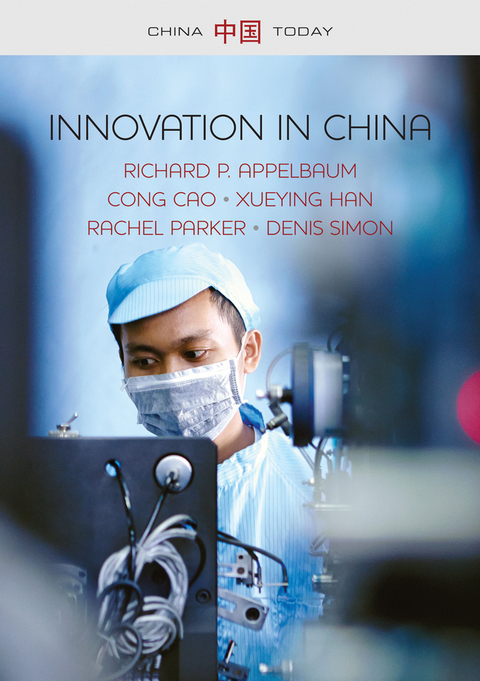
Innovation in China (eBook)
John Wiley & Sons (Verlag)
978-0-7456-8960-9 (ISBN)
In recent decades, China has seen huge investments in high-tech science parks, a surge in home-grown top-ranked global companies, and a significant increase in scientific publications and patents. Helped by state policies and a flexible business culture, the country has been able to leapfrog its way to a more globally competitive position.
However, the authors argue that this approach might not yield the same level of progress going forward if China does not address serious institutional, organizational, and cultural obstacles. While not impossible, this task may well prove to be more difficult for the Chinese Communist Party than the challenges that China has faced in the past.
Richard P. Appelbaum is Professor Emeritus and former Distinguished Research Professor and MacArthur Chair in Global and International Studies and Sociology at the University of California, Santa Barbara
Cong Cao is Professor in Innovation Studies at the University of Nottingham Ningbo China
Xueying Han is Research Staff Member at the Science and Technology Policy Institute (STPI)
Rachel Parker is Senior Director of Research at the Canadian Institute for Advanced Research (CIFAR)
Denis Simon is Executive Vice Chancellor at Duke Kunshan University
China is in the midst of transitioning from a manufacturing-based economy to one driven by innovation and knowledge. This up-to-date analysis evaluates China's state-led approach to science and technology, and its successes and failures. In recent decades, China has seen huge investments in high-tech science parks, a surge in home-grown top-ranked global companies, and a significant increase in scientific publications and patents. Helped by state policies and a flexible business culture, the country has been able to leapfrog its way to a more globally competitive position. However, the authors argue that this approach might not yield the same level of progress going forward if China does not address serious institutional, organizational, and cultural obstacles. While not impossible, this task may well prove to be more difficult for the Chinese Communist Party than the challenges that China has faced in the past.
Richard P. Appelbaum is Professor Emeritus and former Distinguished Research Professor and MacArthur Chair in Global and International Studies and Sociology at the University of California, Santa Barbara Cong Cao is Professor in Innovation Studies at the University of Nottingham Ningbo China Xueying Han is Research Staff Member at the Science and Technology Policy Institute (STPI) Rachel Parker is Senior Director of Research at the Canadian Institute for Advanced Research (CIFAR) Denis Simon is Executive Vice Chancellor at Duke Kunshan University
Introduction: From the World's Factory to the World's Innovator?
Chapter 1 - China's Science and Technology Policy - A New Developmental State?
Chapter 2 - Science and Technology in China: A Historical Overview
Chapter 3 - China's Science and Technology Enterprise: Can Government-Led Efforts Successfully Spur Innovation?
Chapter 4 - China's International S&T Relations: From Self-Reliance to Active Global Engagement
Chapter 5 - How Effective Is China's State-Led Approach to High-Tech Development?
Chapter 6 - Xi Jinping's Chinese Dream: Some Challenges
"This highly important work gives us insightful analysis founded on a tremendous depth of scholarship and interviews. It is the most comprehensive account of China's innovation system through a western lens."
--Margaret McCuaig-Johnston, University of Alberta
"Innovation in China offers a masterful account of China's innovation system, its working, and its impacts (for better and worse). A must read for those who care about innovation, China, or both."
--Dan Breznitz, University of Toronto
"The various aspects related to the effectiveness of China's industrial and innovation policy have long been debated and analysed, but have never been fully understood. [...T]his book will be a valuable source for scholars and practitioners alike."
--Asian Affairs
Introduction: From the World's Factory to the World's Innovator?
China sees itself as an emerging world power. Shortly after his election as the General Secretary of the Central Committee of the Chinese Communist Party (CCP) in November 2012, during a visit to the National Museum off Tiananmen Square, Xi Jinping stood in front of an exhibit called “The Road to Rejuvenation,” and reminded the assembled dignitaries and reporters:
After the 170 or more years of constant struggle since the Opium Wars, the great revival of the Chinese nation enjoys glorious prospects … Now everyone is discussing the Chinese dream, and I believe that realizing the great revival of the Chinese nation is the greatest dream of the Chinese nation in modern times.
(BBC News 2012)
Innovative breakthroughs in science and technology (S&T), resulting in globally competitive goods and services, are key to realizing Xi's Chinese dream. For decades China has been the world's factory, manufacturing and assembling goods ranging from cheap apparel to complex electronics. This role has served China well. Like the newly industrializing economies of East Asia a generation ago, China's meteoric economic growth has been fueled by export-oriented industrialization. The extraordinary amount of foreign direct investment China receives was initially driven by its plentiful supply of cheap labor. In recent years, however, as its economy has grown at historically unprecedented rates, its investments in science and technology have started to pay off. Meanwhile, as labor costs have risen, foreign firms are increasingly drawn to China for reasons other than its manufacturing capabilities: access to what is becoming the world's largest consumer market, and the ability to partner with China's growing (and increasingly better educated) science and engineering talent pool.
China has grown to become the world's second-largest economy, its GDP surpassing Japan's in 2010. In the 33 years between 1978 and 2011, China's annual GDP growth averaged 10 percent, a 20-fold increase over the period (Haltmaier 2013). Even during the 2007–9 recession, China's economy only slowed to about 9 percent (World Bank 2013). Since that time, however, GDP growth has slowed further, as China makes the transition from public investment to consumer spending as a central driver of development. Still, China's GDP grew at 6.8 percent in 2017, more than three times the rate of the world's advanced economies (IMF 2017). When corrected for purchasing power parity, the IMF (2014) estimated that China's GDP surpassed that of the US in 2014.1 China's rapid growth has resulted in a rising middle class, now estimated at several hundred million people.2
By October 2017 China's foreign exchange reserves had dropped to US$3.1 trillion, after reaching a high of US$4 trillion in the first quarter of 2014 (Trading Economics 2016; SCMP 2017); US$1.2 trillion (39 percent) were in the form of US Treasuries (US Department of Treasury 2017). China still retains a sizeable amount of foreign exchange reserves, which have been plowed back into the Chinese economy in the form of high-speed trains, highways, and other infrastructure; universities and science parks; and vast urban developments.
Public investment, which accounts for an estimated two-thirds of China's growth, has proven to be a successful strategy on the part of the Chinese Communist Party, whose legitimacy depends primarily on a rising tide that lifts a growing number of boats. But this approach has thus far produced limited returns in terms of innovation. China may be Walmart's leading trading partner, but the lion's share of the profits from that relationship is realized by Walmart. China may be the world's largest assembly of Apple and Samsung products, but only a small share of value added remains in China (see chapter 4 for further discussion).
As early as 2005, China's leaders set out to rectify this imbalance. China's role as the world's factory is undergoing a major transition: from “made in China” to “designed and created in China,” from imitator to innovator. The 15-year Medium to Long-Term Plan for the Development of Science and Technology (MLP) set forth ambitious goals to transform China's S&T efforts from imitator to innovator (Ministry of Science and Technology 2006). It identified four basic science areas as “science megaprojects” (reproductive biology, protein science, quantum research, and nanotechnology, with stem cell and climate change added later), along with 16 “engineering megaprojects” (three being classified) and eight “frontier technologies” intended to convert scientific knowledge into commercially competitive leading-edge products.
The MLP has been backed up by China's 11th, 12th, and 13th Five-Year Plans, as well as a host of provincial and local efforts to develop world-class S&T capabilities. Significantly, the MLP emphasized the importance of “indigenous innovation” (zizhu chuangxin) capability to enable China to “leapfrog” its way into scientific leadership (the MLP is discussed in greater detail in chapters 2 and 3). Part of China's approach has been to move away from dependence on low-cost and resource-intensive production, which is seen as providing little in terms of technology transfer. Moreover, wages have been raised,3 not only to placate workers, but also to promote the growth of a consuming class, having apparently learned from Henry Ford, who supposedly favored the “five dollar a day” wage so his workers could afford to buy the Model Ts they were producing. This, in turn, is resulting in some capital flight to lower-wage countries such as Vietnam, Bangladesh, Indonesia, and parts of Africa.
Since its adoption of the MLP over a decade ago, China's leaders have ramped up investment in “indigenous innovation” involving research, development, and commercialization of advanced technologies (Appelbaum et al. 2011a).4 Although the MLP serves as an example of state-led S&T-oriented industrial policy, its investment in science and technology has yet to pay the predicted big dividends. As we shall demonstrate, although the trends are promising, China faces some significant barriers to achieving the world-class innovations it hopes to achieve. China's universities and science parks are impressive to look at, with laboratories and facilities that rival those of the US and Europe. Sparkling facilities, however, do not automatically translate into innovative breakthroughs.
In January 2013 China's State Council issued a notice advancing the government's plans for indigenous innovation.5 The notice, an addendum to the 12th Five-Year Plan (2011–15) intended to support and implement the MLP, set forth State Council goals intended “to deepen the scientific and technological system to accelerate the nation's innovation system.” It served as an official reminder that “the 12th Five-Year Plan states the urgent needs of our nation, at this crucial period, to build an innovation-oriented country, to thoroughly build a well and prosperous society, to accelerate the development of economic progress to enhance the capabilities of indigenous innovation to higher limits.” The notice reaffirmed earlier calls for “supporting technological leapfrog development,” to be achieved by “strengthening the building of basic conditions for technological innovation.” These included an augmentation of research laboratory facilities, such as national key laboratories, improved instrumentation, and the construction of a network of field research stations. The notice called for “enhancing the ability to continuously innovate key industries,” including advances in materials,6 information technology, and energy.7 There was a strong emphasis on green technologies, including the “implementation of a low-carbon technology innovation industrialization project, strengthening carbon capture, R&D and capabilities of utilization and sequestration technologies.” Perhaps with growing traffic congestion and air pollution in mind, the notice also called for “accelerating the construction of intelligent digital traffic management, integrated transport, and green transportation.” The notice called for a wide range of mechanisms to “strengthen the regional innovation development capacity [and] accelerate the construction of distinctive regional innovation systems.” While the eastern region – already home to China's leading high-tech and manufacturing sectors – is to provide “an open resource-intensive sharing of its scientific and educational advantages,” the notice also called for investment in central and western China as well. It specifically singled out “national high-tech industrial development zones,” such as Beijing's Zhongguancun, Wuhan's East Lake, and Shanghai's Zhangjiang as the role models.
Finally, China's universities and vocational schools are seen as key to these efforts. While the notice called for such worthwhile goals as strengthening the educational system, enhancing people's abilities and talents, conducting world-class academic research, and promoting collaborative innovation, these are to be achieved largely through technological advances such as...
| Erscheint lt. Verlag | 15.10.2018 |
|---|---|
| Reihe/Serie | China Today |
| China Today | China Today |
| Sprache | englisch |
| Themenwelt | Naturwissenschaften |
| Sozialwissenschaften ► Soziologie | |
| Technik | |
| Wirtschaft ► Volkswirtschaftslehre ► Makroökonomie | |
| Schlagworte | AI • Artificial Intelligence • Asia & Australasia • Asien • Asien u. Australasien / Ökonomie u. Handel • China • China /Technik • Development • Economics • higher education • Innovation • nanotechnology • Ökonomische Soziologie • Rise of China • Science • Sociology • Sociology of Economics • Sociology of Science & Technology • Soziologie • Soziologie d. Naturwissenschaft u. Technik • STS • Technology • technology and innovation in China • Volkswirtschaftslehre |
| ISBN-10 | 0-7456-8960-4 / 0745689604 |
| ISBN-13 | 978-0-7456-8960-9 / 9780745689609 |
| Informationen gemäß Produktsicherheitsverordnung (GPSR) | |
| Haben Sie eine Frage zum Produkt? |
 EPUB (Adobe DRM)
Kopierschutz: Adobe-DRM
Adobe-DRM ist ein Kopierschutz, der das eBook vor Mißbrauch schützen soll. Dabei wird das eBook bereits beim Download auf Ihre persönliche Adobe-ID autorisiert. Lesen können Sie das eBook dann nur auf den Geräten, welche ebenfalls auf Ihre Adobe-ID registriert sind.
Details zum Adobe-DRM
Dateiformat: EPUB (Electronic Publication)
EPUB ist ein offener Standard für eBooks und eignet sich besonders zur Darstellung von Belletristik und Sachbüchern. Der Fließtext wird dynamisch an die Display- und Schriftgröße angepasst. Auch für mobile Lesegeräte ist EPUB daher gut geeignet.
Systemvoraussetzungen:
PC/Mac: Mit einem PC oder Mac können Sie dieses eBook lesen. Sie benötigen eine
eReader: Dieses eBook kann mit (fast) allen eBook-Readern gelesen werden. Mit dem amazon-Kindle ist es aber nicht kompatibel.
Smartphone/Tablet: Egal ob Apple oder Android, dieses eBook können Sie lesen. Sie benötigen eine
Geräteliste und zusätzliche Hinweise
Buying eBooks from abroad
For tax law reasons we can sell eBooks just within Germany and Switzerland. Regrettably we cannot fulfill eBook-orders from other countries.
aus dem Bereich