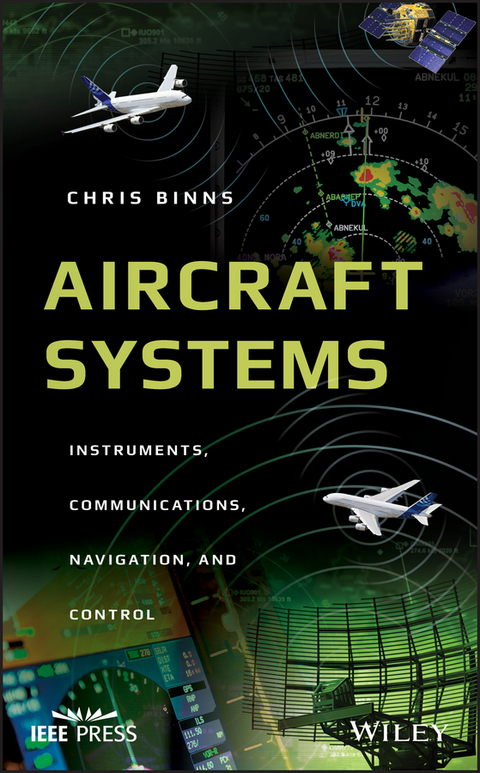
Aircraft Systems (eBook)
John Wiley & Sons (Verlag)
978-1-119-26235-0 (ISBN)
An authoritative guide to the various systems related to navigation, control, and other instrumentation used in a typical aircraft
Aircraft Systems offers an examination of the most recent developments in aviation as it relates to instruments, radio navigation, and communication. Written by a noted authority in the field, the text includes in-depth descriptions of traditional systems, reviews the latest developments, as well as gives information on the technologies that are likely to emerge in the future. The author presents material on essential topics including instruments, radio propagation, communication, radio navigation, inertial navigation, and puts special emphasis on systems based on MEMS.
This vital resource also provides chapters on solid state gyroscopes, magnetic compass, propagation modes of radio waves, and format of GPS signals. Aircraft Systems is an accessible text that includes an investigation of primary and secondary radar, the structure of global navigation satellite systems, and more. This important text:
- Contains a description of the historical development of the latest technological developments in aircraft instruments, communications and navigation
- Gives several 'interesting diversion' topics throughout the chapters that link the topics discussed to other developments in aerospace
- Provides examples of instruments and navigation systems in actual use in cockpit photographs obtained during the authors work as a flight instructor
- Includes numerous worked examples of relevant calculations throughout the text and a set of problems at the end of each chapter
Written for upper undergraduates in aerospace engineering and pilots in training, Aircraft Systems offers an essential guide to both the traditional and most current developments in aviation as it relates to instruments, radio navigation, and communication.
PROF. CHRIS BINNS is an Emeritus professor at the Department of Physics and Astronomy with the University of Leicester,??UK. Currently he is a??flight instructor and continues to teach engineers at universities in Greece and in the UK.
PROF. CHRIS BINNS is an Emeritus professor at the Department of Physics and Astronomy with the University of Leicester,??UK. Currently he is a??flight instructor and continues to teach engineers at universities in Greece and in the UK.
1
Historical Development
1.1 Introduction
If you board a commercial flight in 2016, you will step onto an aircraft that has a significant redundancy of electrical power and safety systems with a high level of automation. The instruments in the cockpit show the pilots via highly ergonomic displays the attitude, height, climb rate, speed, and Mach number of the aircraft as well as the state of the engines and other factors such as the outside air temperature and the wind speed and direction. On‐board weather radar informs the pilots of storms in the path with detailed information about the precipitation, turbulence, and the lateral and vertical extent of the storms. The navigation system takes inputs from GPS satellites, an inertial reference system (IRS), and VHF radio beacons; filters the information; and provides a precise indication of the position of the aircraft in three dimensions to within a few meters. These same instruments and navigation systems provide information to the autopilot, which can control the aircraft in height and position to follow a specific flight plan and land the plane at the destination airport if the latter has the necessary ground systems installed. The navigation computer contains a detailed database of all man‐made and natural potential obstacles and provides warnings of approaching terrain or structures. The flight is conducted via a comprehensive air traffic control (ATC) system that tracks the aircraft and maintains communication links with the pilots throughout the flight to ensure safe separation with other aircraft. In addition, the aircraft will communicate automatically with others in the local area and build a three‐dimensional map of all nearby flights to provide a traffic avoidance system that is independent of ground air traffic controllers. The system will not only warn the pilots of nearby traffic but also in extreme cases will inform them what evasive action to take. These and other systems have led to an unprecedented level of safety in commercial air travel which, if represented as fatalities per km traveled, is safer than any other type of transport on water or land [1]. This parameter does not necessarily provide the fairest comparison between different modes of travel since air travel will naturally do well with any safety assessment that uses distance traveled as the criterion. For example, when using fatalities per hour traveled, aviation drops to third on the list below rail and bus transport. It remains true, however, that air travel safety has made vast improvements by any measure in the last few decades and this is largely due to the incorporation of the systems listed above. All of these will be described in detail in subsequent chapters but before delving into the technical complexity it is worth exploring, in this chapter, a condensed history of the development of some of those instruments and systems.
1.2 The Advent of Instrument Flight
In the earliest days of aviation, the pilot's senses were the main aircraft instruments, with vision being used to estimate speed, height, and flight attitude while hearing and smell were used to monitor the state of health of the engine. The Wright flyer did have instruments installed including an anemometer, a stopwatch, and a revolution counter but these were used exclusively to analyze the performance of the flyer and the engine post landing. The flight itself was conducted entirely utilizing the senses of the pilot. Flying by senses alone dominated aviation throughout the First World War and led to the myth of instinctive balance when flying an aeroplane. This remained while flights were rarely conducted in bad weather and small rolled attitudes that developed inadvertently while flying through an individual cloud went unheeded. After the war, airmail and the first passenger services started to be developed but initially these flew under the weather sometimes at very low altitude resulting in many fatalities.
It was realized by the end of the First World War that flying in cloud with pilot vision completely removed from the available information could quickly lead to spatial disorientation and the aircraft spiraling out of the cloud with complete loss of control. The problem is that inner ear senses, which measure linear and angular acceleration, are evolved for life on the ground and provide misleading sensations in aircraft. Examples include the Somatogyral illusion in which an established banked turn is undetected as there is no angular acceleration but rolling out of the turn produces the illusion of a bank in the opposite direction, and the Somatogravic illusion where accelerations and decelerations are interpreted as pitches up and down, respectively. Gyroscopic turn coordinators were available by 1918 but without instrument training pilots still tended to favor their senses over the indications of the instrument.
Early pioneers in the development of instrument flight were two US army pilots, William Ocker and Carl Crane. By 1918, the first gyroscope‐based attitude indicators (AIs) (see Section 1.4 and Section 3.1.9), invented by Elmer Sperry, were available and Ocker was one of the first to attempt an extended flight in cloud using the instrument. The flight still ended up with the aircraft in a spiral dive but Ocker realized that the main reason was his failure to put complete faith in the instrument and to pay too much attention to his erroneous balance senses. Ocker was one of the first to correctly identify the misinformation coming from balance organs and became somewhat of an evangelist for using instruments in flight. Crane was nearly killed in 1925 when he dropped into a spiral dive out of cloud while flying a congressman's son to Washington and was acutely aware of the problems of maintaining control while blind. Ocker and Crane teamed up in 1929 and conducted a comprehensive study of flying in clouds, which led, in 1932, to the publication of their book, Blind Flight in Theory and Practice, which is the first systematic exploration of instrument flight. By the late 1920s, a full range of pressure and gyro instruments were available as well as some radio navigation devices (see below) and in 1929 Jimmy Doolittle demonstrated a “blind” takeoff, aerodrome circuit, and landing in an aircraft whose dome was covered [2]. The cockpit in Doolittle's NY‐2 Husky biplane is shown in Figure 1.1a and contains the six main glass instruments that are to be found in a current general aviation (GA) light aircraft. That is, an altimeter (i), an AI (ii), an airspeed indicator (iii), a turn indicator or turn coordinator (iv), a direction indicator (DI) (v), and a vertical speed indicator (VSI) (vi). By the 1950s, the layout of these six instruments was standardized into what was deemed to be the most ergonomic arrangement (the so‐called “6‐pack”) and they were mounted as shown in Figure 1.1b, which shows a Piper PA28 cockpit.
Figure 1.1 (a) Flight instruments in the cockpit of the NY‐2 Husky biplane used in the first “blind” takeoff and landing flight by Doolittle in 1929.
Source: Reproduced from Ref. [2] with permission of ETHW.
(b) The same six instruments in the standard layout in a 1960’s light aircraft (Piper PA28).
In older large aircraft with traditional instruments, the standard 6‐pack is also evident directly in front of the pilot though it is embedded in an extended array of engine and navigation instruments. The main change to this layout came in the transition to “glass cockpits” in the late 1960s where several instruments are displayed on a single electronic screen. The term is slightly misleading as there is probably less glass in a glass cockpit than a traditional one with a large array of glass‐fronted instruments but basically it means information is displayed on electronic screens rather than individual instruments. The change to glass cockpits marked the transition from direct‐sensing to remote‐sensing instrumentation. In the case of older direct‐sensing pressure instruments, the pressure being measured is brought via tubes directly into the back of the instrument, which then converts it into a reading on the instrument face as described in Chapter 2. This leads to a large amount of tubing mixed in with all the wiring behind the instrument panel. In remote sensing, a transducer measures the quantity required remotely and converts it into an analog or digital electrical signal, which is conveyed by wires, either to an individual instrument, or to a computer and display generator. In the most modern systems, a digital data bus is used to convey information from all the sensors, which significantly reduces the complexity of the wiring. Figure 1.2 compares a cockpit with traditional direct‐sensing instruments in a twin piston engine aircraft (Figure 1.2a) and a glass cockpit in which the remote‐sensing instruments communicate via a computer to the electronic displays, again in a twin piston engine aircraft (Figure 1.2b). Note, however, that even in the glass cockpit there are some direct‐sensing instruments provided as backup in case of a total power failure. The glass screen immediately in front of the left pilot seat is referred to as the Primary Flight Display (PFD).
Figure 1.2 (a) Instrument display in the cockpit of a twin piston engine aircraft using entirely analog...
| Erscheint lt. Verlag | 12.10.2018 |
|---|---|
| Reihe/Serie | IEEE Press |
| Wiley - IEEE | Wiley - IEEE |
| Sprache | englisch |
| Themenwelt | Technik ► Elektrotechnik / Energietechnik |
| Technik ► Fahrzeugbau / Schiffbau | |
| Technik ► Luft- / Raumfahrttechnik | |
| Technik ► Maschinenbau | |
| Schlagworte | Aeronautic & Aerospace Engineering • Aircraft Communications Addressing and Reporting System • Area and Global Navigation Systems • Combining Systems Performance Based Navigation and Required Navigation Performance • Communication technology • Communication via Satellite • Development of Aircraft Digital Communications • Development of Aircraft Voice Communications • Development of Auto Flight Control Systems</p> • Development of Flight Instruments Based on Air Pressure • Development of Flight Instruments Based on Gyroscopes • Development of Radio Navigation • Electrical & Electronics Engineering • Elektrotechnik u. Elektronik • Global Navigation Satellite Systems • Guided Radio Beam Navigation • Hyperbolic Navigation • Inertial Navigation • Kommunikationstechnik • <p>Guide to Aircraft Systems • Luft- u. Raumfahrttechnik • Maschinenbau • mechanical engineering • Partielle Differentialgleichung • Radio Direction Finding • resource to Aircraft Systems • Secondary Surveillance Radar and Traffic Alert and Collision Avoidance System • Text on Aircraft Systems • The Advent of Instrument Flight • The Airspeed Indicator • the altimeter • The Vertical Speed Indicator Variometer • Understanding Aircraft Systems • VHF/UHF Radio Navigation Systems |
| ISBN-10 | 1-119-26235-6 / 1119262356 |
| ISBN-13 | 978-1-119-26235-0 / 9781119262350 |
| Informationen gemäß Produktsicherheitsverordnung (GPSR) | |
| Haben Sie eine Frage zum Produkt? |
 EPUB (Adobe DRM)
Kopierschutz: Adobe-DRM
Adobe-DRM ist ein Kopierschutz, der das eBook vor Mißbrauch schützen soll. Dabei wird das eBook bereits beim Download auf Ihre persönliche Adobe-ID autorisiert. Lesen können Sie das eBook dann nur auf den Geräten, welche ebenfalls auf Ihre Adobe-ID registriert sind.
Details zum Adobe-DRM
Dateiformat: EPUB (Electronic Publication)
EPUB ist ein offener Standard für eBooks und eignet sich besonders zur Darstellung von Belletristik und Sachbüchern. Der Fließtext wird dynamisch an die Display- und Schriftgröße angepasst. Auch für mobile Lesegeräte ist EPUB daher gut geeignet.
Systemvoraussetzungen:
PC/Mac: Mit einem PC oder Mac können Sie dieses eBook lesen. Sie benötigen eine
eReader: Dieses eBook kann mit (fast) allen eBook-Readern gelesen werden. Mit dem amazon-Kindle ist es aber nicht kompatibel.
Smartphone/Tablet: Egal ob Apple oder Android, dieses eBook können Sie lesen. Sie benötigen eine
Geräteliste und zusätzliche Hinweise
Buying eBooks from abroad
For tax law reasons we can sell eBooks just within Germany and Switzerland. Regrettably we cannot fulfill eBook-orders from other countries.
aus dem Bereich