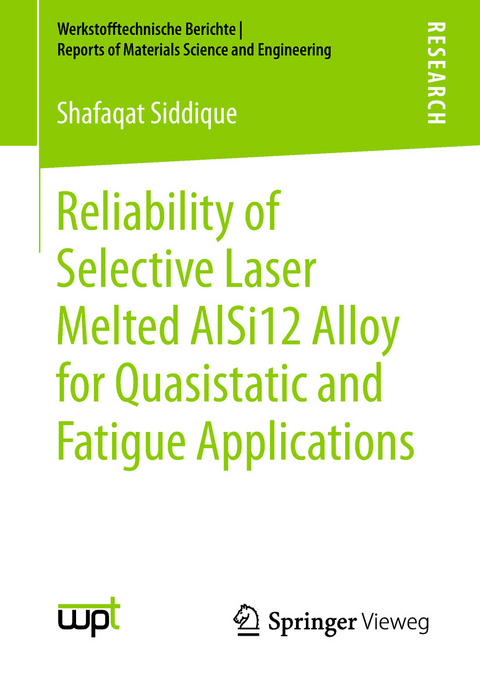
Reliability of Selective Laser Melted AlSi12 Alloy for Quasistatic and Fatigue Applications (eBook)
XXI, 146 Seiten
Springer Fachmedien Wiesbaden (Verlag)
978-3-658-23425-6 (ISBN)
About the Author
Shafaqat Siddique worked as Scientific Assistant at TU Dortmund University, Department of Materials Test Engineering (WPT), headed by Prof. Dr.-Ing. Frank Walther, and completed his Ph.D. research in cooperation with Laser Zentrum Nord (LZN) in Hamburg. He continues his post-doctoral research at TU Dortmund University, Germany.
Shafaqat Siddique worked as Scientific Assistant at TU Dortmund University, Department of Materials Test Engineering (WPT), headed by Prof. Dr.-Ing. Frank Walther, and completed his Ph.D. research in cooperation with Laser Zentrum Nord (LZN) in Hamburg. He continues his post-doctoral research at TU Dortmund University, Germany.
Shafaqat Siddique worked as Scientific Assistant at TU Dortmund University, Department of Materials Test Engineering (WPT), headed by Prof. Dr.-Ing. Frank Walther, and completed his Ph.D. research in cooperation with Laser Zentrum Nord (LZN) in Hamburg. He continues his post-doctoral research at TU Dortmund University, Germany.
Foreword 6
Preface 7
Abstract 8
Kurzfassung 9
Table of contents 11
List of abbreviations 14
List of symbols 16
1 Introduction 19
2 State of the art 22
2.1 Additive manufacturing (AM) 22
2.1.1 Spectrum of AM processes 22
2.1.2 Selective laser melting (SLM) process 25
2.1.3 Property profile of SLM-manufactured parts 28
2.2 Fatigue behavior of metallic materials 30
2.2.1 Cyclic deformation behavior and Woehler curve 30
2.2.2 Parameters affecting fatigue behavior 33
2.2.3 Crack initiation and crack propagation mechanisms 35
2.2.4 Fatigue prediction methodologies 40
2.3 Process-property relationships in SLM parts 45
2.3.1 Physical properties 45
2.3.2 Quasistatic properties 48
2.3.3 Fatigue properties 50
2.3.4 Crack propagation properties 53
2.3.5 Inferences and objectives 54
2.4 Aluminum-Silicon alloys 57
2.4.1 Physical properties 57
2.4.2 Phase diagram 58
2.4.3 Mechanical properties and applications 60
3 Investigation methodology 62
3.1 Processing setup and design of experiments 62
3.2 Post-processing 65
3.3 Non-destructive defect detection 65
3.4 Quasistatic tensile testing 68
3.5 Fatigue testing in HCF range 70
3.6 Fatigue testing in VHCF range 72
3.7 Crack propagation testing 74
3.8 Fatigue prediction methodology 75
4 Characterization of AlSi12 alloy 82
4.1 Powder characteristics 82
4.2 Microstructure 83
4.3 Chemical composition 87
4.4 Defect morphology 88
4.5 Hardness 91
4.6 Residual stresses 92
5 Results and discussions 94
5.1 Quasistatic and fatigue behavior of AlSi12 alloy 94
5.1.1 Quasistatic behavior 94
5.1.2 Damage behavior under in-situ interrupted loading 99
5.1.3 Fatigue behavior in HCF range 102
5.1.4 Fatigue behavior in VHCF range 112
5.1.5 Crack propagation behavior 117
5.2 Hybrid AlSi12 alloy structures 119
5.2.1 Specimen manufacturing and post-processing 120
5.2.2 Interface characterization 121
5.2.3 Quasistatic behavior 122
5.2.4 Fatigue behavior in HCF range 124
5.2.5 Fatigue behavior in VHCF range 127
5.3 Fatigue prediction methodology 130
5.3.1 Fracture mechanics-based approach 130
5.3.2 Plasticity-based approach 133
6 Summary 142
7 Outlook 145
References 147
Curriculum Vitae 162
| Erscheint lt. Verlag | 18.9.2018 |
|---|---|
| Reihe/Serie | Werkstofftechnische Berichte │ Reports of Materials Science and Engineering | Werkstofftechnische Berichte │ Reports of Materials Science and Engineering |
| Zusatzinfo | XXI, 146 p. 89 illus., 10 illus. in color. |
| Verlagsort | Wiesbaden |
| Sprache | englisch |
| Themenwelt | Technik ► Maschinenbau |
| Schlagworte | Additive Manufacturing (AM) • Al-alloys • Fatigue mechanisms • Fatigue prediction • Quasistatic behavior • Selective Laser Melting (SLM) |
| ISBN-10 | 3-658-23425-3 / 3658234253 |
| ISBN-13 | 978-3-658-23425-6 / 9783658234256 |
| Informationen gemäß Produktsicherheitsverordnung (GPSR) | |
| Haben Sie eine Frage zum Produkt? |
 PDF (Wasserzeichen)
DRM: Digitales Wasserzeichen
Dieses eBook enthält ein digitales Wasserzeichen und ist damit für Sie personalisiert. Bei einer missbräuchlichen Weitergabe des eBooks an Dritte ist eine Rückverfolgung an die Quelle möglich.
Dateiformat: PDF (Portable Document Format)
Mit einem festen Seitenlayout eignet sich die PDF besonders für Fachbücher mit Spalten, Tabellen und Abbildungen. Eine PDF kann auf fast allen Geräten angezeigt werden, ist aber für kleine Displays (Smartphone, eReader) nur eingeschränkt geeignet.
Systemvoraussetzungen:
PC/Mac: Mit einem PC oder Mac können Sie dieses eBook lesen. Sie benötigen dafür einen PDF-Viewer - z.B. den Adobe Reader oder Adobe Digital Editions.
eReader: Dieses eBook kann mit (fast) allen eBook-Readern gelesen werden. Mit dem amazon-Kindle ist es aber nicht kompatibel.
Smartphone/Tablet: Egal ob Apple oder Android, dieses eBook können Sie lesen. Sie benötigen dafür einen PDF-Viewer - z.B. die kostenlose Adobe Digital Editions-App.
Buying eBooks from abroad
For tax law reasons we can sell eBooks just within Germany and Switzerland. Regrettably we cannot fulfill eBook-orders from other countries.
aus dem Bereich