Nano-inspired Biosensors for Protein Assay with Clinical Applications (eBook)
378 Seiten
Elsevier Science (Verlag)
978-0-12-815054-2 (ISBN)
Professor Genxi Li received his BA in Polymer Chemistry, MA in Analytical Chemistry, and PhD in Analytical Chemistry from the Chemistry Department at Nanjing University, China, in 1988, 1991, and 1994, respectively. He was then a postdoc in the Biochemistry Department at Nanjing University. In 1996, he was made Associate Professor, and since 2001 he has been a full professor. He worked as a visiting scholar in the Department of Biology, Munich University in 1998; Faculty of Pharmaceutical Sciences, Tohoku University in 1999; and Department of Biological Chemistry and Molecular Pharmacology, Harvard University in 2000. In 2006, he was also a Professor affiliated with the School of Life Sciences, Shanghai University. From January 1999 to May 2010, he was the Chair of the Biochemistry Department at Naning University, and from November 2008 to October 2011, he was the Dean of the School of Life Sciences at Shanghai University. He is now the Vice President and Secretary General of the Chinese Protein Society, Member of the Committee for Chemical Sensors, China Instrument & Control Society, Member of the Council of the Biophysical Society of China, and Member of the Council of the Chinese Society of Biochemistry and Molecular Biology. He is also a member of the editorial board of several journals. His research interests include electrochemical biosensors and nano-based biosensors, mainly towards the assay of proteins with clinical applications. He has published more than 200 papers with more than 4000 citations.
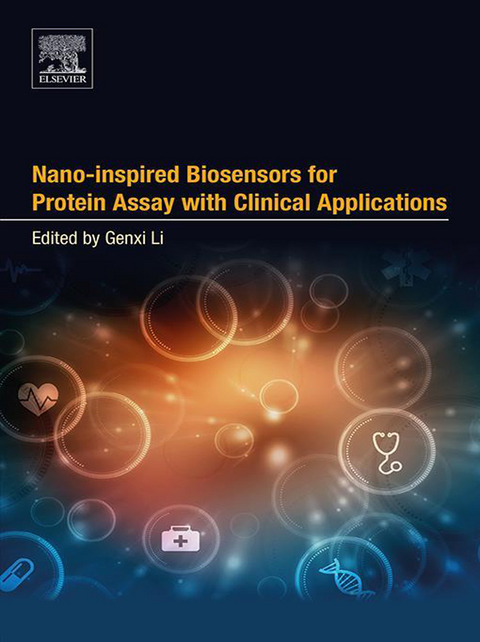
Nano-inspired Biosensors for Protein Assay with Clinical Applications introduces the latest developments in nano-inspired biosensing, helping readers understand both the fundamentals and frontiers in this rapidly advancing field. In recent decades, there has been increased interest in nano-inspired biosensors for clinical application. Proteins, e.g. antigen-antibody, tumor markers and enzymes are the most important target in disease diagnosis, and a variety of biosensing techniques and strategies have been developed for protein assay. This book brings together all the current literature on the most recent advances of protein analysis and new methodologies in designing new kinds of biosensors for clinical diagnostic use. - Provides a single source of information on the latest developments in the field of biosensors for protein analysis and clinical diagnosis- Focuses on biosensors fabricated with nanomaterials and nanotechnology- Gives detailed methodologies for designing and fabricating nano-inspired biosensors
| Erscheint lt. Verlag | 29.8.2018 |
|---|---|
| Sprache | englisch |
| Themenwelt | Naturwissenschaften ► Chemie ► Analytische Chemie |
| Naturwissenschaften ► Chemie ► Physikalische Chemie | |
| Naturwissenschaften ► Chemie ► Technische Chemie | |
| Technik | |
| ISBN-10 | 0-12-815054-8 / 0128150548 |
| ISBN-13 | 978-0-12-815054-2 / 9780128150542 |
| Informationen gemäß Produktsicherheitsverordnung (GPSR) | |
| Haben Sie eine Frage zum Produkt? |
 EPUB (Adobe DRM)
Kopierschutz: Adobe-DRM
Adobe-DRM ist ein Kopierschutz, der das eBook vor Mißbrauch schützen soll. Dabei wird das eBook bereits beim Download auf Ihre persönliche Adobe-ID autorisiert. Lesen können Sie das eBook dann nur auf den Geräten, welche ebenfalls auf Ihre Adobe-ID registriert sind.
Details zum Adobe-DRM
Dateiformat: EPUB (Electronic Publication)
EPUB ist ein offener Standard für eBooks und eignet sich besonders zur Darstellung von Belletristik und Sachbüchern. Der Fließtext wird dynamisch an die Display- und Schriftgröße angepasst. Auch für mobile Lesegeräte ist EPUB daher gut geeignet.
Systemvoraussetzungen:
PC/Mac: Mit einem PC oder Mac können Sie dieses eBook lesen. Sie benötigen eine
eReader: Dieses eBook kann mit (fast) allen eBook-Readern gelesen werden. Mit dem amazon-Kindle ist es aber nicht kompatibel.
Smartphone/Tablet: Egal ob Apple oder Android, dieses eBook können Sie lesen. Sie benötigen eine
Geräteliste und zusätzliche Hinweise
Buying eBooks from abroad
For tax law reasons we can sell eBooks just within Germany and Switzerland. Regrettably we cannot fulfill eBook-orders from other countries.
aus dem Bereich