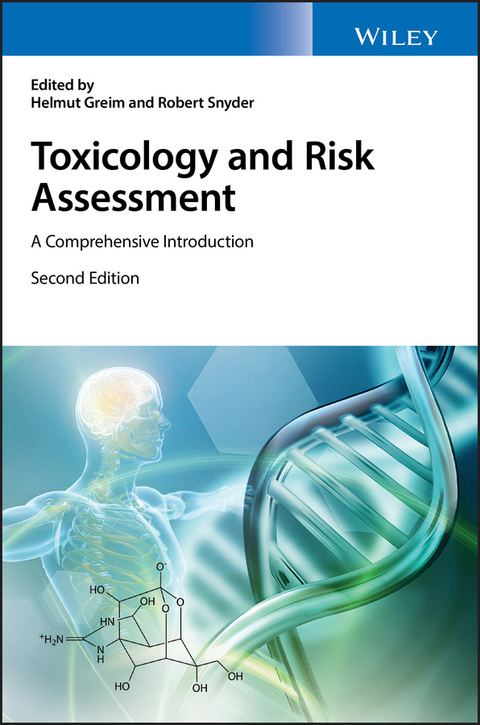
Toxicology and Risk Assessment (eBook)
John Wiley & Sons (Verlag)
9781119135937 (ISBN)
Provides a complete understanding of how our bodies respond to toxicants, and the principles used to assess the health risks of specific exposure scenarios
Toxicology and Risk Assessment: A Comprehensive Introduction, Second Edition reflects recent advances in science and technology, and provides the scientific background and methodological issues to enable the reader to understand the basic principles in toxicology and to evaluate the health risks of specific exposure scenarios.
Completely updated with the latest information, this book offers a concise introduction to the subject. It is divided into five sections: Principles in Toxicology, Organ Toxicology, Methods in Toxicology, Regulatory Toxicology, and Specific Toxicity. The 2nd Edition adds new chapters that cover recent scientific and technological advances and current topics including the endocrine system, alternatives to animal testing, risk assessment and thresholds for carcinogens, European and international regulation, nanomaterials, fuels, fragrances, and agrochemicals.
- Concentrates on the basic concepts of toxicology and provides sufficient information for the reader to become familiar with them in order to understand the principles and to evaluate the risks at given exposures
- 30% new chapters cover recent scientific and technological advances including alternatives to animal testing; genotoxic carcinogens; REACH regulations; nanomaterials; fuels; fragrances; PAHs; and agrochemicals
- Written by a team of international specialists, and edited by two outstanding scientists in the field
Fully updated and expanded, Toxicology and Risk Assessment: A Comprehensive Introduction, Second Edition is an essential text for any student or researcher with an interest in toxicology and related risk assessments.
Helmut Greim, MD, is a toxicologist and former chair of the Institute of Toxicology and Environmental Hygiene at the Technical University of Munich, Germany. His research experience is in drug metabolism, toxicokinetics, mechanisms of carcinogenic agents, and in vitro test systems.
Robert Snyder, PhD, is Associate Dean for Research, Ernest Mario School of Pharmacy at the Environmental and Occupational Health Sciences Institute, New Jersey, USA. His research areas are in the toxicology of bone marrow, impact of chemicals on the 'niche,' mechanisms of benzene toxicology, and leukemogenesis.
Helmut Greim, MD, is a toxicologist and former chair of the Institute of Toxicology and Environmental Hygiene at the Technical University of Munich, Germany. His research experience is in drug metabolism, toxicokinetics, mechanisms of carcinogenic agents, and in vitro test systems. Robert Snyder, PhD, is Associate Dean for Research, Ernest Mario School of Pharmacy at the Environmental and Occupational Health Sciences Institute, New Jersey, USA. His research areas are in the toxicology of bone marrow, impact of chemicals on the "niche," mechanisms of benzene toxicology, and leukemogenesis.
Short CVs of Authors
Adler, Ilse‐DoreIlse‐Dore Adler studied biology, chemistry and geography in Berlin and Tübingen to become a high school teacher. She graduated in Berlin (1965) and did her PhD thesis work (1965–1968) in Heidelberg at the Institute of Human Genetics on the topic of the genetic effects of caffeine on the germ cells of mice. After a post‐doctoral period (1970–1971) at the Children's Cancer Research Foundation, Harvard Medical School, Boston, USA, she joined the Institute of Mammalian Genetics of the GSF, Neuherberg, Germany (now Helmholz‐Zentrum München) and worked there on germ cell mutagenesis topics until her retirement in 2004. She served as Secretary and then President of the EEMS, was Adjunct Professor (1989–2004) at the Texas University Medical School, Galveston, USA) and served as advisor and reviewer of scientific projects of NIEHS.
Api, Anne MarieAnne Marie Api is Vice President, Human Health Sciences at the Research Institute for Fragrance Materials, Inc. (RIFM). Dr. Api has used her advanced knowledge of fragrance ingredient safety to establish a quality record of managing fragrance ingredient safety at RIFM. She has authored over 100 scientific publications and is a member of numerous scientific organizations. She received for the 2018 Toxicology Forum Philippe Shubik Distinguished Scientist Award.
Bartsch, RüdigerDr. Rüdiger Bartsch is certified expert in toxicology (DGPT) and has worked for more than 20 years in the scientific secretariat of the Permanent Senate Commission for the Investigation of Health Hazards of Chemical Compounds in the Work Area of the German Research Foundation. His main work is the derivation of occupational exposure levels for industrial chemicals, focusing on the underlying toxic mechanism. Dr. Bartsch is a biologist and received his PhD from the Technical University of Munich.
Bevan, RuthDr. Ruth Bevan has considerable expertise in toxicology and human health risk assessment in areas connected with environmental or occupational exposure to chemicals. She has published on a broad range of environment and health issues, notably in the field of occupational cancer burden and biomonitoring of environmental exposures (including via consumer articles, drinking water, food and air).
Blömeke, BrunhildeBrunhilde Blömeke received her PhD in biology and started her academic career as a molecular toxicologist. At present she holds the position of Professor for Environmental Toxicology at the University of Trier, Germany. Her primary research interest is focused on the molecular mechanisms of chemicals and the development of in vitro methods for their detection and risk assessment. She serves as member of several advisory committees, including the DFG Permanent Senate Commission for the Investigation of Health Hazards of Chemical Compounds in the Work Area (German MAK commission).
Bolt, HermannProfessor Dr. Hermann Bolt studied medicine and biochemistry at the universities of Cologne and Tübingen, and started his academic career in the Institute of Toxicology at the University of Tübingen. In 1979 he became head of the Section of Toxicology at the Institute of Pharmacology, University of Mainz and in 1982 Professor of Toxicology and Occupational Medicine at the University of Dortmund with the position of Director of the Institute of Occupational Health of the Leibniz Research Center for Working Environment and Human Factors. Dr. Bolt is a general toxicologist with major research experience in the metabolism and toxic mechanisms of steroids and industrial chemicals. Dr. Bolt has served in many national and international committees and chaired the Scientific Committee on Occupational Exposure Limits of the General Directorate Employment of the European Commission.
Borm, PaulPaul Borm holds degrees in biochemistry (MSc) and pharmacology (PhD), and has focused his academic career (1984–2004) on inhalation toxicology and risk assessment. Since 2011 Paul Borm has been CSO and shareholder of Nano‐Imaging (Aachen), as well as managing director of Nanoconsult. He supports both start‐ups in business development and advises major international companies with regard to risk management and product stewardship. In addition he holds a professorship at the University of Düsseldorf and teaches medical imaging.
Calow, PeterPeter Calow is a professor at the Humphrey School of Public Affairs, University of Minnesota and has held previous professorial positions at the universities of Nebraska‐Lincoln (USA), Sheffield (UK), and Roskilde (Denmark). His current research is on the interface between science and public policy, with special interest in the better use of risk assessment in environmental policy and regulation. He has written more than 300 articles and edited/authored more than 20 books.
Csanády, György AndrásGyörgy András Csanády (1958–2011) studied chemistry at the Eötvös‐Loránd‐University, Budapest, where he received his PhD. After research positions in Austria and the chemical industry at the Institute of Toxicology, North Carolina he joined the Institute of Toxicology at the federal Research Center in Munich, Germany. His research activities focused on the development of physiological based toxicokinetic models for the risk assessment of chemicals. He held the position of Associate Professor at the Technical University of Munich.
Dekant, WolfgangDr. Wolfgang Dekant has been Professor of Toxicology at the Department of Pharmacology and Toxicology of the University of Würzburg since 1992. He is involved in international toxicology research projects as well as advisory services and collaborates with the relevant authorities and organizations, including the European Union, the World Health Organization, the US Environmental Protection Agency, the Federal Environment Agency, and federal ministries in Germany. He is also responsible for numerous scientific publications as an author and editor.
Dietrich, DanielProfessor Daniel Dietrich, PhD, ERT, FATS, studied biochemistry and biology at the University of Zurich and ETH Zurich, gaining a Master of Science (1984) and a PhD in toxicology (Institute of Toxicology ETH Zurich, 1988). He is head of the Institute of Human and Environmental Toxicology at the University of Konstanz, elected external expert “Life Sciences for Human Well‐being” for the European Parliament, ad hoc expert for the High Level Group of the European Commission's Scientific Advice Mechanism, and Academic Advisor for the European Risk Forum.
Eckert, Gunter PeterProfessor Dr. Gunter Peter Eckert is full‐professor for nutrition in prevention and therapy at the Justus‐Liebig‐University of Giessen. He studied food chemistry and environmental toxicology, and holds a PhD in pharmacology. He is a trained pharmacologist at the Goethe‐University in Frankfurt, where he is responsible for teaching toxicology.
Efferth, ThomasProfessor Dr. Thomas Efferth is chair of the Department of Pharmaceutical Biology, Institute of Pharmacy and Biochemistry, Johannes Gutenberg University, Mainz, Germany. He is honorary professor at the Northeast Forestry University, Harbin, and at the Zhejiang Chinese Medical University, Hangzhou, China. Moreover, he is visiting professor at the Zhejiang University of Science and Technology, Hangzhou, China. He has published over 490 PubMed‐listed papers in the field of cancer research, pharmacology, and natural products, and is editor‐in‐chief of the journal Phytomedicine. He is scientific advisory board member of the German Pharmaceutical Society and several other institutions.
Filser, Johannes G.Johannes G. Filser, PhD, studied biochemistry at the University of Tübingen; habilitation thesis at the University of Mainz in 1987. His main research topics at the Institutes of Toxicology at the Universities of Tübingen and Mainz and later on at the federal Research Center (former GSF) were toxicokinetics and metabolism of xenobiotics in laboratory animals and humans. Between 1993 and 2012 he served as associate professor at the Technical University of Munich.
Forbes, ValeryValery Forbes is Dean of the College of Biological Sciences at the University of Minnesota, a position she has held since July 2015. A marine biologist by training, Dr. Forbes' research aims to improve the science underlying risk assessments of chemicals and other stressors on ecological systems.
Gebel, ThomasProfessor Dr. Thomas Gebel is head of the toxicology unit at the German BAuA, the Federal Institute for Occupational Safety and Health. He deals with the toxicological evaluation of workplace chemicals with respect to both hazard classification and occupational exposure limit setting. He is associate professor for environmental toxicology at the Technical University of Dortmund.
Göen, ThomasProfessor Dr. Thomas Göen is a chemist and expert in the human metabolism of hazardous substances as well as analytical procedures for the determination of such substances and their metabolites in biological matrices. He is a member of the DFG Senate Commission for the Investigation of Hazardous Compounds in the Work Area and the Human Biomonitoring Commission of the German Federal Environment Agency. He is also engaged in the organization of the German External Quality Assessment Scheme, which offers the proficiency control of laboratories worldwide for about 200 biomonitoring...
| Erscheint lt. Verlag | 22.8.2018 |
|---|---|
| Sprache | englisch |
| Themenwelt | Naturwissenschaften ► Biologie |
| Naturwissenschaften ► Chemie ► Technische Chemie | |
| Technik | |
| Schlagworte | Arbeitstoxikologie • Biochemie • biochemistry • biomonitoring of exposure • Biowissenschaften • chemical exposure • chemical exposure assessment • Chemical identification • Chemie • Chemistry • evaluating chemical exposure • evaluating toxic exposure • guide to toxicology • Hazard assessment • Hazard Identification • Health Risks • human exposure to chemical • human exposure to physical agents • Life Sciences • <p>toxicology • mechanisms of carcinogenic agents • Monitoring toxicity • Occupational Toxicology • Paracelsus’ paradigm • risk characterization in toxicology • toxic exposure • toxicity assessment • toxicity research • toxicity studies • Toxicokinetics • Toxicology • toxicology and hazard identification • toxicology and health • toxicology and risk assessment • Toxicology and Risk Assessment: A Comprehensive Introduction</p> • Toxicology Methods • toxicology principles • Toxikologie |
| ISBN-13 | 9781119135937 / 9781119135937 |
| Informationen gemäß Produktsicherheitsverordnung (GPSR) | |
| Haben Sie eine Frage zum Produkt? |
 EPUB (Adobe DRM)
Kopierschutz: Adobe-DRM
Adobe-DRM ist ein Kopierschutz, der das eBook vor Mißbrauch schützen soll. Dabei wird das eBook bereits beim Download auf Ihre persönliche Adobe-ID autorisiert. Lesen können Sie das eBook dann nur auf den Geräten, welche ebenfalls auf Ihre Adobe-ID registriert sind.
Details zum Adobe-DRM
Dateiformat: EPUB (Electronic Publication)
EPUB ist ein offener Standard für eBooks und eignet sich besonders zur Darstellung von Belletristik und Sachbüchern. Der Fließtext wird dynamisch an die Display- und Schriftgröße angepasst. Auch für mobile Lesegeräte ist EPUB daher gut geeignet.
Systemvoraussetzungen:
PC/Mac: Mit einem PC oder Mac können Sie dieses eBook lesen. Sie benötigen eine
eReader: Dieses eBook kann mit (fast) allen eBook-Readern gelesen werden. Mit dem amazon-Kindle ist es aber nicht kompatibel.
Smartphone/Tablet: Egal ob Apple oder Android, dieses eBook können Sie lesen. Sie benötigen eine
Geräteliste und zusätzliche Hinweise
Buying eBooks from abroad
For tax law reasons we can sell eBooks just within Germany and Switzerland. Regrettably we cannot fulfill eBook-orders from other countries.
aus dem Bereich