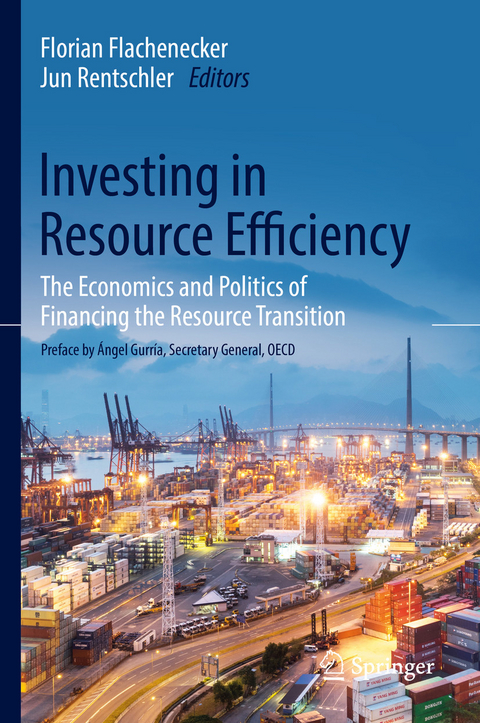
Investing in Resource Efficiency (eBook)
XVI, 294 Seiten
Springer International Publishing (Verlag)
978-3-319-78867-8 (ISBN)
This book covers the multi-faceted incentives, trade-offs, and challenges associated with the economics and politics of resource efficiency investments. By contributing a wide range of empirical evidence, practitioners' insights, and policy perspectives, this book carefully examines the role of resource efficiency in reconciling environmental and economic considerations. It also discusses the critical role of resource efficiency investments in mitigating climate change and enabling sustainable development.
Featuring expert insights from academia, the European Commission, the European Investment Bank, and the European Bank for Reconstruction and Development, this book provides a policy oriented guide, reference, and toolbox for unlocking the potential of resource efficiency. To this end, it identifies practical measures for overcoming barriers and creating smart incentives for leveraging resource efficiency investments. Overall, this book brings together evidence to develop innovative ideas and strategies for improving the efficient use of resources and advancing clean and sustainable development.
'This book is an important and timely contribution', Angel Gurria, Secretary General, OECD
Florian Flachenecker is a Junior Economist (Young Professionals Programme) at the Organisation for Economic Co-operation and Development (OECD) working on the OECD Green Growth Strategy and environmental indicators. Previously, he was a Doctoral Researcher at University College London (UCL), empirically investigating the effects of resource efficiency on competitiveness and climate change mitigation. Florian was a Visiting Fellow at the European Political Strategy Centre of the European Commission, developing a competitiveness strategy for the EU. Moreover, he worked as a Consultant at the European Bank for Reconstruction and Development on resource efficiency investment projects on the firm-level, and he worked on European policy issues at the German Federal Ministry of Finance. Florian holds a PhD in Economics from UCL, a MA in Economics from the College of Europe, and a BSc in Economics from the University of Mannheim as well as the Tecnológico de Monterrey.
Jun Rentschler is an Economist (YP) at The World Bank working at the intersection of climate change and sustainable resilient development. He is also a Visiting Research Fellow at the Oxford Institute for Energy Studies, the Payne Institute for Earth Resources in Colorado, and the Graduate Institute for Policy Studies in Tokyo. He spent two years as a Consultant at the European Bank for Reconstruction and Development (EBRD) working on resource efficiency investment projects. He also served as an Economic Adviser at the German Foreign Ministry, where he focused on economic and energy policy. Jun holds a MSc and a PhD in Economics from UCL, specialising in the fields of development, climate, and energy. He has published widely on these topics, including in academic journals and his book 'Fossil Fuel Subsidy Reforms: A guide to economic and political complexity'.
Florian Flachenecker is a Junior Economist (Young Professionals Programme) at the Organisation for Economic Co-operation and Development (OECD) working on the OECD Green Growth Strategy and environmental indicators. Previously, he was a Doctoral Researcher at University College London (UCL), empirically investigating the effects of resource efficiency on competitiveness and climate change mitigation. Florian was a Visiting Fellow at the European Political Strategy Centre of the European Commission, developing a competitiveness strategy for the EU. Moreover, he worked as a Consultant at the European Bank for Reconstruction and Development on resource efficiency investment projects on the firm-level, and he worked on European policy issues at the German Federal Ministry of Finance. Florian holds a PhD in Economics from UCL, a MA in Economics from the College of Europe, and a BSc in Economics from the University of Mannheim as well as the Tecnológico de Monterrey.Jun Rentschler is an Economist (YP) at The World Bank working at the intersection of climate change and sustainable resilient development. He is also a Visiting Research Fellow at the Oxford Institute for Energy Studies, the Payne Institute for Earth Resources in Colorado, and the Graduate Institute for Policy Studies in Tokyo. He spent two years as a Consultant at the European Bank for Reconstruction and Development (EBRD) working on resource efficiency investment projects. He also served as an Economic Adviser at the German Foreign Ministry, where he focused on economic and energy policy. Jun holds a MSc and a PhD in Economics from UCL, specialising in the fields of development, climate, and energy. He has published widely on these topics, including in academic journals and his book ‘Fossil Fuel Subsidy Reforms: A guide to economic and political complexity’.
Foreword.- Part I: Background and Concepts.- Part II: Methodologies and Evidence.- Part III: Case Studies and Practitioners' Insights.- Part IV: Policy Implications and Conclusions.
| Erscheint lt. Verlag | 21.8.2018 |
|---|---|
| Zusatzinfo | XVI, 294 p. 63 illus., 37 illus. in color. |
| Verlagsort | Cham |
| Sprache | englisch |
| Themenwelt | Sozialwissenschaften ► Politik / Verwaltung |
| Technik | |
| Wirtschaft ► Betriebswirtschaft / Management ► Finanzierung | |
| Wirtschaft ► Volkswirtschaftslehre | |
| Schlagworte | circular economy • climate change • Climate Change Management • Development Finance • energy efficiency • G7 Resource Efficiency Alliance • green growth • Resource Efficiency Investments • Roadmap to a Resource Efficient Europe • sustainable development • Sustainable Development Goals |
| ISBN-10 | 3-319-78867-1 / 3319788671 |
| ISBN-13 | 978-3-319-78867-8 / 9783319788678 |
| Informationen gemäß Produktsicherheitsverordnung (GPSR) | |
| Haben Sie eine Frage zum Produkt? |
 PDF (Wasserzeichen)
DRM: Digitales Wasserzeichen
Dieses eBook enthält ein digitales Wasserzeichen und ist damit für Sie personalisiert. Bei einer missbräuchlichen Weitergabe des eBooks an Dritte ist eine Rückverfolgung an die Quelle möglich.
Dateiformat: PDF (Portable Document Format)
Mit einem festen Seitenlayout eignet sich die PDF besonders für Fachbücher mit Spalten, Tabellen und Abbildungen. Eine PDF kann auf fast allen Geräten angezeigt werden, ist aber für kleine Displays (Smartphone, eReader) nur eingeschränkt geeignet.
Systemvoraussetzungen:
PC/Mac: Mit einem PC oder Mac können Sie dieses eBook lesen. Sie benötigen dafür einen PDF-Viewer - z.B. den Adobe Reader oder Adobe Digital Editions.
eReader: Dieses eBook kann mit (fast) allen eBook-Readern gelesen werden. Mit dem amazon-Kindle ist es aber nicht kompatibel.
Smartphone/Tablet: Egal ob Apple oder Android, dieses eBook können Sie lesen. Sie benötigen dafür einen PDF-Viewer - z.B. die kostenlose Adobe Digital Editions-App.
Buying eBooks from abroad
For tax law reasons we can sell eBooks just within Germany and Switzerland. Regrettably we cannot fulfill eBook-orders from other countries.
aus dem Bereich