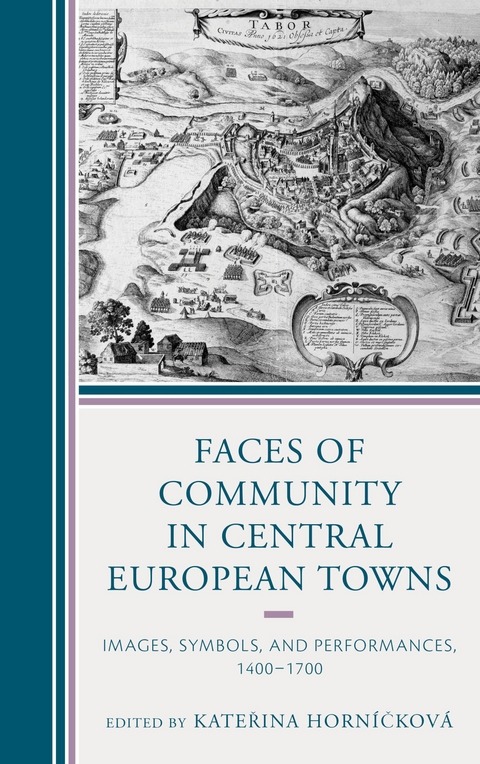
Faces of Community in Central European Towns (eBook)
448 Seiten
Lexington Books (Verlag)
978-1-4985-5113-7 (ISBN)
Concepts of visual communication form an explanatory framework for discussing the visual expressions of urban symbolic communication in urban life in towns in the center of Europe in the late medieval and early modern period, including the dramatic times of the Reformation and Counter-Reformation. This book examines the role of images and visual representation by concentrating on the varieties of symbolic communication in towns that made a range of relationships visual: the status and role of urban civic, professional, and religious communities and the relations between the town and its lord or powerful families and individuals. The geographical framework of this book is the region in the former Habsburg countries north of the Danube River embracing the region between western Bohemia and what is today eastern Slovakia, including the borderland towns of northern Austria. Two studies focus on specific local and occupational communities in the Prague towns, but most of the texts in this book focus on small towns by contemporary European standards in which many forms of urban topography, buildings, objects, and monuments survive, even though few written sources have been preserved. Accessing a wide range of literature in regional languages and German for English speakers, this collection describes typical urban landscapes in early modern Central Europe outside the well-known Central European urban centers and traditional areas of study.The book is a relevant new contribution to medieval and early modern studies, not only covering an underappreciated geographical area but also addressing general questions about the history of rituals and performance as well as visual culture, communication, and identity discourses in late medieval and early modern urban space.
Kateřina Horníčková is researcher at the University of Vienna.
Introduction: To Be Seen: The Visual Aspect in Urban Symbolic Communication, Kateřina HorníčkováList of AbbreviationsChapter 1: Towns in Neighboring Regions, 1400–1700: Austria, Bohemia, Moravia, and the Carpathian Basin, Elisabeth GruberChapter 2: The Bohemian Town as a Space for Symbolic Communication (1400–1600), Robert ŠimůnekChapter 3: Representing bonum commune in Austrian Border-Region Towns: Seals, Fortifications, and Hospitals, Elisabeth GruberChapter 4: The Topography of Justice: Symbols, Rituals, and the Representation of Urban Justice in Early Modern Northern Hungary, Blanka SzeghyováChapter 5: Urban Commemorative Festivities as Representations and Visualizations of Town Order, Tomáš BorovskýChapter 6: Insiders’ Visions: Memory and Self-Representation in Bohemian Utraquist Towns, Kateřina HorníčkováChapter 7: The Representation Practices of the Prague Painters’ Guild in the Late Middle Ages and the Early Modern Period, Michal ŠroněkChapter 8: The Self-Presentation of Burghers in Moravian Seigniorial Towns: Telč and Slavonice in the Second Half of the Sixteenth Century, Zdeňka MíchalováChapter 9: Public Expressions of Religious Transformation in Moravian Towns (1550–1618), Josef HrdličkaChapter 10: Reading the Prague Lesser Town Square: Topography of Change in a Residential City, Jana DoktorováChapter 11: Epitaphs in the Moravian Royal Cities Around 1600 and their Confessional Imagination, Ondřej JakubecChapter 12: The Jesuits and their Urban Visual Presence in the Bohemian Lands, Michal ŠroněkChapter 13: Rewriting Memory: Remodelling Churches in Seventeenth-Century Freistadt, Kateřina PražákováChapter 14: Post-Face(s): On the Relationship of Visual Culture and Urbanity in Late Medieval and Early Modern Central Europe, Katalin Szende
| Erscheint lt. Verlag | 15.9.2018 |
|---|---|
| Co-Autor | Tomas Borovsky, Michal Sronek, Blanka Szeghyova, Katalin Szende, Jana Doktorova, Elisabeth Gruber, Katerina Hornickova, Josef Hrdlicka, Ondrej Jakubec, Zdenka Michalova, Katerina Prazakova, Robert Simunek |
| Zusatzinfo | 56 Illustrations including: - 52 Halftones, Black & White including Black & White Photographs; - 3 Maps; - 1 Tables. |
| Sprache | englisch |
| Themenwelt | Kunst / Musik / Theater ► Allgemeines / Lexika |
| Kunst / Musik / Theater ► Kunstgeschichte / Kunststile | |
| Geschichte ► Allgemeine Geschichte ► Mittelalter | |
| Geisteswissenschaften ► Geschichte ► Regional- / Ländergeschichte | |
| Technik ► Architektur | |
| Schlagworte | Central Europe • Counter-Reformation culture • Early modern towns • Late medieval towns • Medieval History • Reformation culture • Symbolic communication • Urban Communication • Urban History • Urban monuments • urban studies • Urban visual culture |
| ISBN-10 | 1-4985-5113-0 / 1498551130 |
| ISBN-13 | 978-1-4985-5113-7 / 9781498551137 |
| Informationen gemäß Produktsicherheitsverordnung (GPSR) | |
| Haben Sie eine Frage zum Produkt? |
 EPUB (Adobe DRM)
Kopierschutz: Adobe-DRM
Adobe-DRM ist ein Kopierschutz, der das eBook vor Mißbrauch schützen soll. Dabei wird das eBook bereits beim Download auf Ihre persönliche Adobe-ID autorisiert. Lesen können Sie das eBook dann nur auf den Geräten, welche ebenfalls auf Ihre Adobe-ID registriert sind.
Details zum Adobe-DRM
Dateiformat: EPUB (Electronic Publication)
EPUB ist ein offener Standard für eBooks und eignet sich besonders zur Darstellung von Belletristik und Sachbüchern. Der Fließtext wird dynamisch an die Display- und Schriftgröße angepasst. Auch für mobile Lesegeräte ist EPUB daher gut geeignet.
Systemvoraussetzungen:
PC/Mac: Mit einem PC oder Mac können Sie dieses eBook lesen. Sie benötigen eine
eReader: Dieses eBook kann mit (fast) allen eBook-Readern gelesen werden. Mit dem amazon-Kindle ist es aber nicht kompatibel.
Smartphone/Tablet: Egal ob Apple oder Android, dieses eBook können Sie lesen. Sie benötigen eine
Geräteliste und zusätzliche Hinweise
Buying eBooks from abroad
For tax law reasons we can sell eBooks just within Germany and Switzerland. Regrettably we cannot fulfill eBook-orders from other countries.
aus dem Bereich