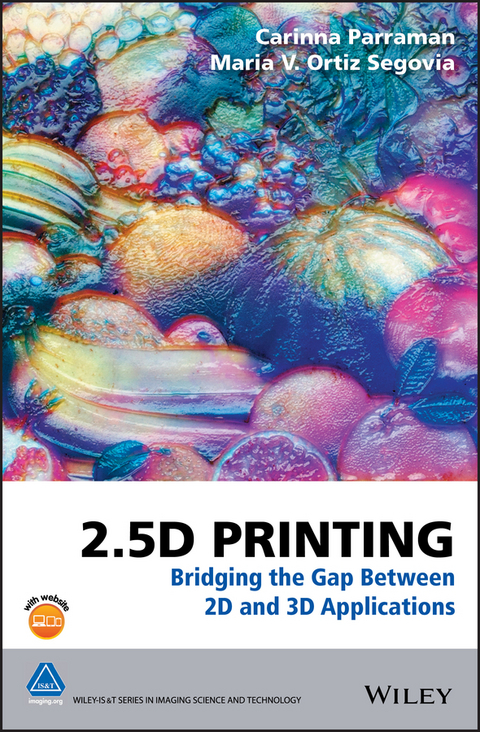
2.5D Printing (eBook)
John Wiley & Sons (Verlag)
978-1-118-96733-1 (ISBN)
2.5D Printing: Bridging the Gap Between 2D and 3D Applications examines the relationship between two- and three-dimensional printing and explores the current ideas, methods, and applications. It provides insights about the diversity of our material culture and heritage and how this knowledge can be used to design and develop new methods for texture printing. The authors review the evolving research and interest in working towards developing methods to: capture, measure and model the surface qualities of 3D and 2D objects, represent the appearance of surface, material and textural qualities, and print or reproduce the material and textural qualities.
The text reflects information on the topic from a broad range of fields including science, technology, art, design, conservation, perception, and computer modelling. 2.5D Printing: Bridging the Gap Between 2D and 3D Applications provides a survey of traditional methods of capturing 2.5D through painting and sculpture, and how the human perception is able to judge and compare differences. This important text:
- Bridges the gap between the technical and perceptual domains of 2D and 3D printing
- Discusses perceptual texture, color, illusion, and visual impact to offer a unique perspective
- Explores how to print a convincing rendering of texture that integrates the synthesis of texture in fine art paintings, with digital deposition printing
- Describes contemporary methods for capturing surface qualities and methods for modelling and measuring, and ways that it is currently being used
- Considers the impact of 2.5D for future technologies
2.5D Printing is a hands-on guide that provides visual inspiration, comparisons between traditional and digital technologies, case studies, and a wealth of references to the world of texture printing.
Please visit the companion website at: www.wiley.com/go/bridging2d3d .
Dr. Carinna Parraman is Professor in Design, Colour and Print, and Director of the Centre for Fine Print Research, University of the West of England, Bristol, UK. She works with artists, industrialists and scientists on a range of collaborative projects including 3D fabrication and 2.5D printing, ink development, and paper coatings.
Dr. Maria V. Ortiz Segovia is the leading scientist of the colour and image processing activities in Océ Print Logic Technologies, France. She is in charge of conducting collaborations and partnerships between Océ and different universities, laboratories and research institutions around the globe.
A guide that examines the history and current state of 2.5D printing and explores the relationship between two and three dimensions 2.5D Printing: Bridging the Gap Between 2D and 3D Applications examines the relationship between two- and three-dimensional printing and explores the current ideas, methods, and applications. It provides insights about the diversity of our material culture and heritage and how this knowledge can be used to design and develop new methods for texture printing. The authors review the evolving research and interest in working towards developing methods to: capture, measure and model the surface qualities of 3D and 2D objects, represent the appearance of surface, material and textural qualities, and print or reproduce the material and textural qualities. The text reflects information on the topic from a broad range of fields including science, technology, art, design, conservation, perception, and computer modelling. 2.5D Printing: Bridging the Gap Between 2D and 3D Applications provides a survey of traditional methods of capturing 2.5D through painting and sculpture, and how the human perception is able to judge and compare differences. This important text: Bridges the gap between the technical and perceptual domains of 2D and 3D printing Discusses perceptual texture, color, illusion, and visual impact to offer a unique perspective Explores how to print a convincing rendering of texture that integrates the synthesis of texture in fine art paintings, with digital deposition printing Describes contemporary methods for capturing surface qualities and methods for modelling and measuring, and ways that it is currently being used Considers the impact of 2.5D for future technologies 2.5D Printing is a hands-on guide that provides visual inspiration, comparisons between traditional and digital technologies, case studies, and a wealth of references to the world of texture printing. Please visit the companion website at: www.wiley.com/go/bridging2d3d
Dr. Carinna Parraman is Professor in Design, Colour and Print, and Director of the Centre for Fine Print Research, University of the West of England, Bristol, UK. She works with artists, industrialists and scientists on a range of collaborative projects including 3D fabrication and 2.5D printing, ink development, and paper coatings. Dr. Maria V. Ortiz Segovia is the leading scientist of the colour and image processing activities in Océ Print Logic Technologies, France. She is in charge of conducting collaborations and partnerships between Océ and different universities, laboratories and research institutions around the globe.
| Erscheint lt. Verlag | 13.8.2018 |
|---|---|
| Reihe/Serie | The Wiley-IS&T Series in Imaging Science and Technology | Wiley-IS&T Series in Imaging Science and Technology |
| Sprache | englisch |
| Themenwelt | Technik ► Elektrotechnik / Energietechnik |
| Schlagworte | 2½D • 2.5D, 2D and 3D printing • 2.5D-Druck • 2.5D Printing Bridging the Gap Between 2D and 3D Applications • analogue versus digital: traditional making and 21st century fabrication methods • Bildgebende Systeme u. Verfahren • Carinna Parraman and Maria V. Ortiz Segovia • Electrical & Electronics Engineering • Elektrotechnik u. Elektronik • guide to 2.5D printing • Guide to texture printing • heritage and conservation • illumination and illusion • Imaging Systems & Technology • industrial print technologies and manufacturing • measurement, standards and qualities • methods for scanning and capturing • modelling 2.5 printing • new methods of 3D printing • reference to 2.5 printing • reference to texture printing • reproduction, fakes and forgeries • textural qualities in 2D printing • Texture and tactile • traditional materials and new materials • two and three dimensional printing |
| ISBN-10 | 1-118-96733-X / 111896733X |
| ISBN-13 | 978-1-118-96733-1 / 9781118967331 |
| Informationen gemäß Produktsicherheitsverordnung (GPSR) | |
| Haben Sie eine Frage zum Produkt? |
 PDF (Adobe DRM)
Kopierschutz: Adobe-DRM
Adobe-DRM ist ein Kopierschutz, der das eBook vor Mißbrauch schützen soll. Dabei wird das eBook bereits beim Download auf Ihre persönliche Adobe-ID autorisiert. Lesen können Sie das eBook dann nur auf den Geräten, welche ebenfalls auf Ihre Adobe-ID registriert sind.
Details zum Adobe-DRM
Dateiformat: PDF (Portable Document Format)
Mit einem festen Seitenlayout eignet sich die PDF besonders für Fachbücher mit Spalten, Tabellen und Abbildungen. Eine PDF kann auf fast allen Geräten angezeigt werden, ist aber für kleine Displays (Smartphone, eReader) nur eingeschränkt geeignet.
Systemvoraussetzungen:
PC/Mac: Mit einem PC oder Mac können Sie dieses eBook lesen. Sie benötigen eine
eReader: Dieses eBook kann mit (fast) allen eBook-Readern gelesen werden. Mit dem amazon-Kindle ist es aber nicht kompatibel.
Smartphone/Tablet: Egal ob Apple oder Android, dieses eBook können Sie lesen. Sie benötigen eine
Geräteliste und zusätzliche Hinweise
Buying eBooks from abroad
For tax law reasons we can sell eBooks just within Germany and Switzerland. Regrettably we cannot fulfill eBook-orders from other countries.
aus dem Bereich