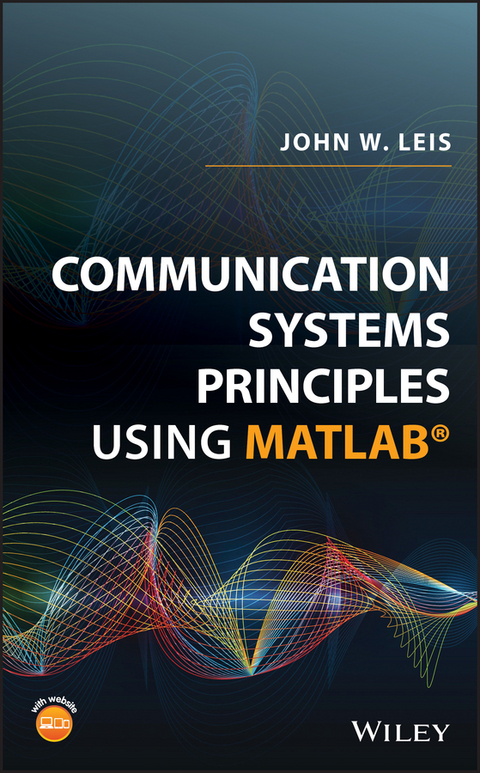
Communication Systems Principles Using MATLAB (eBook)
John Wiley & Sons (Verlag)
978-1-119-47068-7 (ISBN)
JOHN W. LEIS, PHD, is an Associate Professor of Electrical and Computer Engineering at the University of Southern Queensland. He has authored a large number of academic papers, and is author of Digital Signal Processing using MATLAB¯® for Students and Researchers. Dr. Leis's interests include signal processing for data compression and coding, medical signal processing, and advanced instrumentation using signal processing algorithms. He has collaborated nationally and internationally on various research projects, and is a Senior Member of the Institution of Electrical & Electronic Engineers (IEEE).
| Erscheint lt. Verlag | 31.7.2018 |
|---|---|
| Sprache | englisch |
| Themenwelt | Technik ► Elektrotechnik / Energietechnik |
| Technik ► Nachrichtentechnik | |
| Schlagworte | Amplitude modulation • audio encoding • block error codes • Channel capacity • Checksum • Communication technology • Communication Technology - Networks • Congestion Control • Convolutional coding • CRC • Cyclic redundancy check • DCT • DECIBEL • Digital Signatures • Discrete Cosine Transform • Drahtlose Kommunikation • Electrical & Electronics Engineering • Elektrotechnik u. Elektronik • enciphering • Encryption • Entropy • error checking • Frequency Modulation • hamming codes • Hash Functions • image coding • Intermodulation • IP addressing • Key exchange • Kommunikationsnetz • Kommunikationsnetze • Kommunikationstechnik • lans • light detectors for optical fiber • light sources for optical fiber • Linear Predictive Coding • line codes • LPC • <p>telecommunications building blocks • maximum power transfer • Mobile & Wireless Communications • modified DCT • object data structures • OFDM • OFDM using FFT • Optical Telecommunications • orthogonal frequency division multiplexing • orthogonal signals • Packet Switching • Phase Modulation • principles of optical fiber • public key encryption</p> • Pulse Shaping • Quantization • radio wave diffraction • radio wave reflection • Root mean square • routing algorithms • shortest path algorithms • Spread Spectrum • standing waves • subnetworks • TCP • Transmission Control Protocol • Transmission Lines • vector quantization • Viterbi trellis • WiFi • wired local area networks • wired telecommunications • Wireless local area networks • Wireless Telecommunications • WLANs |
| ISBN-10 | 1-119-47068-4 / 1119470684 |
| ISBN-13 | 978-1-119-47068-7 / 9781119470687 |
| Informationen gemäß Produktsicherheitsverordnung (GPSR) | |
| Haben Sie eine Frage zum Produkt? |
 PDF (Adobe DRM)
Kopierschutz: Adobe-DRM
Adobe-DRM ist ein Kopierschutz, der das eBook vor Mißbrauch schützen soll. Dabei wird das eBook bereits beim Download auf Ihre persönliche Adobe-ID autorisiert. Lesen können Sie das eBook dann nur auf den Geräten, welche ebenfalls auf Ihre Adobe-ID registriert sind.
Details zum Adobe-DRM
Dateiformat: PDF (Portable Document Format)
Mit einem festen Seitenlayout eignet sich die PDF besonders für Fachbücher mit Spalten, Tabellen und Abbildungen. Eine PDF kann auf fast allen Geräten angezeigt werden, ist aber für kleine Displays (Smartphone, eReader) nur eingeschränkt geeignet.
Systemvoraussetzungen:
PC/Mac: Mit einem PC oder Mac können Sie dieses eBook lesen. Sie benötigen eine
eReader: Dieses eBook kann mit (fast) allen eBook-Readern gelesen werden. Mit dem amazon-Kindle ist es aber nicht kompatibel.
Smartphone/Tablet: Egal ob Apple oder Android, dieses eBook können Sie lesen. Sie benötigen eine
Geräteliste und zusätzliche Hinweise
Buying eBooks from abroad
For tax law reasons we can sell eBooks just within Germany and Switzerland. Regrettably we cannot fulfill eBook-orders from other countries.
aus dem Bereich