


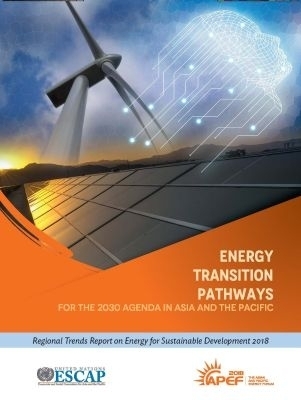
Energy Transition Pathways for the 2030 Agenda in Asia and the Pacific
Regional Trends Report on Energy for Sustainable Development 2018
Seiten
2018
United Nations (Verlag)
978-92-1-120778-1 (ISBN)
United Nations (Verlag)
978-92-1-120778-1 (ISBN)
- Titel z.Zt. nicht lieferbar
- Versandkostenfrei
- Auch auf Rechnung
- Artikel merken
Provides an in-depth analysis to first determine the level of achievement ipossible under the current policy regime by developing a baseline. It then identifies the gap between the baseline and the 2030 targets to inform policymakers the additional efforts and resources that would be needed to adequately achieve SDG7 targets.
The Asia and the Pacific region has become a global economic powerhouse. The region’s rapid and sustained economic growth, increasing population, expanding industrialisation and rapid urbanization are driving rapid growth in energy demand, which. Ensuring that supplies of energy are adequate to meet the growth in demand in ways that are socially, economically and environmentally responsible creates a new set of challenges for policymakers.The transition to 2030 energy pathway, which is aimed at addressing those challenges, has four coherent and interlinked objectives – increased energy supply to meet the growing demand, improved energy security, meeting the SDG7 targets and achieving NDCs. Addressing the complex and challenging task requires policymakers to develop a clear, sustainable and achievable pathway that would enable the countries, as well as the region as a whole, to achieve the 2030 goals and targets This report undertakes an in-depth analysis to first determine the level of achievement is possible under the current policy regime by developing a baseline. It then identifies the gap between the baseline and the 2030 targets to inform policymakers the additional efforts and resources that would be needed to adequately achieve SDG7 targets as well as the NDCs mitigation targets for the energy sector. Finally, different transition pathways have been developed and their socio-economic and environmental facets have been examined to assist policymakers to make an informed decision. The report also identifies the enabling policy, technology and market environment that would accelerate the achievement of the 2030 targets.
The Asia and the Pacific region has become a global economic powerhouse. The region’s rapid and sustained economic growth, increasing population, expanding industrialisation and rapid urbanization are driving rapid growth in energy demand, which. Ensuring that supplies of energy are adequate to meet the growth in demand in ways that are socially, economically and environmentally responsible creates a new set of challenges for policymakers.The transition to 2030 energy pathway, which is aimed at addressing those challenges, has four coherent and interlinked objectives – increased energy supply to meet the growing demand, improved energy security, meeting the SDG7 targets and achieving NDCs. Addressing the complex and challenging task requires policymakers to develop a clear, sustainable and achievable pathway that would enable the countries, as well as the region as a whole, to achieve the 2030 goals and targets This report undertakes an in-depth analysis to first determine the level of achievement is possible under the current policy regime by developing a baseline. It then identifies the gap between the baseline and the 2030 targets to inform policymakers the additional efforts and resources that would be needed to adequately achieve SDG7 targets as well as the NDCs mitigation targets for the energy sector. Finally, different transition pathways have been developed and their socio-economic and environmental facets have been examined to assist policymakers to make an informed decision. The report also identifies the enabling policy, technology and market environment that would accelerate the achievement of the 2030 targets.
United Nations Publications is the official publisher for the UN and it produces over 400 titles each year. The range of subjects covered are as varied as the issues being tackled by the UN as it works for a better world for all. Since the first printing of the UN Charter, this publishing unit has been providing valued information to those in government, academia and business
| Erscheinungsdatum | 01.09.2018 |
|---|---|
| Verlagsort | New York |
| Sprache | englisch |
| Maße | 203 x 267 mm |
| Gewicht | 203 g |
| Themenwelt | Naturwissenschaften ► Biologie ► Ökologie / Naturschutz |
| Technik ► Elektrotechnik / Energietechnik | |
| Wirtschaft ► Volkswirtschaftslehre | |
| ISBN-10 | 92-1-120778-9 / 9211207789 |
| ISBN-13 | 978-92-1-120778-1 / 9789211207781 |
| Zustand | Neuware |
| Informationen gemäß Produktsicherheitsverordnung (GPSR) | |
| Haben Sie eine Frage zum Produkt? |
Mehr entdecken
aus dem Bereich

aus dem Bereich
Gewinnung - Aufbereitung - Speicherung - Verteilung
Buch | Softcover (2022)
Springer Vieweg (Verlag)
CHF 55,95
Methoden – Lösungen – Anwendungen
Buch | Hardcover (2025)
Hanser (Verlag)
CHF 69,95


