



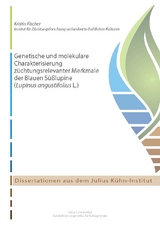
Genetische und molekulare Charakterisierung züchtungsrelevanter Merkmale der Blauen Süßlupine (Lupinus angustifolius L.)
Seiten
2018
Bundesforschungsinstitut für Kulturpflanzen (JKI) (Verlag)
978-3-95547-063-0 (ISBN)
Bundesforschungsinstitut für Kulturpflanzen (JKI) (Verlag)
978-3-95547-063-0 (ISBN)
Narrow-leafed lupin is considered to be a legume with great future potential because of its high and valuable protein content. Cultivated lupins appear in agricultural production in diverse forms and for very different purposes: grain production and forage in crop rotation, green manure, and as a relatively new area the production of healthy
food products. Therefore novel cultivars for these particular applications are needed. Successful breeding of varieties requires genetic variability with a broad spectrum of agronomic traits. But genetic variation of narrow-leafed lupin, a self-pollinator, is limited due to the bottleneck of former selection for sweetness.
These days overriding goals in lupin breeding are yield stability and yield increase.
Yield stability may be achieved by breeding for anthracnose resistance as it is the most severe disease in lupin cultivation worldwide. Therefore, a screening for anthracnose resistance of a set of plant genetic resources of NLL identified the breeding line Bo7212 as being highly resistant to anthracnose (C. lupini). Segregation analysis of experimental mapping populations indicated that the resistance of Bo7212 is inherited by one single dominant locus. Published molecular anchor markers as well as further sequence information obtained from the model genome Lotus japonicus, RNASeq data and genome sequence information of NLL allowed us (i) to locate the locus LanrBo on linkage group NLL-11 and (ii) to identify closely linked markers that allow for precise marker-assisted selection for LanrBo in narrow-leafed lupin breeding programs.
In an EMS-based mutagenesis program 40,000 seeds of cv. 'Boruta' were treated and a variety of phenotypic mutant lines expressing novel growth types with altered plant height and branching were obtained. These lines promise a potential yield increase. In field trials at two locations for three years, three of a subset of these lines exhibited significantly improved grain yield components compared to the wild type cv. 'Boruta', indicating a successful yield increase by indirect selection for novel branching behaviour. Growth types of these promising lines were shown to be inherited in a monogenic recessive manner and should, hence, be easily fixable in breeding programs. Im Rahmen der Eiweißpflanzenstrategie, die 2012 vom Bundesministerium für Ernährung und Landwirtschaft verabschiedet wurde, soll der Leguminosenanbau insbesondere in Deutschland forciert und gestärkt werden. Der damit verbundene
Nutzen für die lokale Landwirtschaft durch die vielfältigen Ökosystemleistungen sollte Argument genug sein, Soja-Importe aus Süd- und Mittelamerika auf ein Mindestmaß zu reduzieren und somit, besonders in der Tierfütterung, auf heimisches Protein zu setzen und die sogenannte „Fernfütterung“ durch Soja möglichst gering zu halten. Dazu kommt, dass 80 % der importierten Sojaprodukte gentechnisch verändert sind, was mit der Tierfütterung in der ökologischen Landwirtschaft und auch mit den Zielen der Lebensmittelwirtschaft in Deutschland nicht im Einklang steht. Zunehmend werden in beiden Sektoren gentechnik-freie Produkte gefordert. Sowohl “einheimisch“ als auch „gentechnik-frei“ sind neben anderen Ökosystemleistungen Attribute, die die Blaue Lupine für einen Leguminosenanbau, im Nordosten Deutschlands als Alternative zu importiertem Soja attraktiv machen. Dennoch kann die Wirtschaftlichkeit des Lupinenanbaus und der Körnerproduktion aktuell nicht mit sogenannten Cash Crops wie beispielsweise Weizen oder Mais mithalten. Gründe dafür sind hauptsächlich eine unzureichende Ertragsstabilität und eine geringe Ertragsleistung, die in den letzten Jahren aufgrund zu geringer Züchtungsaktivitäten nahezu konstant unbefriedigend geblieben sind.
food products. Therefore novel cultivars for these particular applications are needed. Successful breeding of varieties requires genetic variability with a broad spectrum of agronomic traits. But genetic variation of narrow-leafed lupin, a self-pollinator, is limited due to the bottleneck of former selection for sweetness.
These days overriding goals in lupin breeding are yield stability and yield increase.
Yield stability may be achieved by breeding for anthracnose resistance as it is the most severe disease in lupin cultivation worldwide. Therefore, a screening for anthracnose resistance of a set of plant genetic resources of NLL identified the breeding line Bo7212 as being highly resistant to anthracnose (C. lupini). Segregation analysis of experimental mapping populations indicated that the resistance of Bo7212 is inherited by one single dominant locus. Published molecular anchor markers as well as further sequence information obtained from the model genome Lotus japonicus, RNASeq data and genome sequence information of NLL allowed us (i) to locate the locus LanrBo on linkage group NLL-11 and (ii) to identify closely linked markers that allow for precise marker-assisted selection for LanrBo in narrow-leafed lupin breeding programs.
In an EMS-based mutagenesis program 40,000 seeds of cv. 'Boruta' were treated and a variety of phenotypic mutant lines expressing novel growth types with altered plant height and branching were obtained. These lines promise a potential yield increase. In field trials at two locations for three years, three of a subset of these lines exhibited significantly improved grain yield components compared to the wild type cv. 'Boruta', indicating a successful yield increase by indirect selection for novel branching behaviour. Growth types of these promising lines were shown to be inherited in a monogenic recessive manner and should, hence, be easily fixable in breeding programs. Im Rahmen der Eiweißpflanzenstrategie, die 2012 vom Bundesministerium für Ernährung und Landwirtschaft verabschiedet wurde, soll der Leguminosenanbau insbesondere in Deutschland forciert und gestärkt werden. Der damit verbundene
Nutzen für die lokale Landwirtschaft durch die vielfältigen Ökosystemleistungen sollte Argument genug sein, Soja-Importe aus Süd- und Mittelamerika auf ein Mindestmaß zu reduzieren und somit, besonders in der Tierfütterung, auf heimisches Protein zu setzen und die sogenannte „Fernfütterung“ durch Soja möglichst gering zu halten. Dazu kommt, dass 80 % der importierten Sojaprodukte gentechnisch verändert sind, was mit der Tierfütterung in der ökologischen Landwirtschaft und auch mit den Zielen der Lebensmittelwirtschaft in Deutschland nicht im Einklang steht. Zunehmend werden in beiden Sektoren gentechnik-freie Produkte gefordert. Sowohl “einheimisch“ als auch „gentechnik-frei“ sind neben anderen Ökosystemleistungen Attribute, die die Blaue Lupine für einen Leguminosenanbau, im Nordosten Deutschlands als Alternative zu importiertem Soja attraktiv machen. Dennoch kann die Wirtschaftlichkeit des Lupinenanbaus und der Körnerproduktion aktuell nicht mit sogenannten Cash Crops wie beispielsweise Weizen oder Mais mithalten. Gründe dafür sind hauptsächlich eine unzureichende Ertragsstabilität und eine geringe Ertragsleistung, die in den letzten Jahren aufgrund zu geringer Züchtungsaktivitäten nahezu konstant unbefriedigend geblieben sind.
| Erscheinungsdatum | 25.07.2018 |
|---|---|
| Reihe/Serie | Dissertationen aus dem Julius Kühn-Institut |
| Zusatzinfo | Illustrationen, Diagramme |
| Sprache | englisch; deutsch |
| Maße | 140 x 210 mm |
| Gewicht | 100 g |
| Themenwelt | Naturwissenschaften |
| Technik | |
| Weitere Fachgebiete ► Land- / Forstwirtschaft / Fischerei | |
| Schlagworte | Genetik • Lupine • Züchtung |
| ISBN-10 | 3-95547-063-6 / 3955470636 |
| ISBN-13 | 978-3-95547-063-0 / 9783955470630 |
| Zustand | Neuware |
| Informationen gemäß Produktsicherheitsverordnung (GPSR) | |
| Haben Sie eine Frage zum Produkt? |
Mehr entdecken
aus dem Bereich


aus dem Bereich
Buch | Hardcover (2023)
Haymarket Media (Verlag)
CHF 44,50
erfolgreich produzieren & selbst vermarkten
Buch | Hardcover (2023)
Stocker Verlag
CHF 34,95


