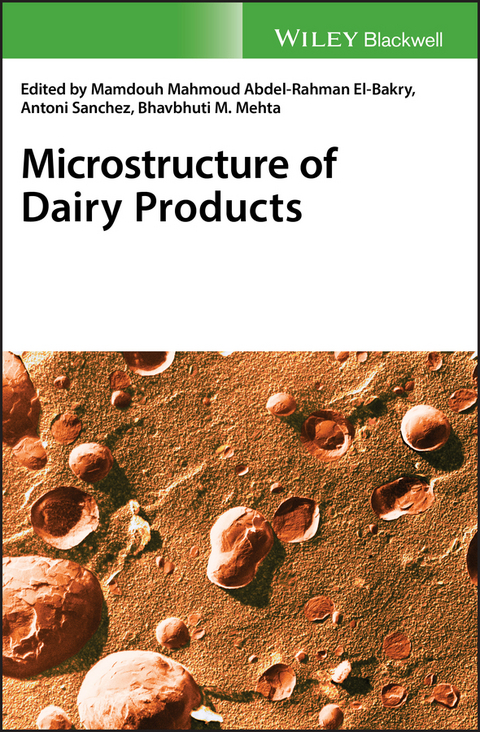
Microstructure of Dairy Products (eBook)
John Wiley & Sons (Verlag)
978-1-118-96420-0 (ISBN)
Provides the most recent developments in microscopy techniques and types of analysis used to study the microstructure of dairy products
This comprehensive and timely text focuses on the microstructure analyses of dairy products as well as on detailed microstructural aspects of them. Featuring contributions from a global team of experts, it offers great insight into the understanding of different phenomena that relate to the functional and biochemical changes during processing and subsequent storage.
Structured into two parts, Microstructure of Dairy Products begins with an overview of microscopy techniques and software used for microstructural analyses. It discusses, in detail, different types of the following techniques, such as: light microscopy (including bright field, polarized, and confocal scanning laser microscopy) and electron microscopy (mainly scanning and transmission electron microscopy). The description of these techniques also includes the staining procedures and sample preparation methods developed. Emerging microscopy techniques are also covered, reflecting the latest advances in this field. Part 2 of the book focuses on the microstructure of various dairy foods, dividing each into sections related to the microstructure of milk, cheeses, yogurts, powders, and fat products, ice cream and frozen dairy desserts, dairy powders and selected traditional Indian dairy products. In addition, there is a review of the localization of microorganism within the microstructure of various dairy products. The last chapter discusses the challenges and future trends of the microstructure of dairy products.
- Presents complete coverage of the latest developments in dairy product microscopy techniques
- Details the use of microscopy techniques in structural analysis
- An essential purchase for companies, researchers, and other professionals in the dairy sector
Microstructure of Dairy Products is an excellent resource for food scientists, technologists, and chemists-and physicists, rheologists, and microscopists-who deal in dairy products.
Mamdouh El-Bakry is a Postdoctoral Researcher in the Department of Chemical Engineering at the Universitat Autónoma of Barcelona, Spain.
Antoni Sanchez is a Professor in the Department of Chemical Engineering at the Universitat Autónoma of Barcelona, Spain.
Bhavbhuti M. Mehta - Associate Professor in Dairy Chemistry Department, SMC College of Dairy Science, Anand Agricultural University, Anand, Gujarat, India
Provides the most recent developments in microscopy techniques and types of analysis used to study the microstructure of dairy products This comprehensive and timely text focuses on the microstructure analyses of dairy products as well as on detailed microstructural aspects of them. Featuring contributions from a global team of experts, it offers great insight into the understanding of different phenomena that relate to the functional and biochemical changes during processing and subsequent storage. Structured into two parts, Microstructure of Dairy Products begins with an overview of microscopy techniques and software used for microstructural analyses. It discusses, in detail, different types of the following techniques, such as: light microscopy (including bright field, polarized, and confocal scanning laser microscopy) and electron microscopy (mainly scanning and transmission electron microscopy). The description of these techniques also includes the staining procedures and sample preparation methods developed. Emerging microscopy techniques are also covered, reflecting the latest advances in this field. Part 2 of the book focuses on the microstructure of various dairy foods, dividing each into sections related to the microstructure of milk, cheeses, yogurts, powders, and fat products, ice cream and frozen dairy desserts, dairy powders and selected traditional Indian dairy products. In addition, there is a review of the localization of microorganism within the microstructure of various dairy products. The last chapter discusses the challenges and future trends of the microstructure of dairy products. Presents complete coverage of the latest developments in dairy product microscopy techniques Details the use of microscopy techniques in structural analysis An essential purchase for companies, researchers, and other professionals in the dairy sector Microstructure of Dairy Products is an excellent resource for food scientists, technologists, and chemists and physicists, rheologists, and microscopists who deal in dairy products.
Mamdouh Mahmoud Abdel-Rahman El-Bakry is a Postdoctoral Researcher in the Department of Chemical Engineering at the Universitat Autònoma of Barcelona, Spain. Antoni Sanchez is a Professor in the Department of Chemical Engineering at the Universitat Autònoma of Barcelona, Spain. Bhavbhuti M. Mehta is an Associate Professor in the Dairy Chemistry Department, SMC College of Dairy Science, Anand Agricultural University, Gujarat, India.
1
Microscopy Techniques for Dairy Products – An Introduction
Mark A.E. Auty
Food Chemistry and Technology Department, Teagasc Food Research Centre, Teagasc, Moorepark, Co. Cork, Ireland
1.1 Introduction
The textural properties of a particular dairy product are strongly influenced by the three‐dimensional arrangement of its structural elements and their interactions (Heertje, 1993). To fully understand the behavior of dairy products, it is therefore not enough to know the chemical composition and bulk physical properties but how they interact and affect the spatial arrangement or organization of the food constituents at the nano‐ and micro‐length scales. Food microstructure studies therefore provide a link between physico‐chemical properties, process behavior and organoleptic qualities of a particular dairy product (Figure 1.1). Linking microscopy with rheological and sensory techniques in particular is necessary for a fuller understanding of food behavior, requiring a multivariate approach to experimental design. This chapter gives a brief overview of the different types of microscopy used to study dairy foods with a focus on confocal microscopy as this is arguably the most useful single technique of benefit to both researchers and food industry technologists.
Figure 1.1 Diagram showing inter‐relationships between microstructure and functionality of dairy products.
1.1.1 Brief History and Background
In the seventeenth century, Antonie van Leeuwenhoek, using a high magnification hand lens, first viewed fat droplets in milk (Leeuwenhoek, 1674). Despite this early start, microscopy of dairy products, and food in general, remained unexplored, with little published literature until well after the development of electron microscopy techniques in the 1940s. As food manufacturers began using microscopes in the 1950s and 1960s, it became apparent that the structural arrangement of food components strongly influenced food processing and quality. Most of the early food‐related electron microscopy work was performed on dairy products, mainly yoghurt and cheese (for reviews see Brooker, 1979; Kalab, 1979a, b, c, 1981, 1993; Holcomb, 1991; Schmidt and Bucheim, 1992). Despite the enormous influence of light microscopy on medical research at the end of the last century and the improvement in optic materials and design, conventional light microscopy of food products remained largely neglected although Lewis (1978) and Flint (1994) published selected methods for light microscopic examination of a range of food ingredients and products, including milk powders and dairy spreads. Contrast between the component of interest and surrounding food material may be achieved by optical techniques, chemical staining, or a combination of both (Flint, 1994). Despite this, optical microscopy of dairy products remained largely neglected until the development of commercial confocal microscopes in the 1990s. In the past 20 years, there has been considerable research interest in food microstructure as a key to understanding structure‐function relationships. A wide range of microscopy techniques is now available for the study of food microstructure, with more being developed (for a review see Morris and Groves, 2013). These techniques are frequently employed to study dairy products such as cheese (El‐Bakry and Sheehan, 2014). The food researcher now has a large toolbox of techniques, the choice of which depends on the particular application. However, a correlative approach employing various microscopy techniques is required to provide a fuller understanding of complex multiphase nano‐ and microstructures (Aguilera and Stanley, 1990; Lewis, 1993). This approach has led to the development of hybrid microscopes such as the RISE (WITech, Ulm, Germany) system which combines a scanning electron microscope with Raman confocal, focused ion beam and even atomic force microscopes, permitting examination of the same sample area by different microscopy techniques.
Many of the common techniques used to study food microstructure have been adapted from specimen preparation procedures for biological tissue. However, there are particular problems associated with the preparation of food products for microscopic examination that the researcher should be aware of. Many foods have high levels of moisture, fat or sugar and preserving the original microstructure of such materials may be difficult, particularly for electron microscopic studies that may require low moisture, conductive specimens. Dried ingredients, such as spray dried powders, crystalline sugars, starches etc. with a moderately small particle size (<100 µm) may be examined in their natural state and require little sample preparation. Highly refractile or opaque solid and semi‐solid food materials however, need to be rendered thin enough to transmit light and generally this is achieved either by compression or sectioning. Soft materials may be compressed or smeared across a microscope slide. Solid food materials and cellular tissues may be chemically fixed, dehydrated then embedded in paraffin wax or plastic resin prior to sectioning by microtomy. Alternatively, frozen sections, approximately 5–20 µm thick, may be cut in a cryostat. Sectioned material can then be observed using any of the optical or chemical contrast techniques described below. Powdered ingredients, for example spray‐dried milk powder particles, should be mounted in a clear, immiscible liquid such as sunflower oil that should be viscous enough to restrict Brownian movement of the particles.
The main microscopy techniques used to study dairy products are listed in Table 1.1.
Table 1.1 Main microscopy techniques used in food microscopy.
| Technique | Radiation type | Incident radiation wavelength | Approximate resolution | Application |
| Stereo‐microscopy | Photons | 400–750 nm | 5 µm | Overview of microstructure |
| Light microscopy | Photons | 400–750 nm | 200 nm | Ingredient localization |
| Fluorescence microscopy | Photons | 350–400 nm (u.v.) 400–750 nm (visible) | 200 nm | Ingredient localization |
| Confocal microscopy | Photons | 350–400 nm (u.v.) 400–750 nm (visible) | 200 nm | Ingredient localization, 3D information |
| SEM | Electrons | 0.001–0.01 nm | 4 nm | Large depth of field‐simulated 3D view |
| TEM | Electrons | 0.01–0.01 nm | 1 nm | Fine structural detail, macromolecular interactions |
| AFM | N/A (physical cantilever) | N/A | Surface topology, nano‐mechanical behavior |
1.2 Conventional Optical Microscopy Techniques
1.2.1 Conventional Light Microscopy – Optical Contrast
1.2.1.1 Bright Field
Bright field illumination employs an axial cone of light from the condenser, which is transmitted through the specimen and is commonly based on Koehler illumination. This technique is useful if there is inherent contrast in the specimen, for example in highly colored food products, otherwise stains or dyes may be used to impart color contrast to the specimen (see below).
1.2.1.2 Polarized Light
A polarized light microscope consists of two polarizing plates arranged perpendicularly, one below the condenser (the polarizer) and a second above the objective (the analyzer). If the sample is isotropic, incident polarized light is not rotated and no light is transmitted. If the polarized light passes through an anisotropic substance, such as a lactose crystal, part of the light is rotated and passes through analyser and appears bright (birefringence). Examples of polarized light microscopy include the study of microcrystalline inclusions in cheese (Brooker, 1979) and lactose crystallization in spray dried milk (Saito, 1985; Maher et al., 2014). Employing “partially uncrossed polars” allows visualization of non‐birefringent material while retaining the polarizing effect as shown in Figure 1.2.
Figure 1.2 Spray dried skim milk powder particles (a) fresh powder; (b)powder stored at 55% relative humidity for 24 h. Polarized light micrographs taken using partially uncrossed polarizing filters, reveal extensive birefringent lactose crystals (b) while allowing visualization of particle shape and occluded air bubbles (dark circles). Scale bar = 100 µm.
1.2.1.3 Phase Contrast
This technique has traditionally been used to study transparent biological material including eukaryotic cells and bacteria. An annular phase ring within the condenser below the sample retards the phase of light by ¼λ. Diffracted and non‐diffracted light passing through the sample is recombined using a similar phase ring in the objective. Contrast is obtained due to difference in refractive index between the sample and its surroundings. This technique, in conjunction with Sudan Black staining, has been used to view fat droplets in...
| Erscheint lt. Verlag | 13.7.2018 |
|---|---|
| Sprache | englisch |
| Themenwelt | Naturwissenschaften ► Biologie |
| Technik ► Lebensmitteltechnologie | |
| Weitere Fachgebiete ► Land- / Forstwirtschaft / Fischerei | |
| Schlagworte | Dairy • Dairy Food • dairy microstructure • dairy product microstructure • dairy products • electron microscopy techniques for dairy food • emerging techniques for microstructural analysis • Food chemistry • food industry • food microstructure • food science • Food Science & Technology • Food Types • Lebensmittel • Lebensmittelchemie • Lebensmittelforschung u. -technologie • Microscopy techniques • microscopy techniques for dairy products • microstructural aspects of dairy products • microstructural aspects of yogurt • microstructure analyses of dairy products • microstructure of cheese • microstructure of dairy products • microstructure of food matrices • microstructure of ice cream • microstructure of milk • microstructure of milk fat • Milcherzeugnis • Milchprodukte |
| ISBN-10 | 1-118-96420-9 / 1118964209 |
| ISBN-13 | 978-1-118-96420-0 / 9781118964200 |
| Informationen gemäß Produktsicherheitsverordnung (GPSR) | |
| Haben Sie eine Frage zum Produkt? |
 EPUB (Adobe DRM)
Kopierschutz: Adobe-DRM
Adobe-DRM ist ein Kopierschutz, der das eBook vor Mißbrauch schützen soll. Dabei wird das eBook bereits beim Download auf Ihre persönliche Adobe-ID autorisiert. Lesen können Sie das eBook dann nur auf den Geräten, welche ebenfalls auf Ihre Adobe-ID registriert sind.
Details zum Adobe-DRM
Dateiformat: EPUB (Electronic Publication)
EPUB ist ein offener Standard für eBooks und eignet sich besonders zur Darstellung von Belletristik und Sachbüchern. Der Fließtext wird dynamisch an die Display- und Schriftgröße angepasst. Auch für mobile Lesegeräte ist EPUB daher gut geeignet.
Systemvoraussetzungen:
PC/Mac: Mit einem PC oder Mac können Sie dieses eBook lesen. Sie benötigen eine
eReader: Dieses eBook kann mit (fast) allen eBook-Readern gelesen werden. Mit dem amazon-Kindle ist es aber nicht kompatibel.
Smartphone/Tablet: Egal ob Apple oder Android, dieses eBook können Sie lesen. Sie benötigen eine
Geräteliste und zusätzliche Hinweise
Buying eBooks from abroad
For tax law reasons we can sell eBooks just within Germany and Switzerland. Regrettably we cannot fulfill eBook-orders from other countries.
aus dem Bereich