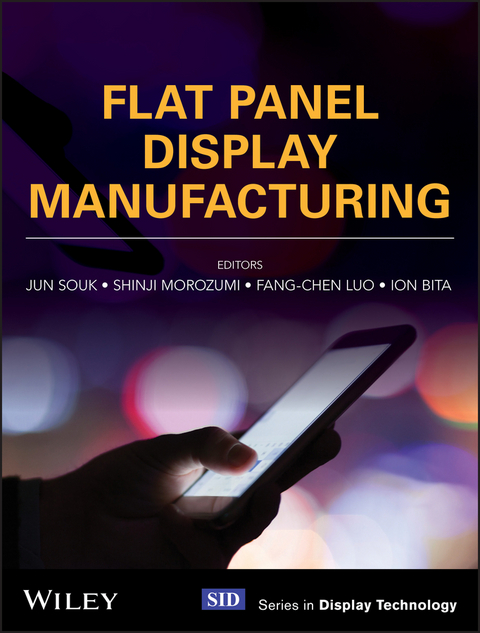
Flat Panel Display Manufacturing (eBook)
John Wiley & Sons (Verlag)
978-1-119-16136-3 (ISBN)
An extensive introduction to the engineering and manufacture of current and next-generation flat panel displays
This book provides a broad overview of the manufacturing of flat panel displays, with a particular emphasis on the display systems at the forefront of the current mobile device revolution. It is structured to cover a broad spectrum of topics within the unifying theme of display systems manufacturing. An important theme of this book is treating displays as systems, which expands the scope beyond the technologies and manufacturing of traditional display panels (LCD and OLED) to also include key components for mobile device applications, such as flexible OLED, thin LCD backlights, as well as the manufacturing of display module assemblies.
Flat Panel Display Manufacturing fills an important gap in the current book literature describing the state of the art in display manufacturing for today's displays, and looks to create a reference the development of next generation displays. The editorial team brings a broad and deep perspective on flat panel display manufacturing, with a global view spanning decades of experience at leading institutions in Japan, Korea, Taiwan, and the USA, and including direct pioneering contributions to the development of displays. The book includes a total of 24 chapters contributed by experts at leading manufacturing institutions from the global FPD industry in Korea, Japan, Taiwan, Germany, Israel, and USA.
- Provides an overview of the evolution of display technologies and manufacturing
- Treats display products as systems with manifold applications, expanding the scope beyond traditional display panel manufacturing to key components for mobile devices and TV applications
- Provides a detailed overview of LCD manufacturing, including panel architectures, process flows, and module manufacturing
- Provides a detailed overview of OLED manufacturing for both mobile and TV applications, including a chapter dedicated to the young field of flexible OLED manufacturing
- Provides a detailed overview of the key unit processes and corresponding manufacturing equipment, including manufacturing test & repair of TFT array panels as well as display module inspection & repair
- Introduces key topics in display manufacturing science and engineering, including productivity & quality, factory architectures, and green manufacturing
Flat Panel Display Manufacturing will appeal to professionals and engineers in R&D departments for display-related technology development, as well as to graduates and Ph.D. students specializing in LCD/OLED/other flat panel displays.
Jun Souk, PhD is Professor of Research and Business Foundation at Korea University, Korea.
Shinji Morozumi, PhD is the founder and chairman of Crystage Inc., Japan.
Fang-Chen Luo, PhD is advisor to the President and Fellow of AU Optronics, Taiwan.
Ion Bita, PhD leads development of display technologies and components at Apple Inc., USA.
An extensive introduction to the engineering and manufacture of current and next-generation flat panel displays This book provides a broad overview of the manufacturing of flat panel displays, with a particular emphasis on the display systems at the forefront of the current mobile device revolution. It is structured to cover a broad spectrum of topics within the unifying theme of display systems manufacturing. An important theme of this book is treating displays as systems, which expands the scope beyond the technologies and manufacturing of traditional display panels (LCD and OLED) to also include key components for mobile device applications, such as flexible OLED, thin LCD backlights, as well as the manufacturing of display module assemblies. Flat Panel Display Manufacturing fills an important gap in the current book literature describing the state of the art in display manufacturing for today's displays, and looks to create a reference the development of next generation displays. The editorial team brings a broad and deep perspective on flat panel display manufacturing, with a global view spanning decades of experience at leading institutions in Japan, Korea, Taiwan, and the USA, and including direct pioneering contributions to the development of displays. The book includes a total of 24 chapters contributed by experts at leading manufacturing institutions from the global FPD industry in Korea, Japan, Taiwan, Germany, Israel, and USA. Provides an overview of the evolution of display technologies and manufacturing Treats display products as systems with manifold applications, expanding the scope beyond traditional display panel manufacturing to key components for mobile devices and TV applications Provides a detailed overview of LCD manufacturing, including panel architectures, process flows, and module manufacturing Provides a detailed overview of OLED manufacturing for both mobile and TV applications, including a chapter dedicated to the young field of flexible OLED manufacturing Provides a detailed overview of the key unit processes and corresponding manufacturing equipment, including manufacturing test & repair of TFT array panels as well as display module inspection & repair Introduces key topics in display manufacturing science and engineering, including productivity & quality, factory architectures, and green manufacturing Flat Panel Display Manufacturing will appeal to professionals and engineers in R&D departments for display-related technology development, as well as to graduates and Ph.D. students specializing in LCD/OLED/other flat panel displays.
JUN SOUK, PHD is a Professor in the Department of Electronic Engineering, Hanyang University, South Korea. SHINJI MOROZUMI, PHD is the founder and chairman of Crystage Inc., Japan. FANG-CHEN LUO, PHD is advisor to the President and Fellow of AU Optronics, Taiwan. ION BITA, PHD leads development of display technologies and components at Apple Inc., USA.
"If there is only one book on flat panel displays that is going to be on your bookshelf, then I would highly recommend this one. It will be a text that you refer to time and again for clear and concise explanations of how LCD and OLED displays are constructed and the processes used to make them into commercially successful products. As you use it, you will find yourself drawn in by the clear and colorful illustrations and will find it hard to not read more than you first intended."
Aris Silzars Ph.D., Member of the Board of Advisors, NanoLumens, Inc. and Past President of SID, USA
"If there is only one book on flat panel displays that is going to be on your bookshelf, then I would highly recommend this one. It will be a text that you refer to time and again for clear and concise explanations of how LCD and OLED displays are constructed and the processes used to make them into commercially successful products. As you use it, you will find yourself drawn in by the clear and colorful illustrations and will find it hard to not read more than you first intended."
Aris Silzars Ph.D., Member of the Board of Advisors, NanoLumens, Inc. and Past President of SID, USA
1
Introduction
Fang‐Chen Luo1, Jun Souk2, Shinji Morozumi3, and Ion Bita4,
1 AU Optronics, Taiwan
2 Department of Electronic Engineering, Hanyang University, South Korea
3 Crystage Inc., Japan
4 Apple Inc., USA
1.1 Introduction
Flat panel displays (FPDs) have greatly changed our daily life and the way we work. Among several types of FPDs, the thin‐film transistor (TFT) liquid crystal displays (TFT‐LCDs) are presently the leading technology, with 30 years of manufacturing history. Recently, TFT‐LCDs reached over 95% market share across TVs, computer monitors, tablet PCs, and smartphones, and are still expanding into other application areas.
The tremendous progress in TFT‐LCD technology has brought us to the point where display performance, screen size, and cost far exceeded most industry leaders' expectation projected at the time of initial TFT‐LCD production, which started in the late 1980s. Owing to a sustained, enormous effort of display engineers around the world for the past three decades, the performance of TFT‐LCD has not only surpassed the original leading cathode ray tube (CRT) in most areas, but also the cost barrier, initially considered to be prohibitive for mass adoption, has been reduced significantly by rapid advances in display manufacturing technology.
In this chapter, we briefly review the history and evolution of display technologies, focusing mainly on the manufacturing technology associated with TFT‐LCD. With organic light emitting diode (OLED) displays in the form of mobile and TV becoming flexible, and growing and drawing a great deal of attention, the current status of active matrix driven OLED (AMOLED) display manufacturing technology is explored in sections 8A, 8B and 10.
1.2 Historic Review of TFT‐LCD Manufacturing Technology Progress
Counted from the early stage production of TFT‐LCD notebook panels that happened in the late 1980s, display manufacturing technologies have evolved enormously over the past three decades in order to meet the market demand for applications and different pixel technologies for notebook, desktop PC, LCD‐TV, and mobile devices. The progress did not come easily, but it was the result of continued innovations and efforts of many engineers across the industry that enabled adoption of new technologies, process simplifications, and increased automation in order to achieve such economics of scale. In this section, we review the historic evolution in TFT‐LCD manufacturing technology from notebooks to LCD‐TV application.
1.2.1 Early Stage TFT and TFT‐Based Displays
TFTs, more precisely, insulated‐gate TFTs, have been critical enablers for the development of flat panel displays. Figure 1.1 shows a schematic cross‐sectional view of the most common type of TFT device, a so‐called inverted staggered TFT. In this device, there is a gate electrode on the bottom, which is covered with an insulator, followed by the active semiconductor material and a top passivation insulator. The passivation insulator is etched back to allow fabrication of source and drain contacts to the semiconductor.
Figure 1.1 Schematic cross‐section of an inverted‐staggered a‐Si:H TFT.
P. K. Weimer at RCA reported first working TFT devices by using CdS as the semiconductor material in 1962 [1]. Various active materials have been developed in addition to CdS: CdSe, polysilicon, amorphous silicon (a‐Si), and so on. Among these, a‐Si remains presently the most widely used due to its practical advantages over other materials.
The first a‐Si TFT was reported by LeComber et al. [2] in 1979, and considered a major milestone in TFT history from a practical standpoint. The characteristics of a‐Si are well matched with the requirements of liquid crystal driving and provide uniform, reproducible film quality over large glass areas using plasma enhanced chemical deposition (PECVD).
The active matrix circuit incorporating a field‐effect‐transistor and a capacitor in every pixel element for LC display addressing, still widely used today, was first proposed by Lechner in 1971 [3]. Fisher et al. [4] reported on the design of an LC color TV panel in 1972. The first attempt for a TFT‐LC panel was reported in 1973 by the Westinghouse group led by Brody [5], which demonstrated the switching of one row of pixels in a 6 × 6‐inch 20 line‐per‐inch panel. In 1973 and 1974, the group reported on an operational TFT‐EL (electroluminescence) [6] and a TFT‐LC panel [7] respectively, all using CdSe as the semiconductor. In the early 1980s, there were active research activities working on a‐Si and high temperature polycrystalline silicon TFTs. Work on amorphous and poly silicon was in its infancy in the late 1970s and nobody had succeeded in building a commercial active matrix display using these materials. In 1983, Suzuki et al. [8] reported a small‐size LCD TV driven by a‐Si TFT and Morozumi et al. [9] reported a pocket‐size LCD TV driven by high‐temperature poly Si. The 2.1inch 240 × 240 pixel LCD‐TV introduced by Seiko Epson (Epson ET‐10) is regarded as the first commercial active matrix LCD product. It prompted the Japanese companies to intensify their efforts to build large‐screen color TFT‐LCDs. In 1989, Sera et al. reported on the low‐temperature poly Si (LTPS) process [10] by recrystallization of a‐Si film using pulsed excimer laser.
1.2.2 The 1990s: Initiation of TFT‐LCD Manufacturing and Incubation of TFT‐LCD Products
In 1988, Sharp produced first 10.4‐inch a‐Si based TFT‐LCD panels for notebook PC application, which launched the TFT‐LCD manufacturing. In 1992, DTI (a company jointly owned by IBM Japan and Toshiba) introduced a 12.1‐inch SVGA panel that was used for the first color laptop computer introduced by IBM (Figure 1.2).
Figure 1.2 12.1‐Inch TFT‐LCD introduced in 1992 and the first color laptop computer by IBM.
Until that time, the product yield of 10.4‐inch or 12.1‐inch LCD panels stayed in a very low level, leading to very expensive panel prices. The industry was not yet fully convinced that the large‐screen sized TFT‐LCD panels could enter a mass production scale with a proper production yield and meet the cost criteria. Nonetheless, the demand of the full‐color TFT‐LCD portable laptop computer was very high despite its high price tag (the initial price of IBM CL‐57SX was almost $10,000) and thus was able to accommodate the unusual high price of notebook display panels (LCD panel cost was nearly 70% of that of laptop computer), opening the door for the expansion of LCD mass production.
Triggered by the demonstration of high image quality large‐screen 12.1‐inch LCD panels, competition on larger LCD panels for laptop computers continued from 1994 to 1998. At the same period, determining an optimum mother glass size that can produce “future standard size” laptop screens was a critical issue in the LCD industry. Starting with 1995, three Korean big companies, Samsung, LG, and Hyundai, also entered the TFT‐LCD business.
Figure 1.3 shows the landscape of LCD companies adopting different mother glass sizes to manufacture notebook display panels. The mainstream LCD panel size increased from 9.4 inches to 14.1 inches from 1993 to 1998, therefore, mother glass sizes increased accordingly from Gen 2 sizes (360 × 475 or 370 × 479 mm) to Gen 3.5 size (600 × 720 mm).
Figure 1.3 Different mother glass sizes LCD companies adopted to manufacture different notebook panel sizes.
The panel size competition settled when NEC introduced 14.1‐inch XGA panels in 1998. The expansion of TFT‐LCD so rapidly progressed that it finally overturned the competitive super twisted nematic (STN) passive matrix LCD market in 1996, which has been used for a long time as the main display panel for laptop computers. This was possible due to the cost down effort and the superior resolution and color performance of TFT‐LCD. Since then, between 1990 and 2010, the mother glass sizes of TFT‐LCD plants have continuously increased to higher generation every two or three years.
Increasing the mother glass size is the most efficient way to reduce panel cost and meet the trend of increasing panel size. Furthermore, the LCD manufacturing technology progressed with numerous technology innovations such as reduced process steps and enhanced productivity with the introduction of new concepts for process equipment.
In the early 1990s, TFT‐LCD panels were primarily used for notebook PC applications. In 1997, 15‐inch diagonal panels were produced for initial LCD desktop monitor applications.
1.2.3 Late 1990s: Booming of LCD Desktop Monitor and Wide Viewing Angle Technologies
After TFT‐LCD penetrated laptop computer screen by major portion reaching near 25 million units in 2000, the TFT‐LCD industry had plans to enter the desktop monitor market, which at that time was 100% CRT. However, TFT‐LCD was far behind in optical performance especially for viewing angle characteristics. In order to...
| Erscheint lt. Verlag | 11.7.2018 |
|---|---|
| Reihe/Serie | Wiley Series in Display Technology |
| Wiley Series in Display Technology | Wiley Series in Display Technology |
| Sprache | englisch |
| Themenwelt | Technik ► Elektrotechnik / Energietechnik |
| Technik ► Nachrichtentechnik | |
| Schlagworte | Display • display engineering • displays for mobile device applications • Electrical & Electronics Engineering • Electrical Engineering - Displays • Elektronische Displays • Elektrotechnik u. Elektronik • factory and supporting systems for flat panel manufacturing • Flachbildschirm • Flat Panel Display Manufacturing • Flat Panel Displays • flat panel engineering • flat panel manufacturing quality • flexible OLED displays • guide to OLED display • LCD backlight manufacturing • LCD display manufacturing • LCD displays • LCD engineering • mobile display manufacturing smartphone • mobile display module architecture • mobile display modules • OLED display engineering • OLED display manufacturing • OLED Displays • TFT-LCD display |
| ISBN-10 | 1-119-16136-3 / 1119161363 |
| ISBN-13 | 978-1-119-16136-3 / 9781119161363 |
| Informationen gemäß Produktsicherheitsverordnung (GPSR) | |
| Haben Sie eine Frage zum Produkt? |
 EPUB (Adobe DRM)
Kopierschutz: Adobe-DRM
Adobe-DRM ist ein Kopierschutz, der das eBook vor Mißbrauch schützen soll. Dabei wird das eBook bereits beim Download auf Ihre persönliche Adobe-ID autorisiert. Lesen können Sie das eBook dann nur auf den Geräten, welche ebenfalls auf Ihre Adobe-ID registriert sind.
Details zum Adobe-DRM
Dateiformat: EPUB (Electronic Publication)
EPUB ist ein offener Standard für eBooks und eignet sich besonders zur Darstellung von Belletristik und Sachbüchern. Der Fließtext wird dynamisch an die Display- und Schriftgröße angepasst. Auch für mobile Lesegeräte ist EPUB daher gut geeignet.
Systemvoraussetzungen:
PC/Mac: Mit einem PC oder Mac können Sie dieses eBook lesen. Sie benötigen eine
eReader: Dieses eBook kann mit (fast) allen eBook-Readern gelesen werden. Mit dem amazon-Kindle ist es aber nicht kompatibel.
Smartphone/Tablet: Egal ob Apple oder Android, dieses eBook können Sie lesen. Sie benötigen eine
Geräteliste und zusätzliche Hinweise
Buying eBooks from abroad
For tax law reasons we can sell eBooks just within Germany and Switzerland. Regrettably we cannot fulfill eBook-orders from other countries.
aus dem Bereich