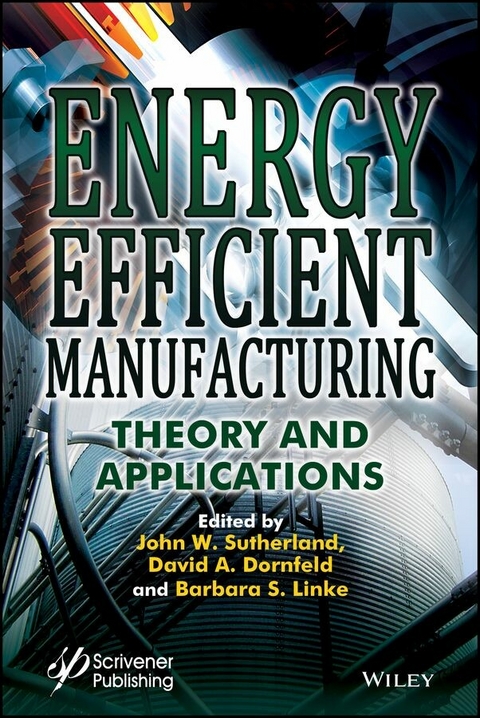
Energy Efficient Manufacturing (eBook)
John Wiley & Sons (Verlag)
978-1-119-51981-2 (ISBN)
Over the last several years, manufacturers have expressed increasing interest in reducing their energy consumption and have begun to search for opportunities to reduce their energy usage. In this book, the authors explore a variety of opportunities to reduce the energy footprint of manufacturing. These opportunities cover the entire spatial scale of the manufacturing enterprise: from unit process-oriented approaches to enterprise-level strategies. Each chapter examines some aspect of this spatial scale, and discusses and describes the opportunities that exist at that level. Case studies demonstrate how the opportunity may be acted on with practical guidance on how to respond to these opportunities.
John W. Sutherland received his PhD from the University of Illinois at Urbana-Champaign and is a Professor and holds the Fehsenfeld Family Headship of Environmental and Ecological Engineering (EEE) at Purdue University. He is one of the world's leading authorities on the application of sustainability principles to design, manufacturing, and other industrial issues. He has published more than 300 papers in various journals and conference proceedings, authored several book chapters, and is co-author of the text "Statistical Quality Design and Control: Contemporary Concepts and Methods". He is a Fellow of the Society of Manufacturing Engineers, American Society of Mechanical Engineers, and CIRP (International Academy for Production Engineering). His honors and recognitions include the SME Outstanding Young Manufacturing Engineer Award, Presidential Early Career Award for Scientists and Engineers, SAE Ralph R. Teetor Award, SME Education Award, SAE International John Connor Environmental Award, and ASME William T. Ennor Manufacturing Technology Award. David A. Dornfeld received his Ph.D. in Mechanical Engineering from UW-Madison in 1976 and was Will C. Hall Family Professor and Chair of Mechanical Engineering at University of California Berkeley. He led the Laboratory for Manufacturing and Sustainability (LMAS) and the Sustainable Manufacturing Partnership studying green/sustainable manufacturing; manufacturing processes; precision manufacturing; process monitoring and optimization. He published over 400 papers, authored three research monographs, contributed chapters to several books and had seven patents. He was a Member of the National Academy of Engineering (NAE), a Fellow of American Society of Mechanical Engineers (ASME), recipient of ASME/SME M. Eugene Merchant Manufacturing Medal, 2015, Ennor Award, 2010 and Blackall Machine Tool and Gage Award, 1986, Fellow of Society of Manufacturing Engineers (SME), recipient of 2004 SME Fredrick W. Taylor Research Medal, member Japan Society of Precision Engineering (JSPE) and recipient of 2005 JSPE Takagi Prize, Fellow of University of Tokyo Engineering and Fellow of CIRP (International Academy for Production Engineering). He passed away in March 2016. Barbara S. Linke obtained her diploma and doctoral degree in Mechanical Engineering from the RWTH Aachen University, Germany. She worked at the Laboratory for Machine Tools and Production Engineering WZL from 2002 - 2010 on grinding technology and tooling engineering. From 2010 - 2012, Barbara was a research fellow at the University of California Berkeley. Since November 2012, Barbara Linke has been an assistant professor at the University of California Davis.
Cover 1
Title Page 5
Copyright Page 6
Dedication 7
Contents 9
1 Introduction to Energy Efficient Manufacturing 17
1.1 Energy Use Implications 18
1.2 Drivers and Solutions for Energy Efficiency 19
References 25
2 Operation Planning & Monitoring
2.1 Unit Manufacturing Processes 27
2.2 Life Cycle Inventory (LCI) of Unit Manufacturing Process 29
2.3 Energy Consumption in Unit Manufacturing Process 32
2.3.1 Basic Concepts of Energy, Power, and Work 32
2.3.2 Framework of Energy Consumption 33
2.4 Operation Plan Relevance to Energy Consumption 35
2.5 Energy Accounting in Unit Manufacturing Processes 36
2.6 Processing Energy in Unit Manufacturing Process 37
2.6.1 Cases of Processing Energy Modeling 37
2.6.1.1 Forging 37
2.6.1.2 Orthogonal Cutting 38
2.6.1.3 Grinding 40
2.6.1.4 Specific Energy vs. MRR 41
2.6.2 Energy Measurement 42
2.7 Energy Reduction Opportunities 42
2.7.1 Shortening Process Chain by Hard Machining 44
2.7.2 Substitution of Process Steps 44
2.7.3 Hybrid processes 45
2.7.4 Adaptation of Cooling and Flushing Strategies 45
2.7.5 Remanufacturing 46
References 46
3 Materials Processing 49
3.1 Steel 50
3.1.1 Steelmaking Technology 51
3.2 Aluminum 52
3.2.1 Aluminum Alloying 53
3.2.2 History of Aluminum Processing 53
3.2.3 Aluminum in Commerce 54
3.2.4 Aluminum Processing 57
3.2.5 Bayer Process 58
3.2.6 Preparation of Carbon 60
3.2.7 Hall-Heroult Electrolytic Process 60
3.3 Titanium 61
3.3.1 Titanium Alloying 62
3.3.2 History of Titanium Processing 63
3.3.3 Titanium in Commerce 64
3.3.4 Titanium Processing Methods 65
3.3.5 Sulfate Process 66
3.3.6 Chloride Process 67
3.3.7 Hunter Process and Kroll Process 67
3.3.8 Remelting Processes 68
3.3.9 Emerging Titanium Processing Technologies 68
3.4 Polymers 70
3.4.1 Life Cycle Environmental and Cost Assessment 75
3.4.2 An Application of Polymer-Powder Processes 75
References 77
4 Energy Reduction in Manufacturing via Incremental Forming and Surface Microtexturing 81
4.1 Incremental Forming 82
4.1.1 Conventional Forming Processes 82
4.1.2 Energy Reduction via Incremental Forming 88
4.1.3 Challenges in Incremental Forming 91
4.1.3.1 Toolpath Planning for Enhanced Geometric Accuracy and Process Flexibility 92
4.1.3.2 Formability Prediction and Deformation Mechanics 101
4.1.3.3 Process Innovation and Materials Capability in DSIF 108
4.1.3.4 Future Challenges in Incremental Forming 111
4.2 Surface Microtexturing 113
4.2.1 Energy Based Applications of Surface Microtexturing 113
4.2.1.1 Microtexturing for Friction Reduction 113
4.2.1.2 Microtexturing Methods 117
4.2.1.3 Future Work in Microtexturing 130
4.3 Summary 131
4.4 Acknowledgement 132
References 132
5 An Analysis of Energy Consumption and Energy Efficiency in Material Removal Processes 139
5.1 Overview 139
5.2 Plant and Workstation Levels 142
5.3 Operation Level 145
5.4 Process Optimization for Energy Consumption 150
5.4.1 Plant Level and Workstation Level 150
5.4.2 Operation Level 153
5.4.2.1 Turning Operation 153
5.4.2.2 Milling Operation 161
5.4.2.3 Drilling Operation 164
5.4.2.4 Grinding Operation 166
5.5 Conclusions 168
Reference 170
6 Nontraditional Removal Processes 175
6.1 Introduction 175
6.1.2 Working Principle 176
6.1.2.1 Electrical Discharge Machining 176
6.1.2.2 Electrochemical Machining 177
6.1.2.3 Electrochemical Discharge Machining 179
6.1.2.4 Electrochemical Grinding 180
6.2 Energy Efficiency 181
Acknowledgments 183
References 183
7 Surface Treatment and Tribological Considerations 185
7.1 Introduction 186
7.2 Surface Treatment Techniques 189
7.2.1 Surface Geometry Modification 190
7.2.2 Microstructural Modification 191
7.2.3 Chemical Approaches 195
7.3 Coating Operations 195
7.3.1 Hard Facing 195
7.3.2 Vapor Deposition 199
7.3.3 Miscellaneous Coating Operations 201
7.4 Tribology 205
7.5 Evolving Technologies 207
7.5.1 Biomimetics – Biologically Inspired Design 207
7.6 Micro Manufacturing 208
7.7 Conclusions 210
References 210
8 Joining Processes 213
8.1 Introduction 214
8.2 Sustainability in Joining 216
8.3 Taxonomy 219
8.4 Data Sources 221
8.5 Efficiency of Joining Equipment 224
8.6 Efficiency of Joining Processes 226
8.6.1 Fusion Welding 227
8.6.2 Chemical Joining Methods 230
8.6.3 Solid-State Welding 232
8.6.4 Mechanical Joining Methods 234
8.6.4.1 Mechanical Fastening 234
8.6.4.2 Adhesive Bonding 235
8.7 Process Selection 236
8.8 Efficiency of Joining Facilities 237
8.9 Case Studies 240
8.9.1 Submerged Arc Welding (SAW) 240
8.9.2 Friction Stir Welding (FSW) 244
Reference 251
9 Manufacturing Equipment 255
9.1 Introduction 255
9.2 Power Measurement 256
9.3 Characterizing the Power Demand 258
9.3.1 Constant Power 258
9.3.2 Variable Power 260
9.3.3 Processing Power 260
9.4 Energy Model 260
9.5 Life Cycle Energy Analysis of Production Equipment 262
9.6 Energy Reduction Strategies 263
9.6.1 Strategies for Equipment with High Processing Power 264
9.6.2 Strategies for Equipment with High Tare Power 265
9.6.2.1 Process Time 265
9.6.2.2 Machine Design 267
9.7 Additional Life Cycle Impacts of Energy Reduction Strategies 268
9.8 Summary 270
References 272
10 Energy Considerations in Assembly Operations 277
10.1 Introduction to Assembly Systems & Operations
10.2 Fundamentals of Assembly Operations 279
10.3 Characterizing Assembly System Energy Consumption 280
10.3.1 Indirect Energy 281
10.3.2 Direct Energy 282
10.4 Direct Energy Considerations of Assembly Joining Processes 284
10.4.1 Mechanical Assembly 284
10.4.2 Adhesive Bonding 285
10.4.3 Welding, Brazing, and Soldering 288
10.5 Assembly System Energy Metrics 291
10.6 Case Study: Heavy Duty Truck Assembly 296
10.6.1 Case Study Energy Consumption Analysis Approach 296
10.6.2 Assembly Process Categorization 297
10.6.3 Case Study Energy Analysis Results 301
10.6.4 Discussion and Recommendations 308
10.7 Future of Energy Efficient Assembly Operations 309
References 310
Appendix 10.A 312
11 Manufacturing Facility Energy Improvement 315
11.1 Introduction 316
11.2 Auxiliary Industrial Energy Consumptions 319
11.2.1 Lighting 319
11.2.1.1 Lighting Technologies 320
11.2.1.2 Opportunities for Improving Energy Efficiency of Industrial Lighting 321
11.2.2 HVAC 323
11.2.2.1 HVAC Systems 324
11.2.2.2 HVAC Energy Efficiency Opportunities 326
11.2.3 Compressed Air 331
11.2.3.1 Compressed Air Technologies 332
11.2.3.2 Improving Energy Efficiency of Air Compressors 333
11.3 Industrial Practices on Energy Assessment and Energy Efficiency Improvement 337
11.3.1 Types of Energy Assessments 337
11.3.2 Energy Assessment Procedures 338
11.4 Energy Management and Its Enhancement Approaches 339
11.4.1 Energy Management Description and Benefits 340
11.4.2 Establishing an Energy Management Approach 342
11.4.2.1 ISO 50001 352
11.5 Conclusions 353
References 354
12 Energy Efficient Manufacturing Process Planning 355
12.1 Introduction 355
12.2 The Basics of Process Planning 357
12.2.1 Types of Production 358
12.2.2 Process Planning Procedure 360
12.2.3 Process Planning Methods 362
12.3 Energy Efficient Process Planning 366
12.3.1 Energy Consumption and Carbon Footprint Models of Manufacturing Processes 366
12.3.2 A Semi-Generative Process Planning Approach for Energy Efficiency 367
12.4 Case Study 369
12.5 Conclusions 373
Reference 374
13 Scheduling for Energy Efficient Manufacturing 375
13.1 Introduction 375
13.2 A Brief Introduction to Scheduling 376
13.2.1 Machine Environments 376
13.2.2 Job Characteristics 378
13.3.3 Feasible Schedules and Gantt Charts 378
13.2.4 Objective Functions: Classic Time-Based Objectives 380
13.3 Objective Functions for Energy Efficiency 381
13.4 An Integer Linear Program for Scheduling anEnergy-Efficient Flow Shop 383
13.4.1 A Very Brief Introduction to Mathematical Optimization 384
13.4.2 A Time-Indexed Integer Linear Program for the Energy-Efficient Flow Shop Problem 386
13.4.3 Algorithms for Solving Integer Linear Programs 392
13.5 Conclusion and Additional Reading 393
References 395
14 Energy Efficiency in the Supply Chain 397
14.1 Supply Chain Management 397
14.2 Supply Chain Structure 398
14.3 Supply Chain Processes 401
14.3.1 Customer Relationship Management 403
14.3.2 Supplier Relationship Management 404
14.3.3 Customer Service Management 405
14.3.4 Demand Management 406
14.3.5 Manufacturing Flow Management 407
14.3.6 Order Fulfillment 408
14.3.7 Product Development and Commercialization 409
14.3.8 Returns Management 410
14.4 Supply Chain Management Components 411
14.5 Conclusion 412
References 412
Endnotes 415
15 Business Models and Organizational Strategies 417
15.1 Introduction 418
15.2 Reference Framework for Selection of Energy Efficiency Projects 420
15.2.1 Mission and Drivers 421
15.2.2 Set Level of Assessment 421
15.2.3 Recognize Opportunities and Risk 422
15.2.4 Select Projects 422
15.2.5 Implementation and Communication 423
15.3 Common Energy Efficiency Opportunities 424
15.3.1 Building Envelope 424
15.3.2 Heating, Ventilation and Air Conditioning (HVAC) 425
15.3.3 Efficient Lighting 426
15.3.4 Efficient Motors and Systems 427
15.3.5 Building Management Systems 428
15.4 Stakeholders 429
15.4.1 Tenants and Owners 429
15.4.2 Regulators 430
15.4.3 Banks/Lenders 430
15.4.4 Energy Service Companies (ESCOs) 431
15.4.5 Business Models 431
15.5 Conclusions 433
References 433
16 Energy Efficient or Energy Effective Manufacturing? 437
16.1 Energy Efficiency: A Macro Perspective 438
16.1.1 Government Perspective 438
16.1.2 Company Perspective 439
16.2 The Basics of Energy Efficiency 441
16.3 Limitations of Energy Efficiency 449
16.4 Energy Effectiveness 452
16.4.1 Effectiveness – It’s Up to the Decision Maker 454
16.4.2 Effectiveness – A Choice on Where to Invest 455
16.4.3 Effectiveness – Is An Action Really Worthwhile? 455
16.5 Summary 458
16.6 Acknowledgments 459
References 459
Index 461
EULA 469
| Erscheint lt. Verlag | 4.7.2018 |
|---|---|
| Sprache | englisch |
| Themenwelt | Technik ► Bauwesen |
| Technik ► Maschinenbau | |
| Schlagworte | action • Barbara • Choice • consumption • Control Systems Technology • Decision • Drivers • Effectiveness • Efficiency • Efficient • Electrical & Electronics Engineering • Elektrotechnik u. Elektronik • Energie • Energieeffizienz • Energieeinsparung • Energy • energy efficiency • Implications • Industrial Engineering • Industrial Engineering / Manufacturing • Industrielle Verfahrenstechnik • Introduction • Last • Maker • Manufacturers • Manufacturing • Operation • Planning • Produktion • Produktion i. d. Industriellen Verfahrenstechnik • References • Regelungstechnik • several years • Solutions |
| ISBN-10 | 1-119-51981-0 / 1119519810 |
| ISBN-13 | 978-1-119-51981-2 / 9781119519812 |
| Informationen gemäß Produktsicherheitsverordnung (GPSR) | |
| Haben Sie eine Frage zum Produkt? |
 PDF (Adobe DRM)
Kopierschutz: Adobe-DRM
Adobe-DRM ist ein Kopierschutz, der das eBook vor Mißbrauch schützen soll. Dabei wird das eBook bereits beim Download auf Ihre persönliche Adobe-ID autorisiert. Lesen können Sie das eBook dann nur auf den Geräten, welche ebenfalls auf Ihre Adobe-ID registriert sind.
Details zum Adobe-DRM
Dateiformat: PDF (Portable Document Format)
Mit einem festen Seitenlayout eignet sich die PDF besonders für Fachbücher mit Spalten, Tabellen und Abbildungen. Eine PDF kann auf fast allen Geräten angezeigt werden, ist aber für kleine Displays (Smartphone, eReader) nur eingeschränkt geeignet.
Systemvoraussetzungen:
PC/Mac: Mit einem PC oder Mac können Sie dieses eBook lesen. Sie benötigen eine
eReader: Dieses eBook kann mit (fast) allen eBook-Readern gelesen werden. Mit dem amazon-Kindle ist es aber nicht kompatibel.
Smartphone/Tablet: Egal ob Apple oder Android, dieses eBook können Sie lesen. Sie benötigen eine
Geräteliste und zusätzliche Hinweise
Buying eBooks from abroad
For tax law reasons we can sell eBooks just within Germany and Switzerland. Regrettably we cannot fulfill eBook-orders from other countries.
aus dem Bereich