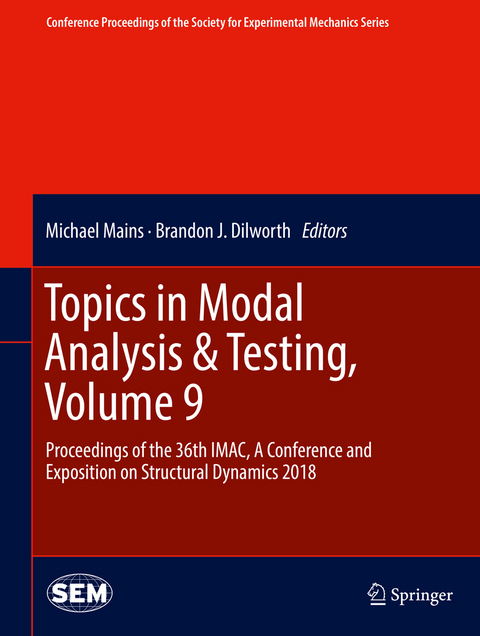
Topics in Modal Analysis & Testing, Volume 9 (eBook)
IX, 392 Seiten
Springer International Publishing (Verlag)
978-3-319-74700-2 (ISBN)

Topics in Modal Analysis & Testing, Volume 9: Proceedings of the 36th IMAC, A Conference and Exposition on Structural Dynamics, 2018, the ninth volume of nine from the Conference, brings together contributions to this important area of research and engineering. The collection presents early findings and case studies on fundamental and applied aspects of Modal Analysis, including papers on:
Operational Modal & Modal Analysis Applications
Experimental Techniques
Modal Analysis, Measurements & Parameter Estimation
Modal Vectors & Modeling
Basics of Modal Analysis
Additive Manufacturing & Modal Testing of Printed Parts
Chapter 1. Stochastic Modal Appropriation (SMA).- Chapter 2. Derivation of Six Degree of Freedom Shaker Inputs Using Sub-Structuring Techniques.- Chapter 3. Forced Response of 2-Dof Gyroscopic Systems with Stable Eigenvalues.- Chapter 4. Modal Testing of a Composite Bladed Disc Using Travelling Wave Excitation Method. -Chapter 5. Simulation of the Dynamic Behavior of a Bi-cable Ropeway with Modal Bases.- Chapter 6. Influence of Noise in Correlation Function Estimates for Operational Modal Analysis.- Chapter 7. Comparison of two (Geometric) Algorithms for Auto OMA.- Chapter 8. Operational Modal Analysis On Wind Turbine Hub.- Chapter 9. The Influence of Edge Boundary Conditions and Cracks on Vibrational Modes of Multilayer Ceramic Capacitors.- Chapter 10. The Cross Spectrum in Multiple Input Multiple Response Vibration Testing.- Chapter 11. A Systematic Evaluation of Test Specification Derivation Methods for Multi-Axis Vibration Testing.- Chapter 12. Designing Hardware for the Boundary Condition Round Robin Challenge.- Chapter 13. Modal Comparison of Stock and Performance Brake Rotors.- Chapter 14. On the Veering Phenomenon Potential in High Speed Gears Design.- Chapter 15. Modal Truncation in Experimental Modal Analysis.- Chapter 16. Combined Mechanical Environments for Design and Qualification.- Chapter 17. Comparing Free-Free and Shaker Table Model Correlation Methods Using Jim Beam. Chapter 18. Realtime Hybrid Testing: Challenges and Experiences from a Teaching Point of View.- Chapter 19. Comparison of Computational Generalized and Standard Eigenvalue Solutions of Rotating Systems. –Chapter 20. Residual States for Modal Models Identified from Accelerance Data.- Chapter 21. Comparison of Time-Domain Objective Functions in Dynamic Fixture Optimization.- Chapter 22. Advanced Hammer Excitation Technique for Impact Modal Testing on Lightweight Materials using Scalable Automatic Modal Hammer.- Chapter 23. Evaluation of MIMO Input Derivations and their Physical Context.- Chapter 24. Using Modal Substructuring to Improve Shock & Vibration Qualification.- Chapter 25. Off-Axis Input Characterization of Random Vibration Laboratory Data for Model Credibility.- Chapter 26. Modal Analysis of a Brake-Ruess Beam and Computational Modeling at the Undergraduate Level.- Chapter 27. A Primer on Multiple Degree of Freedom Vibration Test for Aerospace and Military Applications.- Chapter 28. A Study on the Generation and Propagation of Traveling Waves in Strings.- Chapter 29. A Colored Complex Mode Indicator Function for Selecting a Final Mode Set.- Chapter 30. Using Manual Excitation for Large Displacement on a Highly Damped System.- Chapter 31. Traveling Wave Generation on a Clamped, Thin Plate with Flush-mounted Piezoelectric Actuators.- Chapter 32. Experimental Modal Analysis of an Aircraft Fuselage Panel – Part II.- Chapter 33. Combining Virtual Simulation with Hands-on Experiments for Teaching Mechanical Vibration.- Chapter 34. Finite Element Model Updating Using the Local Correspondence Principle.- Chapter 35. Approximate General Responses of Tuned and Mistuned 4-Degree-of-Freedom Systems with Parametric Stiffness.- Chapter 36. Modal Analysis of a Vertical-axis Darrieus Wind Turbine Blade with a Troposkein Shape.- Chapter 37. Floquet-Type Analysis of Transient Vibrations of a Horizontal Axis Wind Turbine.- Chapter 38. Evaluation of Traveling Wave Models for Carangiform Swimming Based on Complex Modes.- Chapter 39. Application of Frequency-Domain Decomposition Identification Technique to Half Spectral Densities.- Chapter 40. Modal Survey of the MPCV Orion European Service Module Structural Test Article using a Multi-Axis Shaker Table.- Chapter 41. Modal Analysis of Healthy and Cracked Isotropic Plates in Peridynamics.- Chapter 42. Initial Modal Results and Operating Data Acquisition of Shock/Vibration Fixture.- Chapter 43. Effects of Variable Thickness Circular Plates on Frequency Response Functions and Shock Response Spectrum.- Chapter 44. Inverse Force Estimation for Resonant Shock Plate Application.
| Erscheint lt. Verlag | 4.7.2018 |
|---|---|
| Reihe/Serie | Conference Proceedings of the Society for Experimental Mechanics Series | Conference Proceedings of the Society for Experimental Mechanics Series |
| Zusatzinfo | IX, 392 p. 367 illus., 230 illus. in color. |
| Verlagsort | Cham |
| Sprache | englisch |
| Themenwelt | Mathematik / Informatik ► Mathematik |
| Naturwissenschaften ► Physik / Astronomie | |
| Technik ► Bauwesen | |
| Technik ► Maschinenbau | |
| Schlagworte | Additive Manufacturing & Modal Testing of Printed Parts • Basics of Modal Analysis • experimental techniques • Modal Analysis, Measurements & Parameter Estimation • Modal Vectors & Modeling • Operational Modal & Modal Analysis Applications |
| ISBN-10 | 3-319-74700-2 / 3319747002 |
| ISBN-13 | 978-3-319-74700-2 / 9783319747002 |
| Informationen gemäß Produktsicherheitsverordnung (GPSR) | |
| Haben Sie eine Frage zum Produkt? |
 PDF (Wasserzeichen)
DRM: Digitales Wasserzeichen
Dieses eBook enthält ein digitales Wasserzeichen und ist damit für Sie personalisiert. Bei einer missbräuchlichen Weitergabe des eBooks an Dritte ist eine Rückverfolgung an die Quelle möglich.
Dateiformat: PDF (Portable Document Format)
Mit einem festen Seitenlayout eignet sich die PDF besonders für Fachbücher mit Spalten, Tabellen und Abbildungen. Eine PDF kann auf fast allen Geräten angezeigt werden, ist aber für kleine Displays (Smartphone, eReader) nur eingeschränkt geeignet.
Systemvoraussetzungen:
PC/Mac: Mit einem PC oder Mac können Sie dieses eBook lesen. Sie benötigen dafür einen PDF-Viewer - z.B. den Adobe Reader oder Adobe Digital Editions.
eReader: Dieses eBook kann mit (fast) allen eBook-Readern gelesen werden. Mit dem amazon-Kindle ist es aber nicht kompatibel.
Smartphone/Tablet: Egal ob Apple oder Android, dieses eBook können Sie lesen. Sie benötigen dafür einen PDF-Viewer - z.B. die kostenlose Adobe Digital Editions-App.
Buying eBooks from abroad
For tax law reasons we can sell eBooks just within Germany and Switzerland. Regrettably we cannot fulfill eBook-orders from other countries.
aus dem Bereich