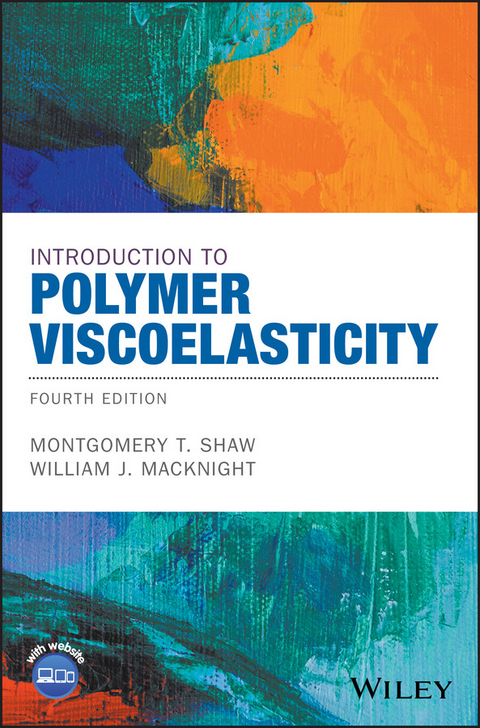
Introduction to Polymer Viscoelasticity (eBook)
John Wiley & Sons (Verlag)
978-1-119-18182-8 (ISBN)
Completely revised and updated, the fourth edition of this classic text continues to offer the reader a thorough understanding of viscoelastic behavior, essential for the proper utilization of polymers.
- Explains principles, corresponding equations, and experimental methods with supporting real-life applications
- Adds coverage of measurement techniques (nano-indentation, atomic force microscopy (AFM), and diffusing wave spectroscopy (DWS)), biopolymer viscoelasticity, and the relationship between mechanical polymer properties and viscoelastic functions
- Has two new ections to address modern areas of viscoelastic measurement: large amplitude oscillatory shear (LAOS) and microrheology
- Includes problems in the text and an Instructor's Manual (including solutions) available for adopting professors
- Prior edition reviews: 'The book is clear written and...[is] appropriate for students in introductory undergraduate courses and for others wanting introduction to the fundamentals of the subject.' (CHOICE, December 2005); 'This book is invariably well written, logically organized and easy to follow...I highly recommend this book to anyone studying polymer viscoelasticity.' (Polymer News, December 2005)
MONTGOMERY T. SHAW, PhD, is Emeritus Distinguished Professor of Chemical Engineering at the University of Connecticut. Among his books are the prior edition of Introduction to Polymer Viscoelasticity and Introduction to Polymer Rheology, both published by Wiley.
WILLIAM J. MACKNIGHT, PhD, is a Professor Emeritus at the University of Massachusetts Amherst, where he was formerly the co-Principal Investigator for the Center for UMass/Industry Research on Polymers (CUMIRP). He has been a co-author for each edition of Introduction to Polymer Viscoelasticity, all published by Wiley.
MONTGOMERY T. SHAW, PhD, is Emeritus Distinguished Professor of Chemical Engineering at the University of Connecticut. Among his books are the prior edition of Introduction to Polymer Viscoelasticity and Introduction to Polymer Rheology, both published by Wiley. WILLIAM J. MACKNIGHT, PhD, is a Professor Emeritus at the University of Massachusetts Amherst, where he was formerly the co-Principal Investigator for the Center for UMass/Industry Research on Polymers (CUMIRP). He has been a co-author for each edition of Introduction to Polymer Viscoelasticity, all published by Wiley.
Chapter 1
Introduction
The subject matter of this book is the response that polymers exhibit when they are subjected to external forces of various kinds. Almost without exception, polymers belong to a class of substances known as “viscoelastic bodies.” As the name implies, these materials respond to external forces in a manner intermediate between the behavior of an elastic solid and a viscous liquid. To set the stage for what follows, it is necessary to describe in very general terms the types of forces to which the viscoelastic bodies might be subjected for characterization purposes.
Consider first the motion of a rigid body in space. This motion can be thought of as consisting of translational and rotational components. If no forces act on the body, it will maintain its original state of motion indefinitely in accordance with Newton’s first law of motion. However, if a single force or a set of forces whose vector sum is nonzero act on the body, it will experience acceleration or a change in its state of motion. Consider, however, the case where the vector sum of forces acting on the body is zero and the body experiences no change in either its translational or rotational component of motion. In such a condition, the body is said to be stressed. If the requirement of rigidity is removed, the body will in general undergo a deformation as a result of the application of these balanced forces. If this occurs, the body is said to be strained. It is the relationship between stress and strain that is our main concern. Depending on the types of stress and strain applied to a body, we can use these quantities to define new quantities—material properties—that ultimately relate to the chemical and physical structure of the body. These material properties are referred to using the terms “modulus” and “compliance.” To understand in rough terms the physical meaning of the modulus of a solid, consider the following simple experiment.
Suppose we have a piece of rubber (e.g., natural rubber), ½ cm × ½ cm × 4 cm, and a piece of plastic (e.g., polystyrene) of the same dimensions. The experiment to be performed consists of suspending a weight (applying a force) of, say 1 kg, from each sample as shown in Figure 1‐1.
Figure 1-1 Deformation of samples made from plastic vs. rubber. As a reference, the undeformed shape for both samples is shown on the left side. A0 refers to the cross‐sectional area of the undeformed sample.
As is obvious, the deformation of the rubber will be much greater than that of the plastic. Using this experiment, we might define a spring constant k as the applied force f divided by the change in length ΔL
and use this number to compare the samples. However, to obtain a measure that is independent of the sample size, that is, a material property, as opposed to a sample property, we must divide the applied force by the initial cross‐sectional area A0 and divide the ΔL by the initial sample length L0. Then, the modulus M is
Because ΔL is much larger for the rubber than for the plastic, from equation (1‐2) it is clear that the modulus of the rubber is much lower than the modulus of the plastic. Thus, the particular modulus defined in equation (1‐2) specifies the resistance of a material to elongation at small deformations and is called the Young’s modulus. It is normally given the symbol E. (See www.rheology.org for suggestions on standard nomenclature for viscoelastic quantities.)
Further experimentation, however, reveals that the situation is more complicated than is initially apparent. If, for example, one were to carry out the test on the rubber at liquid nitrogen temperature, one would find that this “rubber” undergoes a much smaller elongation than with the same force at room temperature. In fact, the extension would be so small as to be comparable to the extension exhibited by the plastic at room temperature. A more dramatic demonstration of this effect is obtained by immersing a rubber ball in liquid nitrogen for several minutes. The cold ball, when bounced, no longer has the characteristic properties of a rubbery object but, instead, is indistinguishable from a hard sphere made of plastic.
On the other hand, if the piece of plastic is heated in an oven to 130 °C and then subjected to the modulus measurement, it is found that a much larger elongation, comparable to the elongation of the rubber at room temperature, results.
These simple experiments indicate that the modulus of a polymeric material is not invariant, but is a function of temperature T, that is, M=M(T).
An investigation of the temperature dependence of the modulus of our two samples is now possible. At temperature T1, we measure the modulus as before, and then increase the temperature to T2, and so on. Schematic data from such an experiment are plotted in Figure 1‐2. The temperature dependence of the modulus is so great that it must be plotted using a logarithmic scale. (This large variation in modulus presents experimental problems that will be treated subsequently.) The region between the vertical dashed lines represents normal‐use temperatures and, consistent with the opening experiment, we find that in this range the plastic has a high modulus while the rubber has a relatively low modulus. Upon cooling, the modulus of the rubber rises markedly, by as much as four orders of magnitude, indicating that the rubber at lower temperatures behaves like a plastic. The nearly constant modulus for the rubber is evidenced at higher temperatures. This behavior is discussed in detail in Chapter 6. At low temperatures, the modulus–temperature behavior for the plastic is seen to be quite similar in shape to that of the rubber except that the large drop, called the glass transition, occurs at higher temperatures, resulting in the high modulus observed at room temperature. At ~100 °C it is clear that the modulus of the plastic is close to that of a rubber, agreeing with the results of one of the earlier “experiments” in this discussion. At yet higher temperatures, the plastic’s modulus drops once again; this is the region where the material can be easily molded.
Figure 1-2 Schematics of the modulus vs. temperature behavior for a rubber and a plastic over a broad temperature range.
One more type of deformational experiment remains to be discussed. Consider a material like pitch or tar, which is used as a roof coating and is applied at elevated temperatures. Our test is similar to the standard experiment done above, utilizing the same size sample at room temperature. First, we suspend the 1‐kg weight from the sample and observe the small resultant extension; the modulus calculated according to equation (1‐2) is high. However, if the sample is left suspended in this vertical position for several hours, the result is a considerable elongation of the sample. Now application of equation (1‐2) gives a very low value for the modulus. Thus, the modulus measurement on the short timescale of a few seconds resulted in a high value while the modulus measurement on the longer time scale of hours resulted in a low modulus. This apparent discrepancy is accounted for by realizing that the modulus is a function of time as well as temperature; this has been found to be the case generally for polymeric materials. Strictly then, the measurements spoken of earlier in this chapter and depicted schematically in Figure 1‐2 should have some time associated with each modulus value. (Time represents the duration between the application of the force and the measurement of the extension.) It is convenient to pick the same constant time for all measurements, so one might consider the constant time in Figure 1‐2 to be 10 seconds.
As is evident from the above discussion, it should be possible to measure the behavior of a material as a function of time at constant temperature. A schematic modulus–time behavior is shown in Figure 1‐3. The modulus is seen to fall from its initial high value by about three orders of magnitude to a modulus indicative of a rubber and, after evidencing a plateau, fall again. The ordinate here is log t; at the chosen temperature, an experiment lasting for 1 to 30 minutes would characterize this material as a plastic. However, in an experiment lasting 108 minutes (200 years), the material would “look like” an elastomer. Longer measurements would correspond to still softer materials. Methods for obtaining curves of the type shown in Figure 1‐3 are discussed in Chapter 4, as well as methods of converting from modulus–time behavior to modulus–temperature behavior and vice versa.
Figure 1-3 Schematic modulus–time curve for a polymer at constant temperature.
* Books concerning the mechanical properties of polymers invariably have graphs that use log scales, and this one is no exception. The argument for the log function should be dimensionless, but such is not the custom. Thus, for example, log (G, Pa) should be interpreted as log [(G, Pa)/1 Pa]. In this volume, “ln” represents natural logarithm, whereas “log” stands for logarithm to base 10. The usual bracket hierarchy {[( )]} is used as needed.
Another experiment is often carried out in...
| Erscheint lt. Verlag | 25.6.2018 |
|---|---|
| Sprache | englisch |
| Themenwelt | Naturwissenschaften ► Chemie ► Organische Chemie |
| Technik ► Maschinenbau | |
| Schlagworte | Boltzmann superposition principle • connecting creep compliance and stress relaxation modulus using Laplace transforms • distributions of relaxation and retardation times • Elastic modulus • Geometries for the Measurement of Viscoelastic Functions • Introduction to Polymer Viscoelasticity Fourth Edition • Kunststoffverarbeitung • large amplitude oscillatory shear • Linear Motion Geometries • <p>Guide to polymer viscoelasticity • Manipulation of the Rouse Matrix • materials characterization • Materials Science • Materialwissenschaften • Maxwell model • molecular theories the Rouse model • Montgomery T. Shaw • Physics • Physik • Polymere • Polymer Physics • Polymerphysik • Polymer Science & Technology • Polymerwissenschaft u. -technologie • reference to Polymer Viscoelasticity • relationship between static and dynamic properties • relationship between the creep compliance and the stress relaxation modulus • Rotational Motion Geometries • The Zimm modification • understanding Polymer Viscoelasticity • viscoelastic models • Voigt-Kelvin model • Voigt Model • Werkstoffprüfung • William J. MacKnight</p> |
| ISBN-10 | 1-119-18182-8 / 1119181828 |
| ISBN-13 | 978-1-119-18182-8 / 9781119181828 |
| Informationen gemäß Produktsicherheitsverordnung (GPSR) | |
| Haben Sie eine Frage zum Produkt? |
 EPUB (Adobe DRM)
Kopierschutz: Adobe-DRM
Adobe-DRM ist ein Kopierschutz, der das eBook vor Mißbrauch schützen soll. Dabei wird das eBook bereits beim Download auf Ihre persönliche Adobe-ID autorisiert. Lesen können Sie das eBook dann nur auf den Geräten, welche ebenfalls auf Ihre Adobe-ID registriert sind.
Details zum Adobe-DRM
Dateiformat: EPUB (Electronic Publication)
EPUB ist ein offener Standard für eBooks und eignet sich besonders zur Darstellung von Belletristik und Sachbüchern. Der Fließtext wird dynamisch an die Display- und Schriftgröße angepasst. Auch für mobile Lesegeräte ist EPUB daher gut geeignet.
Systemvoraussetzungen:
PC/Mac: Mit einem PC oder Mac können Sie dieses eBook lesen. Sie benötigen eine
eReader: Dieses eBook kann mit (fast) allen eBook-Readern gelesen werden. Mit dem amazon-Kindle ist es aber nicht kompatibel.
Smartphone/Tablet: Egal ob Apple oder Android, dieses eBook können Sie lesen. Sie benötigen eine
Geräteliste und zusätzliche Hinweise
Buying eBooks from abroad
For tax law reasons we can sell eBooks just within Germany and Switzerland. Regrettably we cannot fulfill eBook-orders from other countries.
aus dem Bereich