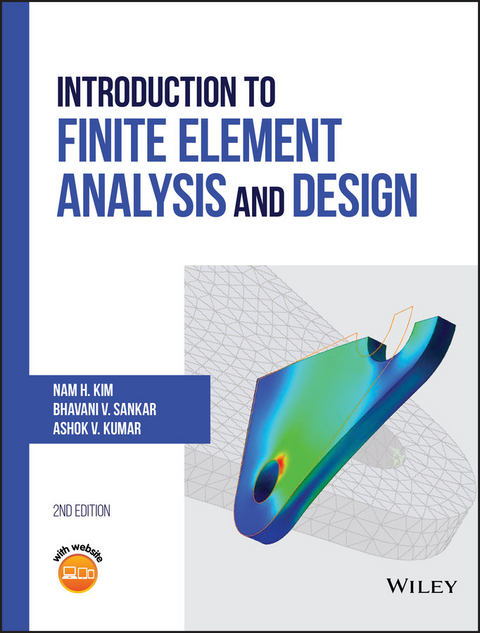
Introduction to Finite Element Analysis and Design (eBook)
John Wiley & Sons (Verlag)
978-1-119-07874-6 (ISBN)
Introduces the basic concepts of FEM in an easy-to-use format so that students and professionals can use the method efficiently and interpret results properly
Finite element method (FEM) is a powerful tool for solving engineering problems both in solid structural mechanics and fluid mechanics. This book presents all of the theoretical aspects of FEM that students of engineering will need. It eliminates overlong math equations in favour of basic concepts, and reviews of the mathematics and mechanics of materials in order to illustrate the concepts of FEM. It introduces these concepts by including examples using six different commercial programs online.
The all-new, second edition of Introduction to Finite Element Analysis and Design provides many more exercise problems than the first edition. It includes a significant amount of material in modelling issues by using several practical examples from engineering applications. The book features new coverage of buckling of beams and frames and extends heat transfer analyses from 1D (in the previous edition) to 2D. It also covers 3D solid element and its application, as well as 2D. Additionally, readers will find an increase in coverage of finite element analysis of dynamic problems. There is also a companion website with examples that are concurrent with the most recent version of the commercial programs.
- Offers elaborate explanations of basic finite element procedures
- Delivers clear explanations of the capabilities and limitations of finite element analysis
- Includes application examples and tutorials for commercial finite element software, such as MATLAB, ANSYS, ABAQUS and NASTRAN
- Provides numerous examples and exercise problems
- Comes with a complete solution manual and results of several engineering design projects
NAM-HO KIM, PHD is a professor in the Department of Mechanical & Aerospace Engineering at the University of Florida, USA. His research interests are in computational mechanics and design optimization, in particular, nonlinear solid mechanics and design under uncertainty.
BHAVANI V. SANKAR, PHD is a professor in the Department of Mechanical & Aerospace Engineering at the University of Florida, USA. His research interests are in mechanics of composite materials and structures, in particular, micromechanics and fracture mechanics.
ASHOK V. KUMAR, PHD is an Associate Professor in the Department of Mechanical & Aerospace Engineering at the University of Florida, USA. His research focus is in the area of computational methods and design optimization.
Introduces the basic concepts of FEM in an easy-to-use format so that students and professionals can use the method efficiently and interpret results properly Finite element method (FEM) is a powerful tool for solving engineering problems both in solid structural mechanics and fluid mechanics. This book presents all of the theoretical aspects of FEM that students of engineering will need. It eliminates overlong math equations in favour of basic concepts, and reviews of the mathematics and mechanics of materials in order to illustrate the concepts of FEM. It introduces these concepts by including examples using six different commercial programs online. The all-new, second edition of Introduction to Finite Element Analysis and Design provides many more exercise problems than the first edition. It includes a significant amount of material in modelling issues by using several practical examples from engineering applications. The book features new coverage of buckling of beams and frames and extends heat transfer analyses from 1D (in the previous edition) to 2D. It also covers 3D solid element and its application, as well as 2D. Additionally, readers will find an increase in coverage of finite element analysis of dynamic problems. There is also a companion website with examples that are concurrent with the most recent version of the commercial programs. Offers elaborate explanations of basic finite element procedures Delivers clear explanations of the capabilities and limitations of finite element analysis Includes application examples and tutorials for commercial finite element software, such as MATLAB, ANSYS, ABAQUS and NASTRAN Provides numerous examples and exercise problems Comes with a complete solution manual and results of several engineering design projects Introduction to Finite Element Analysis and Design, 2nd Edition is an excellent text for junior and senior level undergraduate students and beginning graduate students in mechanical, civil, aerospace, biomedical engineering, industrial engineering and engineering mechanics.
NAM-HO KIM, PHD is a professor in the Department of Mechanical & Aerospace Engineering at the University of Florida, USA. His research interests are in computational mechanics and design optimization, in particular, nonlinear solid mechanics and design under uncertainty. BHAVANI V. SANKAR, PHD is a professor in the Department of Mechanical & Aerospace Engineering at the University of Florida, USA. His research interests are in mechanics of composite materials and structures, in particular, micromechanics and fracture mechanics. ASHOK V. KUMAR, PHD is an Associate Professor in the Department of Mechanical & Aerospace Engineering at the University of Florida, USA. His research focus is in the area of computational methods and design optimization.
| Erscheint lt. Verlag | 15.6.2018 |
|---|---|
| Sprache | englisch |
| Themenwelt | Technik ► Maschinenbau |
| Schlagworte | Bar • beam • Boundary conditions • buckling • chemical engineering • Chemische Verfahrenstechnik • Computational Mechanics • Computational / Numerical Methods • Computer-aided Engineering • Computergestützte Verfahrenstechnik • computer software • Constitutive Relationship • convection • convergence • design optimization </p> • energy method • Equilibrium • error estimate • Failure Theory • FEM • Finite-Element-Methode • Frame • fully-stressed design • Galerkin method • Gauss quadrature • heat conduction • integro-differential equation • Interpolation • isoparametric mapping • jacobian • <p>finite element method • Maschinenbau • Maschinenbau - Entwurf • Matrix • mechanical engineering • Mechanical Engineering - Design • Mechanics of Materials • Mesh • Modeling • partial differential equation • principle of minimum potential energy • principle of virtual work • Rayleigh-Ritz method • Rechnergestützte / Numerische Verfahren im Maschinenbau • safety factor • shape functions • solid • Stiffness • Strain • Stress • Truss • Vector • weighted residual |
| ISBN-10 | 1-119-07874-1 / 1119078741 |
| ISBN-13 | 978-1-119-07874-6 / 9781119078746 |
| Informationen gemäß Produktsicherheitsverordnung (GPSR) | |
| Haben Sie eine Frage zum Produkt? |
 PDF (Adobe DRM)
Kopierschutz: Adobe-DRM
Adobe-DRM ist ein Kopierschutz, der das eBook vor Mißbrauch schützen soll. Dabei wird das eBook bereits beim Download auf Ihre persönliche Adobe-ID autorisiert. Lesen können Sie das eBook dann nur auf den Geräten, welche ebenfalls auf Ihre Adobe-ID registriert sind.
Details zum Adobe-DRM
Dateiformat: PDF (Portable Document Format)
Mit einem festen Seitenlayout eignet sich die PDF besonders für Fachbücher mit Spalten, Tabellen und Abbildungen. Eine PDF kann auf fast allen Geräten angezeigt werden, ist aber für kleine Displays (Smartphone, eReader) nur eingeschränkt geeignet.
Systemvoraussetzungen:
PC/Mac: Mit einem PC oder Mac können Sie dieses eBook lesen. Sie benötigen eine
eReader: Dieses eBook kann mit (fast) allen eBook-Readern gelesen werden. Mit dem amazon-Kindle ist es aber nicht kompatibel.
Smartphone/Tablet: Egal ob Apple oder Android, dieses eBook können Sie lesen. Sie benötigen eine
Geräteliste und zusätzliche Hinweise
Buying eBooks from abroad
For tax law reasons we can sell eBooks just within Germany and Switzerland. Regrettably we cannot fulfill eBook-orders from other countries.
aus dem Bereich