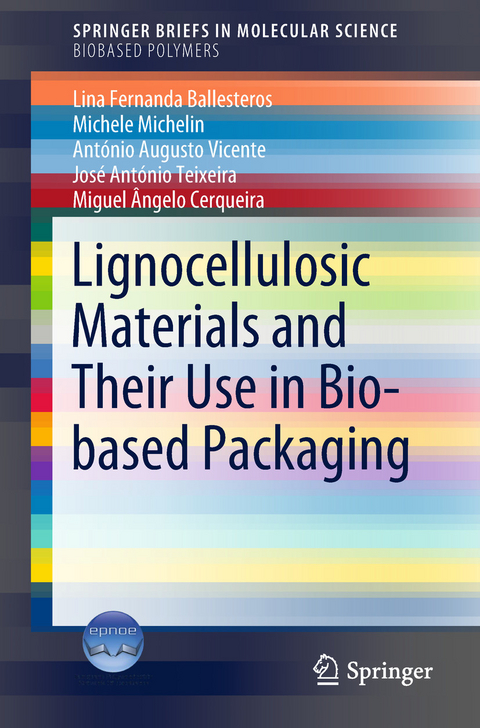
Lignocellulosic Materials and Their Use in Bio-based Packaging (eBook)
XVI, 97 Seiten
Springer International Publishing (Verlag)
978-3-319-92940-8 (ISBN)
Prof. Miguel Ângelo Parente Ribeiro Cerqueira is the co-founder of the company Improveat, Lda (Spin-off of the University of Minho), Braga, Portugal and Assistant Director of Industry and Process Laboratory in the Department of Biological Engineering, University of Minho, Braga, Portugal. He has published 1 patent, 1 book, 5 review articles, 42 peer reviewed articles, and 57 abstracts in international conferences.Prof. Cerqueira has received many awards, the most recent being the Young Scientist Award, at 17th World Congress of Food Science and Technology - IUFoST, from 17 to 21 August 2014, Montreal, Canada.Lina Fernanda Ballesteros Giraldo obtained her PhD in Chemical and Biological Engineering university of Minho – Braga, Portugal. Her active research areas involve characterization of lignocellulosic materials, Extraction and characterization of bioactive compounds from natural sources, Extraction of antioxidant phenolic compounds. Her research interest include the use of coffee industry residue for fructooligosaccharides production by solid-state fermentation, extraction and characterization of polysaccharides and production of edible coatings/films for food application. Dr. Giraldo speaks Spanish, Portugeuse and English and has published five peer reviewed articles and one book chapter and ten abstracts in international conferences.Prof. José António Couto Teixeira is based in the Biological Engineering Department, Universidade of Minho Campus de Gualtar, Braga in Portugal.To date, he has supervision of 31 PhD theses and 20 Post-docs and is a Scientific Consultant to the companies Frulact, Unicer, Quinta Dos Ingleses, Mendes Goncaves, Biotempo, BLC3, Fermentum and Partex.He is also President of the Scientific Council of Portugal Foods (the largest Portuguese Food Cluster) and President of the Portuguese Biotechnology Society; member of Institute of Food Technologists. Prof. Teixeira has co-edited the books “Reactores Biológicos-Fundamentos e Aplicações” (in Portuguese), Engineering Aspects of Milk and Dairy Products and Engineering Aspects of Food Biotechnology. Additionally, he is the author/co-author of over 400 peer reviewed papers.
Preface 6
Acknowledgements 8
Contents 9
About the Authors 11
Abbreviations 14
1 Introduction 16
1.1 General Aspects and Outline 16
1.2 Economic and Environmental Aspects of Bio-based Packaging 17
1.3 Bio-Based Packaging Developments 20
References 25
2 Lignocellulosic Materials: Sources and Processing Technologies 27
2.1 Current Perspective 27
2.2 Lignocellulosic Materials: Definition, Composition and Sources 27
2.3 Structure of Lignocellulosic Materials 29
2.3.1 Cellulose 29
2.3.2 Hemicellulose 30
2.3.3 Lignin 31
2.4 Processing Technologies 32
2.4.1 Processing of Lignocellulosic Material Components 35
2.4.1.1 Cellulose Processing 35
2.4.1.2 Hemicellulose Processing 41
2.4.1.3 Lignin Processing 42
References 44
3 Functional Properties of Lignocellulosic Materials 48
3.1 General Aspects 48
3.1.1 Cellulose Properties 48
3.1.2 Hemicellulose Properties 53
3.1.3 Lignin Properties 54
References 57
4 Processing, Production Methods and Characterization of Bio-Based Packaging Materials 61
4.1 Production of Bio-based Packaging 61
4.1.1 Wet Process 62
4.1.2 Dry Process 64
4.1.3 Other Processing Technologies 65
4.2 Properties and Characterization Techniques 65
4.2.1 Thermal and Mechanical Properties 65
4.2.2 Barrier Properties 66
4.2.3 Optical Properties 69
4.2.4 Solubility 70
4.2.5 Chemical Structure and Morphology 70
4.2.6 Wettability of Bio-Based Coatings 71
4.3 Biodegradability and Life Cycle Assessment 71
References 73
5 Use of Lignocellulosic Materials in Bio-based Packaging 76
5.1 Bio-Based Packaging 76
5.2 Lignocellulosic Materials as Packaging Materials 77
5.2.1 Cellulose and Cellulose Derivatives as Packaging Materials 77
5.2.1.1 Cellulose and Cellulose Derivatives in Poly(Lactic Acid) 82
5.2.1.2 Cellulose and Cellulose Derivatives in PHA/PHB 83
5.2.1.3 Cellulose and Cellulose Derivatives in Starch 85
5.2.2 Hemicelluloses as Packaging Materials 86
5.2.3 Lignin as Packaging Material 87
5.2.4 Raw or Mildly Pre-treated LCMs as Packaging Material 90
References 91
6 Food Applications of Lignocellulosic-Based Packaging Materials 97
6.1 General Aspects 97
6.1.1 Coatings 97
6.1.2 Films 99
References 103
7 Conclusion and Future Trends 105
7.1 Conclusion 105
7.2 Future Trends 106
References 107
| Erscheint lt. Verlag | 18.6.2018 |
|---|---|
| Reihe/Serie | Biobased Polymers |
| Biobased Polymers | |
| Biobased Polymers | |
| SpringerBriefs in Molecular Science | SpringerBriefs in Molecular Science |
| Zusatzinfo | XVI, 97 p. 11 illus. |
| Verlagsort | Cham |
| Sprache | englisch |
| Themenwelt | Naturwissenschaften ► Chemie |
| Technik ► Maschinenbau | |
| Wirtschaft | |
| Schlagworte | Biobased packaging • Biodegradable packaging • Biopolymer applications packaging • Lignocellulose packaging • Sustainable Films and Coatings |
| ISBN-10 | 3-319-92940-2 / 3319929402 |
| ISBN-13 | 978-3-319-92940-8 / 9783319929408 |
| Informationen gemäß Produktsicherheitsverordnung (GPSR) | |
| Haben Sie eine Frage zum Produkt? |
 PDF (Wasserzeichen)
DRM: Digitales Wasserzeichen
Dieses eBook enthält ein digitales Wasserzeichen und ist damit für Sie personalisiert. Bei einer missbräuchlichen Weitergabe des eBooks an Dritte ist eine Rückverfolgung an die Quelle möglich.
Dateiformat: PDF (Portable Document Format)
Mit einem festen Seitenlayout eignet sich die PDF besonders für Fachbücher mit Spalten, Tabellen und Abbildungen. Eine PDF kann auf fast allen Geräten angezeigt werden, ist aber für kleine Displays (Smartphone, eReader) nur eingeschränkt geeignet.
Systemvoraussetzungen:
PC/Mac: Mit einem PC oder Mac können Sie dieses eBook lesen. Sie benötigen dafür einen PDF-Viewer - z.B. den Adobe Reader oder Adobe Digital Editions.
eReader: Dieses eBook kann mit (fast) allen eBook-Readern gelesen werden. Mit dem amazon-Kindle ist es aber nicht kompatibel.
Smartphone/Tablet: Egal ob Apple oder Android, dieses eBook können Sie lesen. Sie benötigen dafür einen PDF-Viewer - z.B. die kostenlose Adobe Digital Editions-App.
Buying eBooks from abroad
For tax law reasons we can sell eBooks just within Germany and Switzerland. Regrettably we cannot fulfill eBook-orders from other countries.
aus dem Bereich