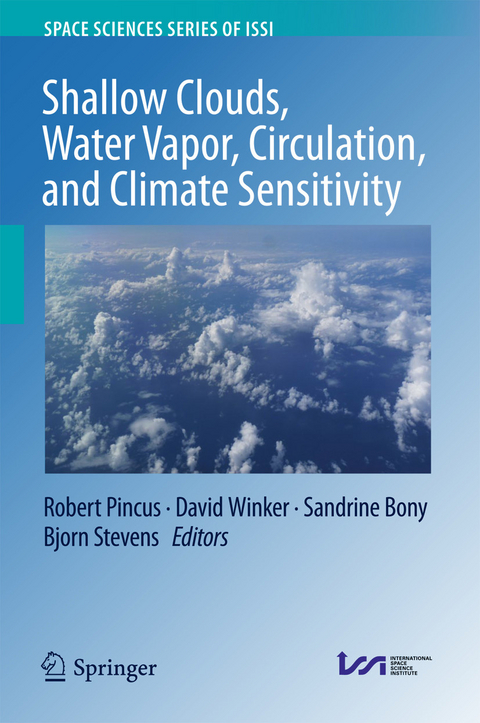
Shallow Clouds, Water Vapor, Circulation, and Climate Sensitivity (eBook)
396 Seiten
Springer International Publishing (Verlag)
9783319772738 (ISBN)

The aritcles 'Observing Convective Aggregation', 'An Observational View of Relationships Between Moisture Aggregation, Cloud, and Radiative Heating Profiles', 'Implications of Warm Rain in Shallow Cumulus and Congestus Clouds for Large-Scale Circulations', 'A Survey of Precipitation-Induced Atmospheric Cold Pools over Oceans and Their Interactions with the Larger-Scale Environment', 'Low-Cloud Feedbacks from Cloud-Controlling Factors: A Review', 'Mechanisms and Model Diversity of Trade-Wind Shallow Cumulus Cloud Feedbacks: A Review', 'Structure and Dynamical Influence of Water Vapor in the Lower Tropical Troposphere', 'Emerging Technologies and Synergies for Airborne and Space-Based Measurements of Water Vapor Profiles', 'Observational Constraints on Cloud Feedbacks: The Role of Active Satellite Sensors', and 'EUREC4A: A Field Campaign to Elucidate the Couplings Between Clouds, Convection and Circulation' are available as open access articles under a CC BY 4.0 license at link.springer.com.
Robert Pincus is a senior research scientist at the Cooperative Institute for Research in Environmental Sciences at the University of Colorado. He works on problems at the nexus of clouds, radiation, and climate ranging from practical questions as to how radiation calculations may be optimally coupled to modeling systems, through efforts aimed at the robust comparison of models and remote sensing observations, to a range of contributions synthesizing how observations of the past and projections of future change can be synthesized.
David Winker is a senior scientist at NASA Langley Research Center and Principal Investigator of the CALIPSO satellite mission. His work focuses on the use of lidar and combined lidar and passive observations to better understand atmospheric aerosols and clouds. His efforts have ranged from the development of space lidar systems and innovative retrieval techniques to the development of global lidar data products tailored to the needs of the climate and operational weather forecast communities. CALIPSO global cloud products have served as benchmark references for the GEWEX Cloud Assessment and for the evaluation of cloud thermodynamic phase in global models, leading to new insights into the behavior of clouds and guiding the improvement of models.
Bjorn Stevens is a director at the Max Planck Institute for Meteorology, where he leads the Atmosphere in the Earth System Department, and a professor at the University of Hamburg. His research, which uses a wide range of methodologies to study how water in the atmosphere influences Earth's climate, has made important contributions to understanding of how turbulent mixing and cloud microphysical processes influence the structure and organization of clouds. In showing how these processes influence the cloud response to warming, and how radiative forcing responds to aerosol perturbations, his research has proven instrumental for our present comprehension of climate change.
Sandrine Bony is a Director of Research at the National Center for Scientific Research (CNRS) in France, working at the Laboratoire de Météorologie Dynamique (LMD) of Sorbonne University. Her research aims at understanding the role of clouds in climate and in climate change through modeling, observational and theoretical approaches. Her most important contributions include unraveling the physical mechanisms through which clouds respond to climate change and influence climate sensitivity, showing the influence of the organization of tropical convection on climate, and understanding the ways in which clouds and precipitation couple to atmospheric circulations.
Robert Pincus is a senior research scientist at the Cooperative Institute for Research in Environmental Sciences at the University of Colorado. He works on problems at the nexus of clouds, radiation, and climate ranging from practical questions as to how radiation calculations may be optimally coupled to modeling systems, through efforts aimed at the robust comparison of models and remote sensing observations, to a range of contributions synthesizing how observations of the past and projections of future change can be synthesized. David Winker is a senior scientist at NASA Langley Research Center and Principal Investigator of the CALIPSO satellite mission. His work focuses on the use of lidar and combined lidar and passive observations to better understand atmospheric aerosols and clouds. His efforts have ranged from the development of space lidar systems and innovative retrieval techniques to the development of global lidar data products tailored to the needs of the climate and operational weather forecast communities. CALIPSO global cloud products have served as benchmark references for the GEWEX Cloud Assessment and for the evaluation of cloud thermodynamic phase in global models, leading to new insights into the behavior of clouds and guiding the improvement of models. Bjorn Stevens is a director at the Max Planck Institute for Meteorology, where he leads the Atmosphere in the Earth System Department, and a professor at the University of Hamburg. His research, which uses a wide range of methodologies to study how water in the atmosphere influences Earth’s climate, has made important contributions to understanding of how turbulent mixing and cloud microphysical processes influence the structure and organization of clouds. In showing how these processes influence the cloud response to warming, and how radiative forcing responds to aerosol perturbations, his research has proven instrumental for our present comprehension of climate change. Sandrine Bony is a Director of Research at the National Center for Scientific Research (CNRS) in France, working at the Laboratoire de Météorologie Dynamique (LMD) of Sorbonne University. Her research aims at understanding the role of clouds in climate and in climate change through modeling, observational and theoretical approaches. Her most important contributions include unraveling the physical mechanisms through which clouds respond to climate change and influence climate sensitivity, showing the influence of the organization of tropical convection on climate, and understanding the ways in which clouds and precipitation couple to atmospheric circulations.
Preface to the Special Issue “ISSI Workshop on Shallow Clouds and Water Vapor, Circulation and Climate Sensitivity”1. Convective Self-Aggregation in Numerical Simulations: A ReviewA.A. Wing, K. Emanuel, C.E. Holloway, C. Muller 2. Observing Convective AggregationC.E. Holloway, A.A. Wing, S. Bony, C. Muller, H. Masunaga, T.S. L’Ecuyer, D.D. Turner, P. Zuidema3. An Observational View of Relationships Between Moisture Aggregation, Cloud, and Radiative Heating ProfilesM.D. Lebsock · T.S. L’Ecuyer · R. Pincus 4. Correction to: An Observational View of Relationships Between Moisture Aggregation, Cloud, and Radiative Heating ProfilesM.D. Lebsock · T.S. L’Ecuyer · R. Pincus 5. Implications of Warm Rain in Shallow Cumulus and Congestus Clouds for Large-Scale CirculationsL. Nuijens · K. Emanuel · H. Masunaga · T. L’Ecuyer 6. A Survey of Precipitation-Induced Atmospheric Cold Pools over Oceans and Their Interactions with the Larger-Scale EnvironmentP. Zuidema · G. Torri · C. Muller · A. Chandra7. Low-Cloud Feedbacks from Cloud-Controlling Factors: A ReviewS.A. Klein · A. Hall · J.R. Norris · R. Pincus 8. Mechanisms and Model Diversity of Trade-Wind Shallow Cumulus Cloud Feedbacks: A ReviewJ. Vial · S. Bony · B. Stevens · R. Vogel 9. Importance Profiles for Water VaporB. Mapes · A.S. Chandra · Z. Kuang · P. Zuidema10. Structure and Dynamical Influence of Water Vapor in the Lower Tropical TroposphereB. Stevens · H. Brogniez · C. Kiemle · J.-L. Lacour · C. Crevoisier · J. Kiliani 11. The Representation of Tropospheric Water Vapor Over Low-Latitude Oceans in (Re-)analysis: Errors, Impacts, and the Ability to Exploit Current and Prospective ObservationsR. Pincus · A. Beljaars · S.A. Buehler · G. Kirchengast · F. Ladstaedter · J.S. Whitaker12. Airborne Lidar Observations of Water Vapor Variability in Tropical Shallow Convective EnvironmentC. Kiemle · S. Groß · M. Wirth · L. Bugliaro13. Emerging Technologies and Synergies for Airborne and Space-Based Measurements of Water Vapor ProfilesA.R. Nehrir · C. Kiemle · M.D. Lebsock · G. Kirchengast · S.A. Buehler · U. Löhnert · C.-L. Liu · P.C. Hargrave · M. Barrera-Verdejo · D.M. Winker14. Observational Constraints on Cloud Feedbacks: The Role of Active Satellite SensorsD. Winker · H. Chepfer · V. Noel · X. Cai 15. Shallow Circulations: Relevance and Strategies for Satellite ObservationG. Bellon · O. Reitebuch · A.K. Naumann16. EUREC4A: A Field Campaign to Elucidate the Couplings Between Clouds, Convection and CirculationS. Bony · B. Stevens · F. Ament · S. Bigorre · P. Chazette · S. Crewell · J. Delanoë · K. Emanuel · D. Farrell · C. Flamant · S. Gross · L. Hirsch · J. Karstensen · B. Mayer · L. Nuijens · J.H. Ruppert Jr. · I. Sandu · P. Siebesma · S. Speich · F. Szczap · J. Totems · R. Vogel · M. Wendisch · M. Wirth
| Erscheint lt. Verlag | 29.5.2018 |
|---|---|
| Reihe/Serie | Space Sciences Series of ISSI | Space Sciences Series of ISSI |
| Zusatzinfo | VIII, 396 p. 144 illus., 134 illus. in color. |
| Verlagsort | Cham |
| Sprache | englisch |
| Themenwelt | Naturwissenschaften ► Geowissenschaften |
| Technik | |
| Schlagworte | Aggregation and meteorology • Atmospheric circulation • climate change • Cloud feedbacks • Clouds and large-scale circulation • Clouds, circulation and climate sensitivity • Convection and atmospheric science • ISSI workshop • Remote sensing and clouds • water vapor |
| ISBN-13 | 9783319772738 / 9783319772738 |
| Informationen gemäß Produktsicherheitsverordnung (GPSR) | |
| Haben Sie eine Frage zum Produkt? |
 PDF (Wasserzeichen)
DRM: Digitales Wasserzeichen
Dieses eBook enthält ein digitales Wasserzeichen und ist damit für Sie personalisiert. Bei einer missbräuchlichen Weitergabe des eBooks an Dritte ist eine Rückverfolgung an die Quelle möglich.
Dateiformat: PDF (Portable Document Format)
Mit einem festen Seitenlayout eignet sich die PDF besonders für Fachbücher mit Spalten, Tabellen und Abbildungen. Eine PDF kann auf fast allen Geräten angezeigt werden, ist aber für kleine Displays (Smartphone, eReader) nur eingeschränkt geeignet.
Systemvoraussetzungen:
PC/Mac: Mit einem PC oder Mac können Sie dieses eBook lesen. Sie benötigen dafür einen PDF-Viewer - z.B. den Adobe Reader oder Adobe Digital Editions.
eReader: Dieses eBook kann mit (fast) allen eBook-Readern gelesen werden. Mit dem amazon-Kindle ist es aber nicht kompatibel.
Smartphone/Tablet: Egal ob Apple oder Android, dieses eBook können Sie lesen. Sie benötigen dafür einen PDF-Viewer - z.B. die kostenlose Adobe Digital Editions-App.
Buying eBooks from abroad
For tax law reasons we can sell eBooks just within Germany and Switzerland. Regrettably we cannot fulfill eBook-orders from other countries.
aus dem Bereich