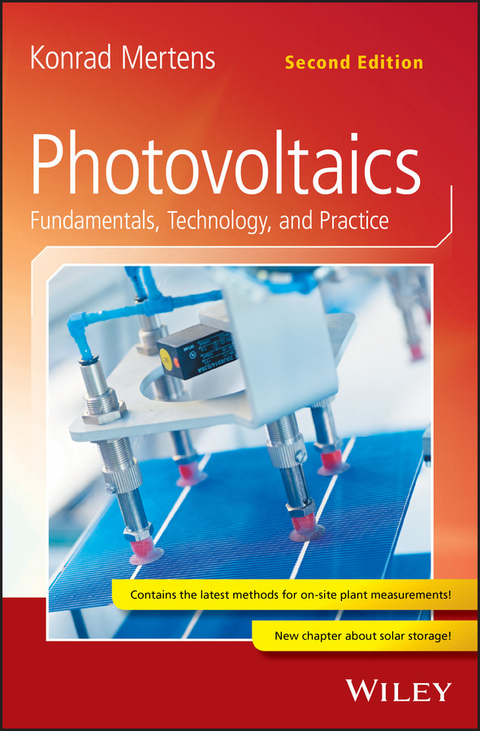
Photovoltaics (eBook)
John Wiley & Sons (Verlag)
978-1-119-40133-9 (ISBN)
A comprehensive tutorial on photovoltaic technology now fully updated to include solar storage and the latest methods for on-site plant measurements
Starting with the basic principles of solar energy, this fully updated, practical text explains the fundamentals of semiconductor physics and the structure and functioning of the solar cell. It describes the latest measurement techniques for solar modules, and the planning and operation of grid-connected and off-grid PV systems.
It also looks at other thin film cells, hybrid wafer cells, and concentrator systems. Additionally, this Second Edition covers solar modules and solar generators; system technology of grid connected plants; the storage of solar energy; photovoltaic measurement technology; the planning and operation of grid-connected systems; economic efficiency of PV systems; and the future development of PV.
- Presents the latest advances in PV R&D and industry deployment
- Updated illustrations and tabular data reflect current state-of-the-art and PV technology efficiencies
- Offers expanded tutorial sections to aid teaching and self-study
- Includes a brand-new chapter on Solar Energy Storage
- Features two enlarged chapters-one on up-to-date photovoltaic metrology and the other on the future developments in photovoltaics
- Comes along with the accompanying website www.textbook-pv.org which offers free downloadable figures of the book, solutions of exercises, additional free PV software etc.
Developed to prepare engineering students for the PV industry, this practical text is an essential PV primer.
Konrad Mertens, PhD, is Professor at Münster University of Applied Sciences, Germany, where he covers the subjects of photovoltaics, sensor technology, and optoelectronics. He is also the founder and head of the university's photovoltaic test lab and head of the lab of sensor technology and optoelectronics.
Konrad Mertens, PhD, is Professor at Münster University of Applied Sciences, Germany, where he covers the subjects of photovoltaics, sensor technology, and optoelectronics. He is also the founder and head of the university's photovoltaic test lab and head of the lab of sensor technology and optoelectronics.
1
Introduction
The supply of our industrial community with electrical energy is indispensable on the one hand, but, on the other hand, it is accompanied by various environmental and safety problems. In this chapter, therefore, we will look at the present energy supply and will familiarize ourselves with renewable energies as feasible future alternatives. At the same time, photovoltaics will be presented in brief and its short but successful history will be considered.
1.1 Introduction
In the introduction, we will explain why we are occupying ourselves with photovoltaics and who should read this book.
1.1.1 Why Photovoltaics?
In past years, it has become increasingly clear that the present method of generating energy has no future. Thus, finiteness of resources is noticeably reflected in the rising prices of oil and gas. At the same time, we are noticing the first effects of burning fossil fuels. The melting of the glaciers, the rise of the ocean levels, and the increase in weather extremes, as well as the nuclear catastrophe in Fukushima, all show that nuclear energy is not the path to follow in the future. Besides the unsolved final storage question, fewer and fewer people are willing to take the risk of large parts of their country being radioactive.
Fortunately, there is a solution with which a sustainable energy supply can be assured: Renewable energy sources. These use infinite sources as a basis for energy supplies and can ensure a full supply with a suitable combination of different technologies such as biomasses, photovoltaics, wind power, and so on. A particular role in the number of renewable energies is played by photovoltaics. It permits an emission‐free conversion of sunlight into electrical energy and, because of its great potential, will be an important pillar in future energy systems.
However, the changeover of our energy supply will be a huge task that can only be mastered with the imagination and knowledge of engineers and technicians. The object of this book is to increase this technical knowledge in the field of photovoltaics. For this purpose, it will deal with the fundamentals, technologies, practical uses, and commercial framework conditions of photovoltaics.
1.1.2 Who Should Read This Book?
This book is meant mostly for students of the engineering sciences who wish to deepen their knowledge of photovoltaics. Nevertheless, it is written in such a way that it is also suitable for technicians, electricians, and the technically interested layman. Furthermore, it can be of use to engineers in the profession to help them to gain knowledge of the current technical and commercial position of photovoltaics.
1.1.3 Structure of the Book
In the introduction, we will first deal with the subject of energy: What is energy and into what categories can it be divided? From this base, we will then consider the present energy supply and the problems associated with it. A solution to these problems is renewable energies and will be presented next in a brief overview. As we are primarily interested in photovoltaics in this book, we will finish with the relatively young but stormy history of photovoltaics.
Chapter 2 deals with the availability of solar radiation. We become familiar with the features of sunlight and investigate how solar radiation can be used as efficiently as possible. Then in the Sahara Miracle, we will consider what areas would be necessary to cover the whole of the world's energy requirements with photovoltaics.
Chapter 3 deals with the basics of semiconductor physics. Here we will concentrate on the structure of semiconductors and an understanding of the p–n junction. Besides this, the phenomenon of light absorption will be explained, without which no solar cell can function. Those familiar with semiconductors can safely skip this chapter.
Chapter 4 gets to the details: We learn of the structure, method of operation, and characteristics of silicon solar cells. Besides this, we will view in detail the parameters and degree of efficiency on which a solar cell depends. Based on world records of cells, we will then see how this knowledge can be successfully put to use.
Chapter 5 deals with cell technologies: What is the path from sand, via silicon solar cell, to the solar module? What other materials are there and what does the cell structure look like in this case? Besides these questions, we will also look at the ecological effects of the production of solar cells.
Chapter 6 deals with the structures and properties of solar generators. Here we will deal with the optimum interconnection of solar modules in order to minimize the effects of shading. Besides this, we will present various types of plants such as pitched roof and ground‐mounted plants.
Chapter 7 deals with system technology of grid‐connected plants. At the start, there is the question of how to convert direct current efficiently into alternating current. Then we will become familiar with the various types of inverters and their advantages and disadvantages.
Chapter 8 deals with the storage of solar power, the very hot topic of the chapter. We learn to know different battery types together with their operating modes. Moreover, it is about systems who can enhance the self‐consumption of solar power in domestic households or commercial enterprises. In an own subchapter off‐grid systems are considered.
Chapter 8 concentrates on photovoltaic metrology. Besides the acquisition of solar radiation, we deal especially with the determination of the real power of solar modules. Furthermore, we become familiar with modern methods of quality analysis such as thermography and electroluminescence metrology.
Chapter 9 presents design and operation of grid‐coupled plants. Besides the optimum planning and dimensioning of plants, methods of profitability calculation are also discussed. In addition, methods for monitoring plants are shown and the operating results of particular plants are presented.
Chapter 10 provides a view of the future of photovoltaics. First, we will estimate power generation potential in Germany. This is followed by a consideration of price development and the coaction of the different energies in the current electrical power system. Finally, we will reflect on how the future energy system will look like and what role photovoltaics will thereby play.
Each chapter has exercises associated with it, which will assist in repeating the material and deepening the knowledge of it. Besides, they provide a control of the students' own knowledge. The solutions to the exercises can be found in the Internet under www.textbook‐pv.org.
1.2 What Is Energy?
We take the use of energy in our daily lives as a matter of course, whether we are operating the coffee machine in the morning, using the car during the day, or returning to a warm home in the evening. In addition, the functionality of our whole modern industrial community is based on the availability of energy: Production and transport of goods, computer‐aided management, and worldwide communication are inconceivable without a sufficient supply of energy.
At the same time, the recognition is growing that the present type of energy supply is partly uncertain, environmentally damaging, and available only to a limited extent.
1.2.1 Definition of Energy
What exactly do we understand about the term energy? Maybe a definition of energy from a famous mouth will help us. Max Planck (founder of quantum physics: 1858–1947) answered the question as follows:
Energy is the ability of a system to bring outside effects (e.g. heat, light) to bear.
For instance, in the field of mechanics, we know the potential energy (or stored energy) of a mass m that is situated at a height h (Figure 1.1a):
Figure 1.1 Depiction of different forms of energy. (a) Potential energy. (b) Kinetic energy. (c) Capacitor energy. (d) Energy at resistor.
with g: Earth's gravity, g = 9.81 m s−2.
If a bowling partner drops his 3 kg bowling ball, then the “1‐m‐high ball” system can have a distinct effect on his foot.
If, on the other hand, he propels the ball as planned forward, then he performs work on the ball. With this work, energy is imparted to the ball system. Thus, we can say in general:
The energy of a...
| Erscheint lt. Verlag | 29.5.2018 |
|---|---|
| Sprache | englisch |
| Themenwelt | Technik ► Elektrotechnik / Energietechnik |
| Schlagworte | build-up of grid-connected systems • DC-components • economic efficiency of PV systems • Electrical & Electronics Engineering • Elektrische Energietechnik • Elektrotechnik u. Elektronik • Energie • Energietechnik • Energy • energy storage technology • fundamentals of photovoltaics • grid connected systems • guide to photovoltaics • Halbleiter • interaction of light with semiconductors • interconnection of solar modules • <i> Photovoltaics: Fundamentals, Technology and Practice</i></p> • <p>photovoltaics • modules and solar generators • operation of grid-connected systems • optoelectronics • photovoltaic measurement technology • photovoltaic tests • Power Technology & Power Engineering • properties of solar modules • PV development • renewable energy • semiconductors • Sensor technology • Solar cells • Solarenergie u. Photovoltaik • Solar Energy & Photovoltaics • Solar Energy Storage • system technology of grid connected plants • textbook to photovoltaics, guide to sensor technology • the future of PV • the pn-junction • types of PV-plants |
| ISBN-10 | 1-119-40133-X / 111940133X |
| ISBN-13 | 978-1-119-40133-9 / 9781119401339 |
| Informationen gemäß Produktsicherheitsverordnung (GPSR) | |
| Haben Sie eine Frage zum Produkt? |
 EPUB (Adobe DRM)
Kopierschutz: Adobe-DRM
Adobe-DRM ist ein Kopierschutz, der das eBook vor Mißbrauch schützen soll. Dabei wird das eBook bereits beim Download auf Ihre persönliche Adobe-ID autorisiert. Lesen können Sie das eBook dann nur auf den Geräten, welche ebenfalls auf Ihre Adobe-ID registriert sind.
Details zum Adobe-DRM
Dateiformat: EPUB (Electronic Publication)
EPUB ist ein offener Standard für eBooks und eignet sich besonders zur Darstellung von Belletristik und Sachbüchern. Der Fließtext wird dynamisch an die Display- und Schriftgröße angepasst. Auch für mobile Lesegeräte ist EPUB daher gut geeignet.
Systemvoraussetzungen:
PC/Mac: Mit einem PC oder Mac können Sie dieses eBook lesen. Sie benötigen eine
eReader: Dieses eBook kann mit (fast) allen eBook-Readern gelesen werden. Mit dem amazon-Kindle ist es aber nicht kompatibel.
Smartphone/Tablet: Egal ob Apple oder Android, dieses eBook können Sie lesen. Sie benötigen eine
Geräteliste und zusätzliche Hinweise
Buying eBooks from abroad
For tax law reasons we can sell eBooks just within Germany and Switzerland. Regrettably we cannot fulfill eBook-orders from other countries.
aus dem Bereich