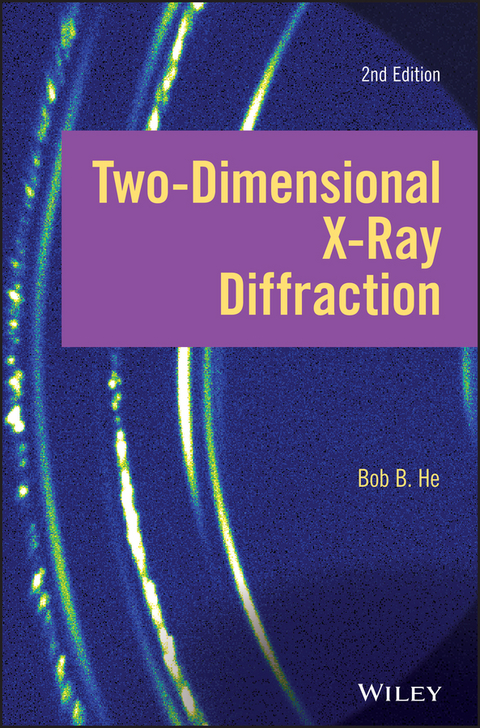
Two-dimensional X-ray Diffraction (eBook)
John Wiley & Sons (Verlag)
978-1-119-35606-6 (ISBN)
Bob B. He, PhD, is Director of Innovation and Business Development XRD² at Bruker AXS-an industry leader in X-ray diffraction instrumentation and solutions (formally Siemens AXS). Dr. He holds 17 U.S. patents and two R&D 100 awards in XRD instrumentation. In recognition of his contribution to the XRD community, he has been recently awarded ICDD Fellow. He earned his doctorate in materials science from Virginia Tech.
Preface xiii
1. Introduction 1
1.1 X-Ray Technology, a Brief History, 1
1.2 Geometry of Crystals, 2
1.3 Principles of X-Ray Diffraction, 11
1.4 Reciprocal Space and Diffraction, 13
1.5 Two-Dimensional X-Ray Diffraction, 19
References, 26
2. Geometry and Fundamentals 29
2.1 Introduction, 29
2.2 Diffraction Space and Laboratory Coordinates, 31
2.3 Detector Space and Detector Geometry, 35
2.4 Sample Space and Goniometer Geometry, 46
2.5 Transformation from Diffraction Space to Sample Space, 50
2.6 Reciprocal Space, 52
2.7 Summary, 53
References, 55
3. X-Ray Source and Optics 57
3.2 X-Ray Optics, 63
References, 85
4. X-Ray Detectors 87
4.1 History of X-Ray Detection Technology, 87
4.2 Point Detectors in Conventional Diffractometers, 89
4.3 Characteristics of Point Detectors, 92
4.4 Line Detectors, 100
4.5 Characteristics of Area Detectors, 107
4.6 Types of Area Detectors, 119
References, 137
5. Goniometer and Sample Stages 141
5.1 Goniometer and Sample Position, 141
5.2 Goniometer Accuracy, 145
5.3 Sample Alignment and Visualization Systems, 149
5.4 Environment Stages, 151
References, 155
6. Data Treatment 157
6.1 Introduction, 157
6.2 Non-Uniform Response Correction, 157
6.3 Spatial Correction, 161
6.4 Detector Position Accuracy and Calibration, 166
6.5 Frame Integration, 177
6.6 Multiple Frame Merge, 186
6.7 Scanning 2D Pattern, 194
6.8 Lorentz, Polarization, and Absorption Corrections, 197
References, 208
7. Phase Identification 211
7.1 Introduction, 211
7.2 Relative Intensity, 212
7.3 Geometry and Resolution, 216
7.4 Sampling Statistics, 221
7.5 Preferred Orientation Effect, 227
References, 233
8. Texture Analysis 235
8.1 Introduction, 235
8.2 Pole Density and Pole-Figure, 236
8.3 Fundamental Equations, 238
8.4 Data Collection Strategy, 242
8.5 Texture Data Process, 251
8.6 Orientation Distribution Function, 256
8.7 Fiber Texture, 261
8.8 Polymer Texture, 264
8.9 Other Advantages of XRD2 for Texture, 268
References, 269
9. Stress Measurement 271
9.1 Introduction, 271
9.2 Principle of X-ray Stress Analysis, 280
9.3 Theory of Stress Analysis with XRD2, 292
9.4 Process of Stress Measurement with XRD2, 307
9.5 Experimental Examples, 325
A9.1 Calculate Principal Stresses, 349
A9.2 Calculate the direction cosines for principal stresses (Eigenvectors), 350
References, 353
10. Small Angle X-ray Scattering 357
10.1 Introduction, 357
10.2 2D SAXS Systems, 361
10.3 Applications Examples, 367
10.4 Some Innovations in 2D SAXS, 370
References, 374
11. Combinatorial Screening 379
11.1 Introduction, 379
11.2 XRD2 Systems for High Throughput Screening, 380
11.3 Combined Screening with XRD2 and Raman, 390
Reference, 393
12. Miscellaneous Applications 395
12.1 Percent Crystallinity, 395
12.2 Crystal Size, 402
12.3 Retained Austenite, 412
12.4 Crystal Orientation, 414
12.5 Thin Film Analysis, 418
Reference, 429
13. Innovation and Future Development 433
13.1 Introduction, 433
13.2 Scanning Line Detector for XRD2, 434
13.3 Three-Dimensional Detector, 438
13.4 Pixel Direct Diffraction Analysis, 441
13.5 High Resolution Two-Dimensional X-Ray Diffractometer, 444
References, 451
Appendix A. Values of Commonly Used Parameters 453
Appendix B. Symbols 459
Index 465
| Erscheint lt. Verlag | 18.5.2018 |
|---|---|
| Sprache | englisch |
| Themenwelt | Naturwissenschaften ► Chemie |
| Technik ► Maschinenbau | |
| Schlagworte | 2d detector scan • 2d x-ray diffraction • 2d x-ray diffraction applications • 2d x-ray diffraction crystallinity analysis • 2d-xray diffraction for chemists • 2d x-ray diffraction for materials science • 2d x-ray diffraction for pharmaceuticals research • 2d x-ray diffraction lab techniques • 2d x-ray diffraction microstructure analysis • 2d x-ray diffraction techniques • 2d x-ray diffraction texture analysis • 2d x-ray diffractometers • Analytical Chemistry • Analytische Chemie • Chemie • Chemistry • crystal orientation • crystal size analysis • cylindrical projection of 2d diffraction pattern • detector space • diffraction space • diffraction vector • grazing incident x-ray diffraction • materials characterization • Materials Science • Materialwissenschaften • merge of multiple 2d diffraction pattern • microdiffraction • microstructure • orientation distribution function • Pharmaceutical & Medicinal Chemistry • Pharmazeutische u. Medizinische Chemie • Phase Identification • pole figure analysis • polymer texture, 2d x-ray diffraction stress analysis • reciprocal space mapping • reflectivity with 2d detector • Retained Austenite • Röntgenbeugung • setting up a 2d x-ray diffraction system • Small Angle Scattering • thin film analysis • unit diffraction vector, diffraction vector transformation • wafer miscut angle • Werkstoffprüfung • what is 2d x-dray diffraction • x-ray detectors • X-ray diffraction • x-ray diffractometers • X-ray optics • X-ray sources • XRD |
| ISBN-10 | 1-119-35606-7 / 1119356067 |
| ISBN-13 | 978-1-119-35606-6 / 9781119356066 |
| Informationen gemäß Produktsicherheitsverordnung (GPSR) | |
| Haben Sie eine Frage zum Produkt? |
 PDF (Adobe DRM)
Kopierschutz: Adobe-DRM
Adobe-DRM ist ein Kopierschutz, der das eBook vor Mißbrauch schützen soll. Dabei wird das eBook bereits beim Download auf Ihre persönliche Adobe-ID autorisiert. Lesen können Sie das eBook dann nur auf den Geräten, welche ebenfalls auf Ihre Adobe-ID registriert sind.
Details zum Adobe-DRM
Dateiformat: PDF (Portable Document Format)
Mit einem festen Seitenlayout eignet sich die PDF besonders für Fachbücher mit Spalten, Tabellen und Abbildungen. Eine PDF kann auf fast allen Geräten angezeigt werden, ist aber für kleine Displays (Smartphone, eReader) nur eingeschränkt geeignet.
Systemvoraussetzungen:
PC/Mac: Mit einem PC oder Mac können Sie dieses eBook lesen. Sie benötigen eine
eReader: Dieses eBook kann mit (fast) allen eBook-Readern gelesen werden. Mit dem amazon-Kindle ist es aber nicht kompatibel.
Smartphone/Tablet: Egal ob Apple oder Android, dieses eBook können Sie lesen. Sie benötigen eine
Geräteliste und zusätzliche Hinweise
Buying eBooks from abroad
For tax law reasons we can sell eBooks just within Germany and Switzerland. Regrettably we cannot fulfill eBook-orders from other countries.
aus dem Bereich