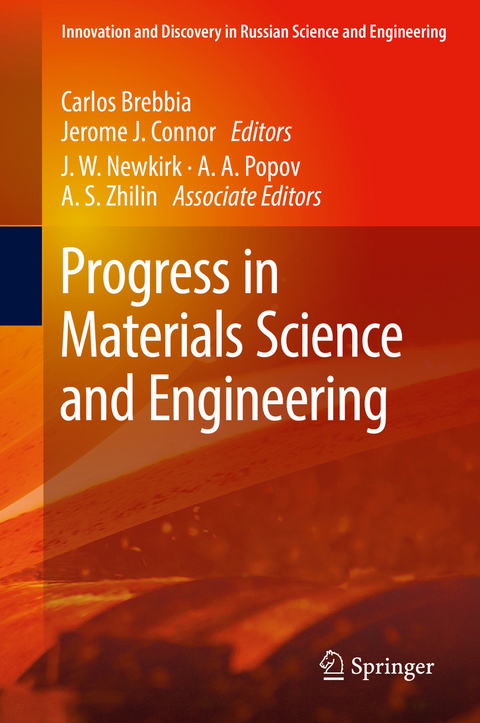
Progress in Materials Science and Engineering (eBook)
IX, 212 Seiten
Springer International Publishing (Verlag)
978-3-319-75340-9 (ISBN)
Professor Carlos A. Brebbia is the Director of the Wessex Institute in the UK, and is renowned worldwide as the originator of the Boundary Element Method. He has written many scientific papers, is editor of many volumes and is the author or co-author of fourteen books. His current interests are in the field of strategic planning and research management. He is the founder of several International Journals and responsible for the publishing program of the Institute. He has helped the Institute to develop academic links with first class institutions around the world. Carlos is also a member of the International Committee for the awards of the Prigogine Medal and the George Green Medal.
Dr. Jerome J. Connor is Professor Emeritus of Civil Engineering at Massachusetts Institute of Technology. His research interests include computational mechanics, structural analysis, motion based structural design, and novel design methodologies for structural systems and has taught courses in computational mechanics and structural engineering. In recent years Connor's work has involved motion based design and damage assessment of engineering materials and he is directing a number of projects related to the applications of structural control to large civil structures as well as investigating methods to quantify damage in engineering materials.
Professor Carlos A. Brebbia is the Director of the Wessex Institute in the UK, and is renowned worldwide as the originator of the Boundary Element Method. He has written many scientific papers, is editor of many volumes and is the author or co-author of fourteen books. His current interests are in the field of strategic planning and research management. He is the founder of several International Journals and responsible for the publishing program of the Institute. He has helped the Institute to develop academic links with first class institutions around the world. Carlos is also a member of the International Committee for the awards of the Prigogine Medal and the George Green Medal.Dr. Jerome J. Connor is Professor Emeritus of Civil Engineering at Massachusetts Institute of Technology. His research interests include computational mechanics, structural analysis, motion based structural design, and novel design methodologies for structural systems and has taught courses in computational mechanics and structural engineering. In recent years Connor’s work has involved motion based design and damage assessment of engineering materials and he is directing a number of projects related to the applications of structural control to large civil structures as well as investigating methods to quantify damage in engineering materials.
Preface 5
Contents 7
Part I: Structure Formation Analysis of Complicated Alloys 10
Chapter 1: Kinetic Parameters and Activation Energy of Pearlitic and Bainitic Transformations Calculated by Analyzing the TTT ... 11
1.1 Introduction 11
1.2 Calculation Technique Development for Kinetic Parameters and Activation Energy of Pearlitic and Bainitic Transformations 12
1.2.1 Digitization of the Existing TTT Diagrams 13
1.2.2 Establishing the Time Dependence of Transformation Development 13
1.2.3 Determining A and n Parameters in the Avrami Equation 13
1.2.4 Activation Energy Calculation 13
1.2.5 Discussion of Results 17
References 18
Chapter 2: Alloying Addition Effect on the Structure and Behavior of a Cu-Ni-Zn Three-Component System Alloy Under Lost-Wax Ca... 19
2.1 Introduction 19
2.2 Materials and Methods 19
2.3 Results 22
2.4 Conclusions 24
References 25
Chapter 3: Structural Changes in Austenitic-Ferritic Steel 03Kh14N10K5M2Yu2T During Heating and Cooling 26
3.1 Introduction 26
3.2 Results and Discussion 28
3.3 Conclusions 32
References 32
Chapter 4: Correlation of Instrumented Charpy Load-Displacement Curves with Crack Growth in API 5L Grade X80 Pipeline Steels 33
4.1 Introduction 33
4.2 Materials and Experimental Procedure 34
4.3 Results and Discussion 34
4.4 Conclusions 37
References 37
Chapter 5: Damping Behavior of Aluminum Replicated Foam 38
5.1 Introduction 38
5.2 Review 39
5.3 Sample Preparation Technology 40
5.4 Measurement Technique 41
5.5 Results and Discussion 42
5.6 Conclusions 43
References 44
Part II: Non-ferrous Metals Metallurgy due to the Refining of Secondary Raw Materials 46
Chapter 6: Recovery of Lead and Zinc from Fine Dust of the Copper Smelting Industry Using a Chelating Agent 47
6.1 Introduction 47
6.2 Experiment Details 47
6.3 Results and Discussions 49
6.3.1 Leaching Tests 49
6.3.2 Study of OEDP Complexes 51
6.4 Conclusions 52
References 53
Chapter 7: High-Pressure Leaching Arsenic Containing Polymetallic Copper Mattes 54
7.1 Introduction 54
7.2 Material 55
7.3 Results and Discussion 55
7.3.1 Oxidative Sulfuric Acid Pressure Leaching 55
7.3.2 Pressure Leaching with Preliminary Treatment of Mattes with Copper Sulfate Followed by Oxidative Leaching 57
7.4 Conclusions 60
References 60
Chapter 8: Investigation of TSL Furnace Hydrodynamics Using Cold Modeling Method 61
8.1 Introduction 61
8.2 Physical Experiments 61
8.2.1 Modeling Setup 62
8.2.2 Modeling Conditions and Results Obtained 62
8.3 Data Analysis 64
8.4 Conclusion 66
References 66
Chapter 9: Physical Simulation of Melt Lancing in a TROF Converter 67
9.1 Introduction 67
9.2 Cold Modeling 68
9.3 Results and Discussion 70
9.3.1 Analysis of Flow Trajectory 70
9.3.2 Analysis of Cavern 71
9.3.3 Energy Balance 72
9.4 Conclusions 72
References 73
Chapter 10: Thermodynamic Features Research of Polymetallic Sulfide Raw Material Leaching 74
10.1 Introduction 74
10.2 Experimental 75
10.3 Results and Discussion 77
10.4 Conclusions 80
References 80
Chapter 11: Investigation of Lignosulfonate Adsorption on Zinc Materials in Acidic Media 81
11.1 Introduction 81
11.2 Materials and Methods 82
11.2.1 Materials 82
11.2.2 Adsorption Experiment 82
11.3 Results and Discussions 83
11.3.1 Lignosulfonate Characteristics 83
11.3.2 Lignosulfonate Adsorption Characteristics 84
11.4 Conclusions 87
References 88
Chapter 12: Complex Processing of Refractory Pyrite Copper, Copper-Zinc and Polymetallic Ores on the Basis of Flotation and Co... 89
12.1 Introduction 89
12.2 Mineral Processing Description 91
12.3 Metallurgy Technology for the Treatment of the Mineral Resource 94
12.4 Conclusions 95
References 96
Part III: Composite Compound Materials Science in Building Engineering 97
Chapter 13: Impact of Waterproofing Permeable Capillary Mixtures on Cement Stone 98
13.1 Introduction 98
13.2 Preparation of Samples 99
13.3 Results of the Study 99
13.4 The Mechanism of the Cement Stone Influence 103
13.5 Conclusions 105
References 105
Chapter 14: Composite Cement with a Polymer Addition 106
14.1 Introduction 106
14.2 Experimental Procedure 107
14.2.1 Raw Materials 107
14.2.2 Experimental Technique 108
14.3 Experimental Results and Discussion 108
14.4 Conclusions 113
References 113
Chapter 15: The Manufacture of Concretes Based on Unburnt Ash Gravel 115
15.1 Introduction 115
15.2 Experiments 116
15.2.1 Differential Thermal Analysis 117
15.3 The Manufacture of Concretes Based on Unburnt Ash Gravel 118
15.4 Conclusions 120
References 120
Chapter 16: Physical-Chemical Bases of a Glass Batch Preparation Technique 121
16.1 Introduction 121
16.2 Experimental Technique 122
16.3 Results and Discussion 122
16.4 Conclusions 127
References 128
Chapter 17: Influence of Ion-Electron Interaction at the Metal-Oxide Melt Boundary on the Protective Properties of Enamel Coat... 129
17.1 Introduction 129
17.2 Experiment 129
17.3 Results and Discussion 130
17.4 Conclusion 135
References 135
Chapter 18: Study of Enamel Slip Particles Interaction Using Model Systems 137
18.1 Introduction 137
18.2 Experiments 137
18.3 Results and Discussion 139
18.3.1 Study of Contact Layers of Water Component of the Coating Enamel Slip 139
18.3.2 Study of Contact Layers of Coating Enamel Slip 140
18.3.3 Study of Contact Layers of Water Component of the Ground Enamel Slip 141
18.3.4 Study of Contact Layers of Ground Enamel Slip 141
18.3.5 Study of Contact Layers of Water Component of the Kombi-Ground Slip 142
18.3.6 Study of Contact Layers of the Kombi-Ground Slip 143
18.3.7 Study of Crystallization Process of Water Component of Slip 143
18.4 Conclusion 144
References 144
Chapter 19: Peculiarities of Formation of Phase Structure and the Hydraulic Activity of High-Calcium Fly Ash 146
19.1 Introduction 146
19.2 Comparative Characteristics of Fly Ash Obtained by Burning of Brown Coals by Various Means 146
19.2.1 Features of the Mineral Matter of Kansko-Achinsk Brown Coals 147
19.2.2 Characteristics of the Fly Ash Tested 147
19.3 Discussion of the Results and Predicting Fly Ash Contents Depending on the Ways of Brown Coals Burning 149
References 151
Part IV: High-Pressure Treatment of Metals and Alloys 152
Chapter 20: Modernisation of the Method of Rolling of Hot-Rolled Tubes 153
20.1 Introduction 153
20.2 A Study of Forming in the Rolling of Round and Oval Billets 154
20.3 Developing the Process of Pipe Plugging on a Stub Mandrel with Kinematic Tension 156
20.4 Conclusion 157
References 158
Chapter 21: New Engineering Solutions in the Production of Laminated Composite Pipes for the Oil Industry 159
21.1 Introduction 159
21.2 Trends in Increasing the Durability of Pump-Compressor Pipes 160
21.3 Developing a Technology for Producing Lined Pump-Compressor Pipes 161
21.4 Testing Lined Pump-Compressor Pipes Under Field Conditions 163
21.5 Conclusion 163
References 164
Chapter 22: Precision of the Tubes Produced by Drawing and Cold Rolling 166
22.1 Introduction 166
22.2 omputer Modeling 167
22.3 Experimental Results 169
22.4 Summary 172
References 172
Chapter 23: Features of Multihole Stamping of Platinum Glass Melting Apparatus Elements 173
23.1 Introduction 173
23.2 Problem Description 173
23.3 Finite Element Modeling 175
23.4 Modeling Results 176
23.5 Conclusion 178
References 178
Chapter 24: Research on Metal Forming in the Pipe Ends Upsetting Process 180
24.1 Introduction 180
24.2 Finite Element Simulation 181
24.3 Full-Scale Experiment 184
24.4 Conclusion 185
References 185
Chapter 25: The Study of Residual Stresses and Surface Hardening in Tubes After Finishing Processes 187
25.1 Introduction 187
25.2 Research Materials and Methods 188
25.3 Research Results 190
25.3.1 Technological Operations´ Influence on Residual Stresses Value 190
25.3.2 Pipe Correction and Polishing Operation Influence on Surface Peening 192
25.4 Conclusion 193
References 194
Author Index 196
Subject Index 198
| Erscheint lt. Verlag | 7.5.2018 |
|---|---|
| Reihe/Serie | Innovation and Discovery in Russian Science and Engineering | Innovation and Discovery in Russian Science and Engineering |
| Zusatzinfo | IX, 212 p. 110 illus., 45 illus. in color. |
| Verlagsort | Cham |
| Sprache | englisch |
| Themenwelt | Technik ► Maschinenbau |
| Schlagworte | Advances in materials • Advances in metallurgy • Complicated alloys • Composite compound materials • High pressure treatment of metals • Non-ferrous metals |
| ISBN-10 | 3-319-75340-1 / 3319753401 |
| ISBN-13 | 978-3-319-75340-9 / 9783319753409 |
| Informationen gemäß Produktsicherheitsverordnung (GPSR) | |
| Haben Sie eine Frage zum Produkt? |
 PDF (Wasserzeichen)
DRM: Digitales Wasserzeichen
Dieses eBook enthält ein digitales Wasserzeichen und ist damit für Sie personalisiert. Bei einer missbräuchlichen Weitergabe des eBooks an Dritte ist eine Rückverfolgung an die Quelle möglich.
Dateiformat: PDF (Portable Document Format)
Mit einem festen Seitenlayout eignet sich die PDF besonders für Fachbücher mit Spalten, Tabellen und Abbildungen. Eine PDF kann auf fast allen Geräten angezeigt werden, ist aber für kleine Displays (Smartphone, eReader) nur eingeschränkt geeignet.
Systemvoraussetzungen:
PC/Mac: Mit einem PC oder Mac können Sie dieses eBook lesen. Sie benötigen dafür einen PDF-Viewer - z.B. den Adobe Reader oder Adobe Digital Editions.
eReader: Dieses eBook kann mit (fast) allen eBook-Readern gelesen werden. Mit dem amazon-Kindle ist es aber nicht kompatibel.
Smartphone/Tablet: Egal ob Apple oder Android, dieses eBook können Sie lesen. Sie benötigen dafür einen PDF-Viewer - z.B. die kostenlose Adobe Digital Editions-App.
Buying eBooks from abroad
For tax law reasons we can sell eBooks just within Germany and Switzerland. Regrettably we cannot fulfill eBook-orders from other countries.
aus dem Bereich