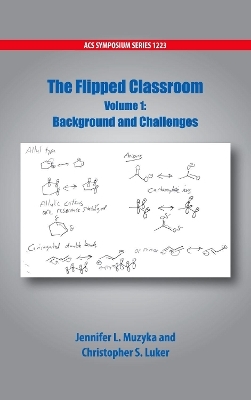
The Flipped Classroom Volume 1
Oxford University Press Inc (Verlag)
978-0-8412-3278-5 (ISBN)
- Keine Verlagsinformationen verfügbar
- Artikel merken
The "flipped classroom" has become the new buzzword not only among educators but also in the general public, with articles in the USA Today, Washington Post, and The New York Times discussing this pedagogical approach. Simply stated, the flipped classroom is a high tech variation on a pedagogical method that has been around for generations. The time honored Socratic method aims to actively engage students with instructors asking them questions, leading them down a
path where they are encouraged to see the connections between ideas. Additionally, flipped classrooms resemble the Thayer method, which expects students to take responsibility for their own learning by studying material before it is covered in class.
Chemistry professors who teach in flipped classrooms embrace a variety of learning theories to guide their implementations. Most chemists who use active learning approaches in their classrooms value some aspect of constructivism theory, in which learners must begin their understanding of the concepts in their pre-class assignments. Later, students apply the concepts in class using active learning methods. For this book, the authors define the flipped classroom as one where students gain
exposure to course content before class and the face-to-face time involves active learning.
The call for and relevance of larger reform efforts in chemical education is not new and this book represents a continuation in the possibilities in achieving reform and meeting the goals of improving students' knowledge of chemistry. Muzyka and Luker provide a deeper, more encompassing picture of the cognitive and affective benefits of this pedagogy.
Jennifer L. Muzyka received her B.S. from University of Dallas and her PhD in organic chemistry from University of Texas, Austin. She began her college teaching career at Roanoke College. Later she moved to Centre College in Kentucky, where she is currently H.W. Stodghill Jr. and Adele H. Stodghill Professor of Chemistry. Muzyka leads workshops on Active Learning in Organic Chemistry and serves on the leadership board for OrganicERs, an online community for organic chemistry educators (http://organicers.org). She also serves on the ACS Division of Chemical Education's Committee on Computers for Chemical Education, currently as committee co-chair. Christopher Luker received his B.S. in chemistry from Allegheny College and his M.A. in Education from The University of Akron. He currently teaches college-preparatory and Advanced Placement chemistry at Highland High School in Medina, Ohio. He has been involved in flipped classroom pedagogy since 2008 and has been involved in numerous local, regional, and national events on the flipped classroom. Luker is currently a doctoral student at Kent State University, where his research interests are related to the metacognitive aspects of the flipped classroom experience.
1. Introduction
2. Flipping the Syllabus: Using the First Day of Class To Encourage Student Acceptance of a New Pedagogical Technique
3. The Flipped Classroom with Limited Internet Access
4. The Use of Active Learning and a Symbolic Math Program in a Flipped Physical Chemistry Course
5. Team-Based Learning in Physical Chemistry
6. Flipped Teaching in Organic Chemistry Using iPad Devices
7. How a Flipped Classroom Promotes Sophisticated Epistemology: Example from a Large Analytical Chemistry Course
8. Active Learning in the Flipped Classroom: Lessons Learned and Best Practices To Increase Student Engagement
9. Flipping for the Masses: Outcomes and Advice for Large Enrollment Chemistry Courses
10. Experiences in Flipping a Large Lecture Course for General, Organic, and Biological Chemistry
Editors' Biographies
Indexes
| Erscheinungsdatum | 01.08.2018 |
|---|---|
| Reihe/Serie | ACS Symposium Series |
| Zusatzinfo | 12 |
| Verlagsort | New York |
| Sprache | englisch |
| Maße | 162 x 230 mm |
| Gewicht | 374 g |
| Themenwelt | Naturwissenschaften ► Chemie ► Analytische Chemie |
| Naturwissenschaften ► Chemie ► Physikalische Chemie | |
| Naturwissenschaften ► Chemie ► Technische Chemie | |
| Technik | |
| ISBN-10 | 0-8412-3278-4 / 0841232784 |
| ISBN-13 | 978-0-8412-3278-5 / 9780841232785 |
| Zustand | Neuware |
| Informationen gemäß Produktsicherheitsverordnung (GPSR) | |
| Haben Sie eine Frage zum Produkt? |
aus dem Bereich