


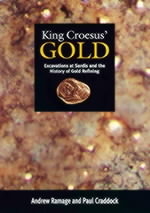
King Croesus Gold (Na)
Seiten
2000
Harvard University Press (Verlag)
978-0-674-50370-0 (ISBN)
Harvard University Press (Verlag)
978-0-674-50370-0 (ISBN)
- Titel ist leider vergriffen;
keine Neuauflage - Artikel merken
The Harvard-Cornell Sardis Expedition unearthed a gold refinery from the time of King Croesus (sixth century BC) where impure gold was treated to produce pure gold and silver. This volume illuminates the industry and technology that produced the riches and offers the first authoritative survey of early gold refining and assaying techniques.
The fabulous wealth of the Lydian Kingdom (in what is now western Turkey) was renowned throughout the classical world--in fact, Lydia's kings created the world's first coinage. The Harvard-Cornell Sardis Expedition has unearthed a gold refinery from the time of King Croesus (the sixth century BC) where impure gold from the Pactolus River was treated to produce pure gold and silver. Though the ancient treasure is now gone, this volume illuminates the industry and technology that produced the riches and offers the first authoritative survey of early gold refining and assaying techniques from around the world. The authors fully describe the excavation of the only known ancient refinery and the scientific study at the British Museum to reconstruct the refining process. The unique evidence from Sardis and accounts from historical sources shed light on ancient metallurgy.
The fabulous wealth of the Lydian Kingdom (in what is now western Turkey) was renowned throughout the classical world--in fact, Lydia's kings created the world's first coinage. The Harvard-Cornell Sardis Expedition has unearthed a gold refinery from the time of King Croesus (the sixth century BC) where impure gold from the Pactolus River was treated to produce pure gold and silver. Though the ancient treasure is now gone, this volume illuminates the industry and technology that produced the riches and offers the first authoritative survey of early gold refining and assaying techniques from around the world. The authors fully describe the excavation of the only known ancient refinery and the scientific study at the British Museum to reconstruct the refining process. The unique evidence from Sardis and accounts from historical sources shed light on ancient metallurgy.
Andrew Ramage is Professor Emeritus in the Department of the History of Art and Visual Studies at Cornell University. Paul Craddock is Head of the Metals Section in the Department of Scientific Research, British Museum.
| Erscheint lt. Verlag | 1.7.2000 |
|---|---|
| Verlagsort | Cambridge, Mass |
| Sprache | englisch |
| Themenwelt | Geisteswissenschaften ► Archäologie |
| Geschichte ► Allgemeine Geschichte ► Altertum / Antike | |
| Technik ► Bauwesen | |
| Technik ► Bergbau | |
| ISBN-10 | 0-674-50370-8 / 0674503708 |
| ISBN-13 | 978-0-674-50370-0 / 9780674503700 |
| Zustand | Neuware |
| Informationen gemäß Produktsicherheitsverordnung (GPSR) | |
| Haben Sie eine Frage zum Produkt? |
Mehr entdecken
aus dem Bereich

aus dem Bereich
ohne den ganzen langweiligen Kram
Buch | Hardcover (2025)
C.H.Beck (Verlag)
CHF 36,40
von den Anfängen bis zum Untergang
Buch | Hardcover (2025)
Alfred Kröner Verlag
CHF 48,95
von den Anfängen bis zur Gegenwart
Buch | Softcover (2025)
C.H.Beck (Verlag)
CHF 16,80


