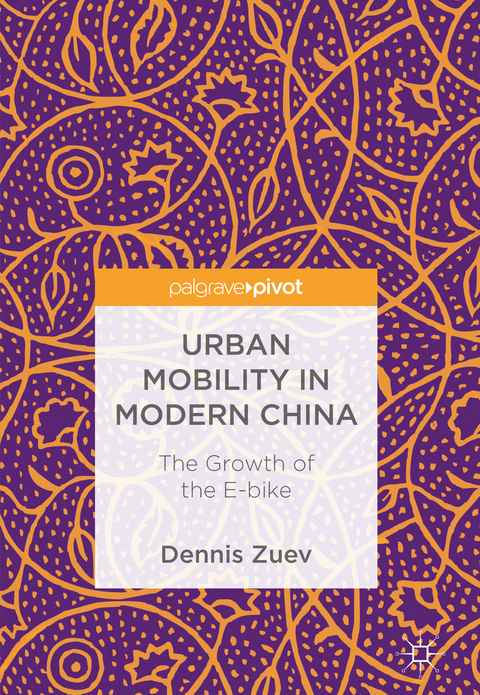
Urban Mobility in Modern China (eBook)
XII, 126 Seiten
Springer International Publishing (Verlag)
978-3-319-76590-7 (ISBN)
Dennis Zuev is a researcher at the Centre for Research and Studies in Sociology, CIES-IUL, Portugal and lecturer at Nürtingen-Geislingen University, Germany.
Dennis Zuev is a researcher at the Centre for Research and Studies in Sociology, CIES-IUL, Portugal and lecturer at Nürtingen-Geislingen University, Germany.
1.Introduction. The chapter explains why looking at development of Chinese urban transport is important. E-bikes are positioned visavis electric vehicles and EV development in China. The chapter discusses challenges and prospect of the low-carbon innovation in China and low-carbon mobility transition in Chinese cities. While EVs have been largely in the spotlight of the media, e-bikes being graded as “low-tech” have been ignored of government support and media attention. The chapter also discusses the data collection and challenges of fieldwork in China on sensitive issues. Why e-bikes are importante in understanding the low-carbon mobility transition in China? 3000 words 1. The Booming low-tech. The chapter provides a brief literature review on the development of electric two-wheeler mobility in Chinese cities. The main goal is to problematize the “low-tech” element in e-mobility innovation in China and show that current everyday life in urban China is highly dependent on e-bike mobility. E-bike is not only a part of everyday life, it is as an indigenous frugal innovation in China. And it is an example of Chinese successful commercialization of low-tech innovation. Why are e-bikes stigmatized in China? 4000 words 2. The Politics of e-bike Mobility in China. The chapter aims to examine the power dynamics behind governing electric two-wheeler mobility in major Chinese cities (bans, control, relationships between diferente road-users, stigmatization of e-bike as na urban monster and stigmatization of users as uncivilized (low-quality people). 2 photos with visual analysis. 6000 words. 3. Everyday Practices: riding, charging and dodging. The chapter uses empirical data from the interviews and ethnographic fieldwork to reflect on the social practices of e-bike users: in particular those of the informal e-bike ride providers in big cities. In particular, the focus is on e-bike related infrastructure spaces (for charging), riding practices (on-road behaviour), charging practices. 3 photos with detailed visual analysis incorporated in the chapter. 4000 words. 4. Everyday Politics: governance and control. This chapter will focus on family use of e-bike (gender Dynamics and hybrid use of car and e-bike). 3 photos. 4000 words. 5. Civilizing Monsters. The chapter will sum up the data analysis to enforce the theoretical argument, that e-bike everyday use is a part of mobility politics in China that until now has largely been overlooked. E-bikes are becoming smarter, fancier and a part of urban landscape in Asia. Ebike is a fancy object for consumption and this fact will be discussed by using a case-study of Niu e-scooters. 3000 words. 6. Conclusion. E-bikes and sustainable mobility futures in China. This chapter will examine potential future scenarios of e-bike development in China visavis other vehicles (low-speed EVs, traditional electric vehicles, bikes and motorbikes. 3000 words.
| Erscheint lt. Verlag | 20.4.2018 |
|---|---|
| Zusatzinfo | XII, 126 p. 12 illus., 10 illus. in color. |
| Verlagsort | Cham |
| Sprache | englisch |
| Themenwelt | Sozialwissenschaften ► Soziologie ► Spezielle Soziologien |
| Technik ► Architektur | |
| Schlagworte | big dataism • e-bike manufacturing • e-bike mobility • e-bike mobility in China • electric bike • informal urban transportation • low-carbon mobility • mobility transition • smart transport • Urban mobility • Urban sustainability • Urban Transportation |
| ISBN-10 | 3-319-76590-6 / 3319765906 |
| ISBN-13 | 978-3-319-76590-7 / 9783319765907 |
| Informationen gemäß Produktsicherheitsverordnung (GPSR) | |
| Haben Sie eine Frage zum Produkt? |
 PDF (Wasserzeichen)
DRM: Digitales Wasserzeichen
Dieses eBook enthält ein digitales Wasserzeichen und ist damit für Sie personalisiert. Bei einer missbräuchlichen Weitergabe des eBooks an Dritte ist eine Rückverfolgung an die Quelle möglich.
Dateiformat: PDF (Portable Document Format)
Mit einem festen Seitenlayout eignet sich die PDF besonders für Fachbücher mit Spalten, Tabellen und Abbildungen. Eine PDF kann auf fast allen Geräten angezeigt werden, ist aber für kleine Displays (Smartphone, eReader) nur eingeschränkt geeignet.
Systemvoraussetzungen:
PC/Mac: Mit einem PC oder Mac können Sie dieses eBook lesen. Sie benötigen dafür einen PDF-Viewer - z.B. den Adobe Reader oder Adobe Digital Editions.
eReader: Dieses eBook kann mit (fast) allen eBook-Readern gelesen werden. Mit dem amazon-Kindle ist es aber nicht kompatibel.
Smartphone/Tablet: Egal ob Apple oder Android, dieses eBook können Sie lesen. Sie benötigen dafür einen PDF-Viewer - z.B. die kostenlose Adobe Digital Editions-App.
Buying eBooks from abroad
For tax law reasons we can sell eBooks just within Germany and Switzerland. Regrettably we cannot fulfill eBook-orders from other countries.
aus dem Bereich