


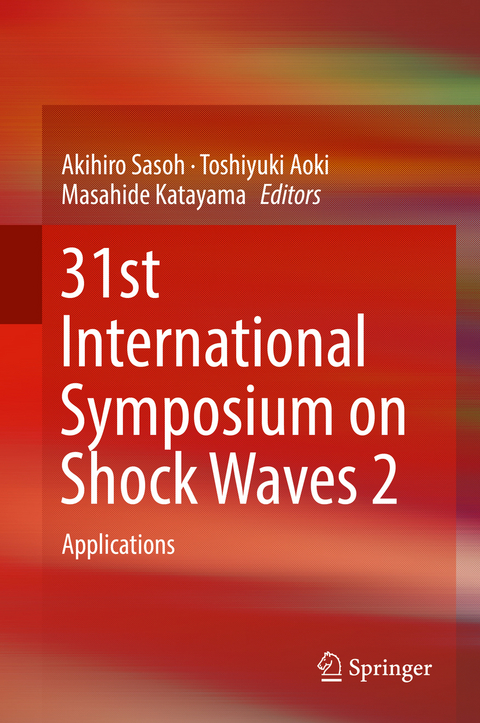
31st International Symposium on Shock Waves 2
Springer International Publishing
978-3-319-91016-1 (ISBN)
- Keine Verlagsinformationen verfügbar
- Artikel merken
Chapter "Effects of Liquid Impurity on Laser-Induced Gas Breakdown in Quiescent Gas: Experimental and Numerical Investigations" is available open access under a Creative Commons Attribution 4.0 International License at link.springer.com.
Chapter1.Strength and Frequency of Underwater Shock Waves Related to Sterilization Effects on a Marine Bacterium.- Chapter2.Effects of Liquid Impurity on Laser-Induced Gas Breakdown in Quiescent Gas: Experimental and Numerical Investigations.- Chapter3.Air Blast from a Structural Reactive Material Solid.- Chapter5.Experimental study on Configuration Effects of Supersonic Projectiles in Transitional Ballistic Regimes.- Chapter6.Non-Ideal Blast Waves from Particle-Laden Explosives.- Chapter7.Attenuation of Blast Wave in a Duct with Expansion Region (Effects of configuration, porous panel, and acoustic material).- Chapter8.Enhancement of Deflagration-to-Detonation Transition Process with Energetic Solid Particle.- Chapter9.Large Scale Computation of Direct Initiation of Cylindrical Detonations.- Chapter10.Numerical Study on a Cycle of Liquid Pulse Detonation Engines.- Chapter11.Experimental investigate on the flame-shock wave interaction and pressure oscillation in a confined combustion chamber.- Chapter12.The Influence of Spatial Heterogeneity in Energetic Material on Non-ideal Detonation Propagation.- Chapter13.Detonation Experiment Research of Gaseous Mixtures with Suspended Metal Particles.- Chapter14.Large Eddy Simulation of Mixing Characteristic in the Cold Rotating-Detonation Chamber.- Chapter15.Research on the Continuous Rotating Detonation Wave in a Hollow Chamber with Laval Nozzle.- Chapter16.Experimental Study on a Long Duration Operation of a Rotating Detonation Engine.- Chapter17.Decaying modes of propagation of spinning detonation and flame front in narrow channel.- Chapter18.Measurement of gaseous fuel concentration in rotating detonation engines.- Chapter19.Investigation of High-Frequency Pulse Detonation Cycle with Fuel Phase Transition.- Chapter20.Simulations of Hydrogen Detonation in Vibrational Non-equilibrium .- Chapter21.Aerodynamic Force Measurement in a Large-Scale Shock Tunnel.- Chapter22.Trial Implementation of TiN Surface Coating for a Main Piston Towards Reducing the Opening Time for a Diaphragmless Driver Section.- Chapter23.Aerodynamic Force Measurement Techniques in JF12 Shock Tunnel .- Chapter24.Optimising the X3R Reflected Shock Tunnel Free-Piston Driver for Long Duration Test Times.- Chapter25.Development and Analysis of an Apollo Earth Re-entry Condition with Representative Post-shock Reynolds Number in the X2 Expansion Tunnel.- Chapter26.Liquid-Coupled Dual Piston Driver for Small-Scale Shock Tubes.- Chapter27.Initial testing of a 2m Mach-10 free piston Shock tunnel at CAAA.- Chapter28.CFD Evaluation and Experiment test of the Running time of the Hypersonic Ludwieg Tube Quiet Wind Tunnel.- Chapter29.Development and Performance Study of Shock Tube with Extended Test-times for Materials Research.- Chapter30.Measurement of Temperature Field around Spiked Bodies at Hypersonic Mach Numbers.- Chapter31.Three-dimensional Laser Interferometric CT density measurement of unsteady flow field around a cylinder induced by discharged shock wave from a cylindrical nozzle.- Chapter32.Curved shock wave propagation in environmental stratosphere by laser ablation.- Chapter33.Hypervelocity tests with a detonation driven expansion tube.- Chapter34.Experiments in HEG related to sonic line and shock stand-off distance on capsule shapes.- Chapter35.Catalytic Recombination Characteristics of Atomic Oxygen on Material Surfaces by Optical Emission Spectroscopy.- Chapter36.Influence of Dual Ignition on Test Conditions of a High Enthalpy Shock Tunnel.- Chapter37.Ablation Measurements in A Low Density Heat Shield Using Ablation Sensor Unit.- Chapter38.The Development of High Enthalpy Reentry Conditions in the X3 Expansion Tube.- Chapter39.Prediction of Intensity Profiles behind a Shock Wave Travelling in Air at Speeds Exceeding 12 km/s.- Chapter40.Revisiting temperature measurements at the focus of spherically converging shocks in argon.- Chapter41.Influence of Matrix Resin on Impact Resistance of CFRP by a Small
| Erscheint lt. Verlag | 3.4.2019 |
|---|---|
| Zusatzinfo | XX, 1186 p. 833 illus., 581 illus. in color. In 2 volumes, not available separately. |
| Verlagsort | Cham |
| Sprache | englisch |
| Maße | 155 x 235 mm |
| Gewicht | 2156 g |
| Themenwelt | Technik ► Luft- / Raumfahrttechnik |
| Schlagworte | Detonation Technology • Flow visualization • fluid- and aerodynamics • high-speed flow • industrial applications of shockwaves • ISSW31 proceedings • shockwaves and aerospace applications • shockwaves and energy applications |
| ISBN-10 | 3-319-91016-7 / 3319910167 |
| ISBN-13 | 978-3-319-91016-1 / 9783319910161 |
| Zustand | Neuware |
| Informationen gemäß Produktsicherheitsverordnung (GPSR) | |
| Haben Sie eine Frage zum Produkt? |


