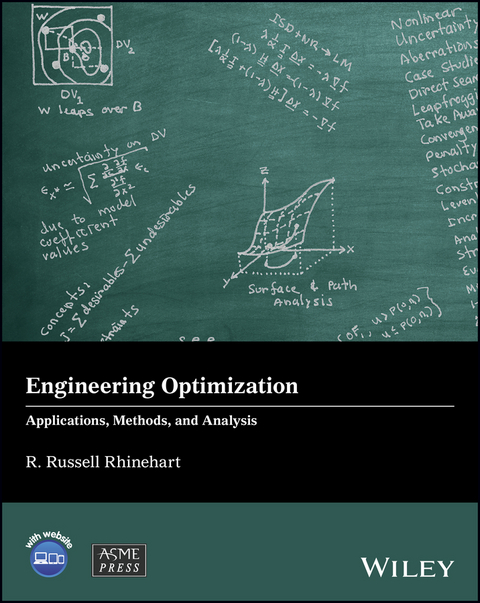
Engineering Optimization (eBook)
John Wiley & Sons (Verlag)
978-1-118-93632-0 (ISBN)

An Application-Oriented Introduction to Essential Optimization Concepts and Best Practices
Optimization is an inherent human tendency that gained new life after the advent of calculus; now, as the world grows increasingly reliant on complex systems, optimization has become both more important and more challenging than ever before. Engineering Optimization provides a practically-focused introduction to modern engineering optimization best practices, covering fundamental analytical and numerical techniques throughout each stage of the optimization process.
Although essential algorithms are explained in detail, the focus lies more in the human function: how to create an appropriate objective function, choose decision variables, identify and incorporate constraints, define convergence, and other critical issues that define the success or failure of an optimization project.
Examples, exercises, and homework throughout reinforce the author's 'do, not study' approach to learning, underscoring the application-oriented discussion that provides a deep, generic understanding of the optimization process that can be applied to any field.
Providing excellent reference for students or professionals, Engineering Optimization:
- Describes and develops a variety of algorithms, including gradient based (such as Newton's, and Levenberg-Marquardt), direct search (such as Hooke-Jeeves, Leapfrogging, and Particle Swarm), along with surrogate functions for surface characterization
- Provides guidance on optimizer choice by application, and explains how to determine appropriate optimizer parameter values
- Details current best practices for critical stages of specifying an optimization procedure, including decision variables, defining constraints, and relationship modeling
- Provides access to software and Visual Basic macros for Excel on the companion website, along with solutions to examples presented in the book
Clear explanations, explicit equation derivations, and practical examples make this book ideal for use as part of a class or self-study, assuming a basic understanding of statistics, calculus, computer programming, and engineering models. Anyone seeking best practices for 'making the best choices' will find value in this introductory resource.
R. Russell Rhinehart is an Emeritus Professor and Amoco Chair in the School of Chemical Engineering at Oklahoma State University. He was named as one of InTECH's 50 Most Influential Industry Innovators in 2004, and was inducted into the Automation Hall of Fame for the Process Industries in 2005. His research focuses on process improvement through modeling, optimization and control, and product improvement through modeling and design.
R. Russell Rhinehart is an Emeritus Professor and Amoco Chair in the School of Chemical Engineering at Oklahoma State University. He was named as one of InTECH's 50 Most Influential Industry Innovators in 2004, and was inducted into the Automation Hall of Fame for the Process Industries in 2005. His research focuses on process improvement through modeling, optimization and control, and product improvement through modeling and design.
Preface
Introduction
Optimization means seeking the best outcome or solution. It is an essential component of all human activities. Whether personal or professional, we seek best designs, best choices, best operation, more bang for the buck, and continuous improvement.
Here are some professional examples: Minimize work events that lead to injury while remaining economically competitive. Structure workflow to maximize return on investment. Design an antenna that maximizes signal clarity for a given power. Define a rocket thrust sequence to maximize height. Determine the number of parallel devices to minimize initial cost plus future risk.
Here are some personal examples: Seek the best vacation experience for the lowest cost. Minimize grocery bill, but meet desires for nourishment and joy of eating. Set the family structure for raising children that leads to well‐adjusted, happy, productive outcomes, but keep within the limits of personal resources. Create a workout regime that leads to fastest and most attractive muscle development, with no injury, and in balance with other desires in quality of life.
Optimization is not just an intellectual exercise; although often, solving the challenge is as rewarding as completing a Sudoku puzzle. We implement the optimized decision. Accordingly, within any application it is essential to completely and appropriately assess the metrics that quantify “best.” If the description of what you want to achieve is not quite right, then the answer will also be wrong, which the implementation will reveal in retrospect. You want to get it right prior to implementation. So, part of this book is about development of the optimization objective.
After the objective is stated, we desire an efficient search logic to find the best solution, with precision and with minimal computational and experimental effort. So, other parts of this book are about the optimizer—the search logic, or algorithm.
Both aspects are essential, and I find that most books on optimization focus on the intellectually stimulating mathematics of the algorithms. So, I offer this book to provide a balance of essential topics to the application to guide user choices in structuring the objective, defining constraints, choosing convergence, choosing initialization, etc. Some will be disappointed that this book is not a compendium of every optimization algorithm conceived by mankind. However, others will value the application perspective.
Also, I find that most people using optimization as a tool did not have a course on it while in school. So, I have written this book in a style that I hope facilitates self‐study by those who need to understand optimization applications while keeping it fit for use as a graduate‐school course textbook.
Key Points
Here are a few essential aspects of optimization:
Point 1: Although optimization offers the joys of solving an intellectual puzzle, it is not just a stimulating mathematical game. Optimization applications are complicated, and the major challenges are the clear and complete statement of:
- The objective function (OF—the outcome you wish to minimize or maximize)
- Constraints (what cannot or should not be violated, or exceeded)
- The decision variables (DV—what you are free to change to seek a minimum)
- The model (how DVs relate to OF and constraints)
- The convergence criterion (the indicator of whether the algorithm has found a close enough proximity to the minimum or maximum and can stop or needs to continue)
- The DV initialization values
- The number of starts from randomized locations to be confident that the global optimum has been found
- The appropriate optimization algorithm (for the function aberrations, for utility, for precision, for efficiency)
- Computer implementation in code Oh yes,
- The mathematics of the optimization algorithm (understanding this is also important)
This book seeks to address all 10 aspects, not just the 10th.
Point 2: Do not study. Learning is most effective if you integrate the techniques into your daily life. You will forget the material that you memorized in order to pass a test. Since this book provides skills that are essential for both personal and career life, I want you to take the techniques with you. I want this book to be useful in your future. Although memorization and high‐level mathematical analysis are both elements of the book, understanding the examples and doing of the exercises is more important. To maximize the impact of this material, you need to integrate it into your daily life. You need to practice it.
Oh, I see I omitted a comma in the first sentence of the paragraph above. It should have been “Do, not study.” Learn by doing. After you read a section and think you understand it, see if you can implement it. Of course, the comma “error” above was intentional to wake up curiosity about the message.
Point 3: Optimization is universal to all engineering, business, science, computer science, and technology disciplines. Although primarily written for engineering applications, this introductory book is designed to be useful for all those seeking to apply optimization in all fields.
Point 4: The implementation of optimization requires computer programming, which for many is an aggravation. To help the reader, I currently have, and plan to support, a website that offers to any visitor optimization software and examples. Visit www.r3eda.com. The “r3” in the address is my initials, and the appended “eda” means “enabling data analysis.” Seeking to maximize ease of use and accessibility, the programs are written as VBA macros for MS Excel. VBA is not the fastest‐computing environment, nor does it have the best scientific data processing functions. However, it has been adequately functional for all of my applications, and if you need something better, the code can be translated. This book provides a VBA primer (Appendix F) for those needing the help in accessing and modifying the code. The programs on the r3eda site solve many of the examples in this book.
Book Aspirations
Readers should be pleased with their ability to:
- Understand and use the fundamental mathematical techniques associated with optimization
- Define objective functions, decision variables, models, and constraints for a variety of optimization applications
- Develop, modify, and program simplified versions of the more common optimization algorithms
- Understand and choose appropriate methods for:
- – Constrained optimization
- – Global optimization
- – Convergence criteria
- – Surface aberrations
- – Stochastic applications
- Understand diverse issues related to optimizer desirability
- Explore, contrast, and evaluate the performance of optimization algorithms and user choices of convergence criteria, numerical derivative estimation, threshold, constraint handling method, parameter values, etc. with respect to precision, user convenience, and other measures of optimizer desirability
- Apply optimization algorithms to case studies relevant to the reader’s career
- Continue learning optimization methods from texts, reports, Internet postings, and refereed journal articles
Optimization is the name for the procedure for finding the best choices. “Procedure,” “best,” and “choices” are separate aspects, and the user must understand each to be able to appropriately define the application. And each aspect has a large range of options.
Procedure
This relates to the method used to find the optimum:
- In process or device design, for example, the choices could be the equipment specifications (type, materials, size), and the evaluation of best in the design could be to minimize capital cost with a constraint on reliability. With mixed continuous, discrete, and class variables as the choices, a direct search algorithm might be the best optimizer.
- Alternately, in scheduling a rocket thrust to reach a desired height, the stage choices might be height, best might be evaluated as minimizing either time or fuel use, and the appropriate algorithm might be dynamic programming.
- Another example is characterized as the traveling salesman problem in which the objective is to determine a sequence of locations to visit to minimize travel distance. Here the choice is the sequence, and the best sequence might be impacted by a priority of visits, expenses, wasted time, etc. The procedure might use the random keys method to convert a sorted list of rational numbers into the sequence.
- As a final contrasting example, in model‐predictive control, the objective might be to minimize time to move a response to a set point while penalizing excessive manipulated variable moves while avoiding constraints; and the choices might be the future sequence of manipulations. If the penalties are quadratic, the appropriate algorithm might be a gradient‐based procedure.
Best
Within optimization terminology, the definition of best for a specific application (and the method for calculating a value to quantify best) is variously termed the cost function or the objective function (OF). It is the function that returns a value representing an assessment of goodness. Best usually means minimize undesirable aspects and/or maximize desirable aspects, and the OF can represent...
| Erscheint lt. Verlag | 26.3.2018 |
|---|---|
| Reihe/Serie | Wiley-ASME Press Series |
| Wiley-ASME Press Series | Wiley-ASME Press Series |
| Sprache | englisch |
| Themenwelt | Mathematik / Informatik ► Mathematik ► Angewandte Mathematik |
| Mathematik / Informatik ► Mathematik ► Finanz- / Wirtschaftsmathematik | |
| Technik ► Elektrotechnik / Energietechnik | |
| Technik ► Maschinenbau | |
| Schlagworte | Electrical & Electronics Engineering • Elektrotechnik u. Elektronik • engineering methods • Engineering Reference • engineering resource • engineering text • graduate level optimization • Industrial Engineering • Industrial Engineering / Manufacturing • Industrielle Verfahrenstechnik • introductory optimization • <p>optimization • Mathematics • Mathematik • Optimierung • Optimization • optimization algorithms • Optimization Analysis • optimization best practices • optimization calculations • optimization convergence • optimization criterion • optimization design • optimization design examples • optimization essentials • optimization exercises • optimization factors • Optimization for engineering • optimization function • optimization fundamentals • optimization guide • optimization handbook • optimization how-to • optimization initialization • optimization math • Optimization Methods • optimization metrics</p> • optimization problem solving • optimization procedure • Optimization process • optimization reference • optimization resource • optimization self-study • Optimization software • Optimization solutions • optimization techniques • optimization terminology • Optimization textbook • optimization theory • optimization utility • optimization variable • Produktion i. d. Industriellen Verfahrenstechnik • specialized optimization • Systems Analysis • Systems Design • Systems Engineering & Management • systems optimization • Systemtechnik • Systemtechnik u. -management • Verfahrenstechnik • Visual Basic optimization code |
| ISBN-10 | 1-118-93632-9 / 1118936329 |
| ISBN-13 | 978-1-118-93632-0 / 9781118936320 |
| Informationen gemäß Produktsicherheitsverordnung (GPSR) | |
| Haben Sie eine Frage zum Produkt? |
 EPUB (Adobe DRM)
Kopierschutz: Adobe-DRM
Adobe-DRM ist ein Kopierschutz, der das eBook vor Mißbrauch schützen soll. Dabei wird das eBook bereits beim Download auf Ihre persönliche Adobe-ID autorisiert. Lesen können Sie das eBook dann nur auf den Geräten, welche ebenfalls auf Ihre Adobe-ID registriert sind.
Details zum Adobe-DRM
Dateiformat: EPUB (Electronic Publication)
EPUB ist ein offener Standard für eBooks und eignet sich besonders zur Darstellung von Belletristik und Sachbüchern. Der Fließtext wird dynamisch an die Display- und Schriftgröße angepasst. Auch für mobile Lesegeräte ist EPUB daher gut geeignet.
Systemvoraussetzungen:
PC/Mac: Mit einem PC oder Mac können Sie dieses eBook lesen. Sie benötigen eine
eReader: Dieses eBook kann mit (fast) allen eBook-Readern gelesen werden. Mit dem amazon-Kindle ist es aber nicht kompatibel.
Smartphone/Tablet: Egal ob Apple oder Android, dieses eBook können Sie lesen. Sie benötigen eine
Geräteliste und zusätzliche Hinweise
Buying eBooks from abroad
For tax law reasons we can sell eBooks just within Germany and Switzerland. Regrettably we cannot fulfill eBook-orders from other countries.
aus dem Bereich